How to choose bonsai tree stumps? Detailed winter selection tips
Look at the type of tree stump. For wild stumps suitable for making bonsai, from a cultivation standpoint, they should tolerate pruning and be easy to wire; from an aesthetic standpoint, their appearance should basically satisfy the conditions of small leaves, curved branches, abundant flowers and bright fruit. Common evergreen types include: Osmanthus heterophyllus (holly osmanthus), Xylosma racemosum, Syzygium buxifolium, Elaeagnus pungens, Mahonia fortunei, Nandina domestica, Pyracantha fortuneana, etc.; common deciduous types include: Euonymus alatus, Adina rubella, Sageretia thea, Lagerstroemia indica, Acer buergerianum, Ligustrum quihoui, Ulmus parvifolia, Wisteria sinensis, etc. Deciduous types can be purchased in both winter and spring.
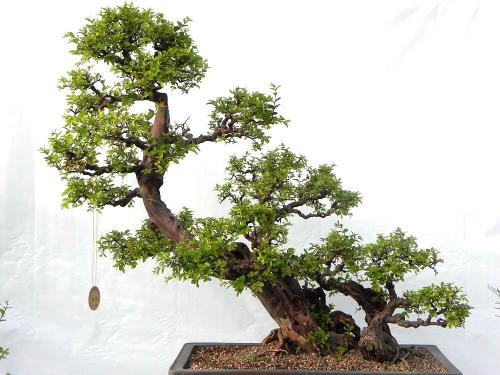
Look at the vitality of the tree stump. First look at the bark: scrape the rough outer bark of the trunk; if the inner layer is green and tiny water droplets seep out, it is a fresh stump. Next look at the branches: gently twist a branch; if it is flexible and not easy to break, or if after breaking the cross-section feels moist and the cambium is light green, it is a newly collected stump. Then look at the roots: scrape the outer skin of a fine root; if the inner layer is white or flesh-red with tiny water droplets seeping out, the roots are flexible, and the tips of the fibrous roots are still milky white, it is a stump that was dug out not long ago. Finally look at the leaves: for evergreens, stumps whose leaves remain green and glossy are best.
Look at the shape: leaves should be fine and thick, with a glossy sheen; lateral roots should be thick and strong, attached in appropriate positions with smooth lines, and preferably with many fine roots attached. The form should be unusual and the trunk should be sturdy and imposing, or tall and upright, or gnarled and full of variety, or lying down as if about to rise, or combining the qualities of "transparent and perforated." Branches should be distributed in an orderly way and full of dynamism, extending alternately front, back, left and right from the trunk, without needing to be sawed off or forcibly twisted and wired; after selection and removal, they can form natural crown layers. A stump that possesses one or two of these five qualities can be selected for cultivation.