Morphology, Habits and Care Tips of the Apocynaceae Caudex Plant Pachypodium brevicaule
Morphology, habits and care tips of Pachypodium brevicaule!
Chinese name: Huibixu Xiao (Pachypodium brevicaule)
Alias: Huimeixu Xiao
Scientific name: Pachypodium brevicaule
Plant family and genus: Apocynaceae, genus Pachypodium
Place of origin and distribution: southwestern Madagascar
Pachypodium brevicaule has no obvious stem; its fleshy tuberous stem (commonly called a "caudex") is initially potato-like in shape, and as the plant grows it gradually becomes flat and irregular like ginger, with a diameter of up to 60 cm. Its surface is grayish-white or grayish-brown and bears spines. On young plants the spines grow at the top of the tuberous stem and are fairly dense, while on old plants the spines are concentrated only around the leaves; in its native habitat it may even grow together with lichens.
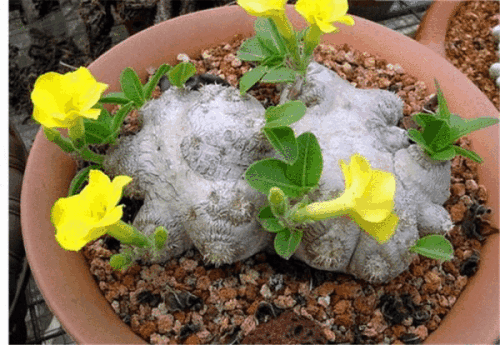
The leaves number several and grow in a cluster at the top of the tuberous stem. The leaf color is fresh green, broadly lanceolate (lanceolate: a leaf blade wider than linear, tapering gradually from the base to the tip, called a lanceolate leaf, with the leaf length three to four times its width, such as the leaves of willow and peach), 2-3 cm long, entire, with white-green veins.
The flowers emerge from the leaf cluster, 2-3 in number, funnel-shaped, with 5 petals, in a bright lemon yellow, beautiful and dreamlike; the flowering period is from December to April of the following year. The pods are slender and held high, often growing in pairs, like antennae, and also like the horns of an animal.
The original meaning of Huibixu Xiao is the Japanese god of fortune; the Japanese god of fortune is similar to China's Maitreya Buddha. If you think of the pot-bellied, tuberous root of Pachypodium brevicaule, doesn't it seem very fitting? With its simple, natural tuberous stem paired with fresh green leaves, and bright, brilliant yellow flowers in winter and spring, Pachypodium brevicaule is refreshing to the eye. It can be planted in an antique-style purple clay pot and displayed in places such as the living room or windowsill; it is rustic and fresh, with excellent ornamental value.
How to care for Pachypodium brevicaule
Pachypodium brevicaule is native to southwestern Madagascar, growing at an altitude of 1300-1900 m. It likes a warm, humid, dry environment with plenty of sunlight, is drought-tolerant, fears waterlogging, and has a certain cold tolerance, withstanding low temperatures of 4°C in winter.
The main growing season is from April to September. During the growing period, give sufficient light and water according to the principle of "do not water until dry, and when watering, water thoroughly," avoiding water accumulation in the pot soil so as to prevent the tuberous stem from rotting.
Because its growth rate is not very fast, it does not need too many nutrients. Apply a low-nitrogen, high-phosphorus, high-potassium compound fertilizer or well-rotted dilute liquid fertilizer once a month.
In summer, when temperatures are high, Pachypodium brevicaule grows slowly but does not go completely dormant. It can be placed in a bright, well-ventilated spot for care, keeping the environment well ventilated, preventing stuffiness and dampness, and stopping fertilization.
In winter, place it indoors in a spot with plenty of sunlight. If the minimum temperature is above 10°C, the plant can continue to grow, can be watered normally, and can be given some light fertilizer based mainly on phosphorus and potassium as appropriate. In this way, the plant will not only have fresh green leaves but also produce bright flowers. After flowering, different plants can be chosen for mutual artificial pollination so that they produce seeds of relatively good quality.
If the temperature is too low, although Pachypodium brevicaule will not die, its leaves tend to fall off and it enters a dormant state. Watering should be controlled and fertilization stopped, so that the plant overwinters in a dry environment, avoiding rot of the tuberous stem caused by low temperatures and water accumulation. A dormant Pachypodium brevicaule will have its flowering period correspondingly delayed until the temperature warms up in spring.
Repot once every 2-3 years in spring. The pot soil should be loose, breathable, well-draining, with a relatively coarse particle size, and contain an appropriate amount of calcium. It can be mixed from 2 parts leaf mold or peat soil, 3 parts coarse sand or vermiculite and orchid stone, with an appropriate amount of calcium materials such as bone meal or shell powder mixed in.
Propagation methods of Pachypodium brevicaule
Pachypodium brevicaule is propagated by sowing. The pods generally mature in summer and autumn; the seeds can be taken out and sown at any time. The medium can be fine sand or vermiculite mixed with a small amount of leaf mold, preferably sterilized at high temperature to kill pests, insect eggs and other harmful organisms in the soil.
After sowing, cover the seeds with a thin layer of soil and keep it moist. The seeds germinate in 10-15 days. The tuberous stem of the seedlings grows relatively slowly, so management must be careful to avoid rot. When the seedlings have 4-6 leaves, divide and transplant them.
To speed up growth and make them flower earlier, grafting can also be used for propagation. The rootstock can be vigorous succulents of the Apocynaceae family and genus Pachypodium, such as Pachypodium lamerei, Pachypodium rutenbergianum and Pachypodium densiflorum; the scion can be Pachypodium brevicaule seedlings, or a robust tuberous stem with buds can be cut off as the scion. Flat grafting is used during the growing season. After grafting, keep the plant in a bright place without direct sunlight, do not let it get rained on, and do not let water touch the wound when watering, so as to prevent rot.
It should be pointed out that although grafted Pachypodium brevicaule grows faster, its ornamental value and collection value are both lower than plants grown from seedlings. Therefore, grafted plants are mostly cultivated as mother plants for collecting seeds.