Why does jasmine only grow leaves and not bloom?
Why does jasmine only grow leaves and not bloom?
(1) Jasmine flower bud differentiation and flower bud opening both require direct sunlight; in an overly shaded environment it gets no light, and therefore does not bloom.
(2) Too much nitrogen fertilizer is applied, and it lacks phosphorus fertilizer.
(3) Branches and leaves are too dense, which affects flower bud formation.
How to grow jasmine
Introducing jasmine cultivation methods to you, how to grow jasmine well, and jasmine pest and disease control
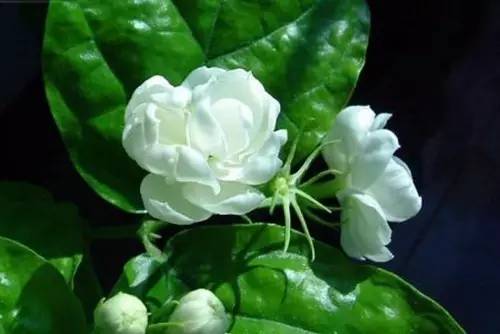
(1) Overview of jasmine
Jasmine is also known as jasmine, Xianghun, Molihua, Meili, Meili, Mali, Mo Li, Mo Li, and Muli flower; it is an evergreen shrub or vine of the Oleaceae family. The plant height is 0.5-2 m. The single leaves are opposite, elliptical, 3-9 cm long. The cyme is terminal, with 3-9 flowers; the corolla is pure white, single or double, and some turn dark red when withering; it is very fragrant, and flowers on new shoots; the flowering period in North China is June-September. Under forcing cultivation in a greenhouse, it can also bloom in winter under high temperature conditions. The leaves are emerald green, the flowers are pure white, and the fragrance is rich, so it is deeply loved by the general public. It is used to beautify courtyards and balconies, fresh and pleasant, sending waves of fragrance from time to time, giving people a feeling of returning to nature. In South China and the Yangtze River basin, jasmine is widely cultivated, and the fresh flowers are used as a scenting material for tea; the tea scented with them is the famous jasmine tea. Jasmine likes a warm, humid environment with ample sunlight; its leaves are emerald green, its flowers are pure white, and its fragrance is rich, making it the most common fragrant potted flower and tree. Among the Jasminum genus, the most famous one is double-petaled jasmine, which is what people commonly call jasmine. Jasmine has good health-care and beauty benefits, can be used in food and drink, and can be used to make jasmine tea. Jasmine cultivation Jasmine cultivation methods [Ornamental value] From June to October there are many white flowers and a striking fragrance; besides pot cultivation, it can also be used in vases and brewed for drinking. [Habits] (1) Likes light. (2) Likes high temperatures; the suitable temperature is 20-30°C; growth stops below 10°C, and it will freeze to death below 5°C. (3) Likes fertile acidic soil.
(2) Key cultivation points of jasmine
If potted jasmine is well cared for, it can bloom three times a year. Temperature: Likes a warm environment; the minimum wintering temperature for jasmine, Jasminum multiflorum, and Jasminum officinale is above 10°C, while Yunnan yellow jasmine and Jasminum floridum can go as low as 5-7°C. Light: Likes sufficient sunlight; in summer it can be placed in an open, directly sunlit place for cultivation, and greenhouse cultivation in winter should also have direct sunlight. Water: Always keep sufficient water in the pot soil, but avoid water accumulation in the pot soil. Air humidity: Likes humid air; you can often spray water around the plant. Repotting: Repot in spring as needed. After several years of cultivation, jasmine needs renewal, and it is best to replace it with a new plant. When repotting old plants, remove the decayed old branches, separate the new growth, and replant. Propagation: Use branches for cuttings in spring; they root easily. By the way, jasmine is the national flower of the Philippines, Tunisia, and Indonesia, symbolizing love and friendship. [Cultivation points] (1) Propagate by cuttings (see Q&A 122 for details), or divide and pot in spring when repotting. (2) When potting, add 5% base fertilizer; the pot soil should preferably be a mix of fertile compost soil and river sand. Pot from March to April. (3) From April to October, fertilize once a week, from dilute to concentrated. Fermented oil cake water, human and livestock manure, or fishy water can all be used. In the early stage, add 8-10 times water; during the flowering period, add 3-4 times water (see Q&A 123 for details). (4) Water as soon as the pot soil is dry; in midsummer, water every morning and evening, and if the air is dry, also supplement with spraying. But during winter dormancy, just keep the pot soil slightly moist; if too wet, it will drop leaves and rot roots. (5) The branches have strong sprouting ability; in spring when repotting, pinch and shape, and during the full flowering period, prune heavily for renewal to promote the sprouting of new branches and flowers. After each flowering period, remove leaves. (6) Potted flowers should be placed in a place with sufficient sunlight. In the shade, the leaves become larger and no flowers are produced. (7) It is often harmed by leaf roller moths and red spiders, which should be controlled in time.
Jasmine is mostly propagated by cuttings, and can also be propagated by horizontal layering, division, and other methods. Hardwood cuttings are usually carried out in March-April or September-October, while softwood cuttings are used from May to August; layering is carried out in May-June or late autumn (mid-to-late October >); division propagation can be carried out in both spring and autumn.
Now let us look at how to grow jasmine and how to carry out high-yield cultivation of jasmine.
In Guizhou Province, in the high-temperature areas below 500 m above sea level in counties (cities) such as Luodian, Wangmo, Ceheng, Anlong, and Chishui, jasmine can be cultivated in the open field. In areas where winter temperatures are lower and jasmine plants are prone to freezing damage, pot cultivation or protected (facility) cultivation is mainly used.
Jasmine can be harvested for many years from a single planting. To obtain high quality and high yield of jasmine, the following work must be done well:
1) Open-field cultivation
(1) Select good varieties According to local climatic conditions, for jasmine cultivation, high-temperature-type double-petaled jasmine improved varieties should be introduced from high-temperature areas in provinces (regions) such as Guangdong, southern Fujian, Guangxi, and Sichuan.
(2) Choose a good site A site facing south with its back to the north should be selected, with sufficient sunlight, relatively deep soil, a low groundwater table, fertile and loose slightly acidic (pH 6-6.5) sandy loam soil, and convenient drainage and irrigation for establishing the garden; the site should preferably have a slope of 3°-5°.
(3) Intensive cultivation Deeply plow the garden soil, break up the soil, level the land, and make beds the same as the land preparation requirements for general farmland, but for garden plots with larger soil clods, the soil-breaking work should be more careful. If fertilizer is sufficient, it can be broadcast over the whole garden and then mixed with soil before making beds and planting; if the amount of fertilizer is limited, then after land preparation, bed making, and hole digging, apply fertilizer in the holes, mix it, and then plant. For planting fertilizer, in addition to using decomposed high-quality organic fertilizer (such as barnyard manure), mix 1-2 kg of phosphorus fertilizer into each hole.
Generally, the method of "one bed, two rows, wide ditch" is used for planting. That is, the bed surface is about 84 cm wide, with two rows planted along the bed, row spacing 50 cm, hole spacing 27-30 cm, about 17 cm from the row to the bed edge, and the bed ditch about 50 cm wide, which is convenient for management. Plant 5-6 plants per hole on the bed, in a triangular arrangement, 2000-3000 holes and 13000-15000 plants per 667 sq m. Later thinning and transplanting should be done before spring sprouting and after autumn
dormancy.
Jasmine is a flower with a large fertilizer requirement and strong tolerance to fertilizer. There have long been sayings such as "clear orchid, turbid jasmine" and "jasmine with clear water does not bloom." Therefore, strengthening fertilizer management after jasmine planting and promoting early branching and more branching are the key to making it produce more and heavier flowers.
For the management of established jasmine gardens, generally before spring sprouting or after autumn dormancy, seize sunny days to apply heavy base fertilizer (mainly decomposed farmyard manure, cake fertilizer, etc., with a small amount of phosphorus and potassium fertilizer added). After spring sprouting, topdress once in time with a seedling-promoting fertilizer, using a small amount of urea (50-100 g per hole) applied into decomposed human and livestock manure water; for spring flower bud pregnancy, topdress once with a bud-strengthening fertilizer (nitrogen, phosphorus, and potassium ratio 3:1:1.5). After each round of flowers and during the bud pregnancy period, a quick-acting fertilizer can be topdressed each time according to this ratio; generally, about 7 key topdressings are made during the annual growth period. At superior management levels, per 667 sq m jasmine is applied 100-150 kg cake fertilizer, more than 5000 kg human and livestock manure and urine, more than 50 kg urea, and phosphorus, potassium fertilizer and trace elements. Except that trace elements and phosphorus and potassium fertilizers can be sprayed after each flowering and during the bud pregnancy period, the remaining fertilizers are mainly applied to the soil, avoiding as much as possible damage to branches and leaves. For the use concentration of trace elements, refer to the relevant previous entries.
In the jasmine garden, after each rain and before topdressing, shallow cultivation of about 7 cm is needed to keep the soil loose and well aerated. In some provinces, most soils are clay loam; if shallow cultivation management is not strengthened, it is likely to cause poor soil aeration, especially the application of chemical fertilizers, which easily makes the soil compact, so it is best not to use chemical fertilizers alone for topdressing.
Jasmine needs heavy fertilizer and heavy water, but fears waterlogging. Too much water easily causes root rot, while too little water stops growth. Therefore, in the jasmine garden, under the condition of ensuring no water accumulation,
whether encountering spring drought, dog-day drought, or autumn drought, irrigation must be carried out in time; in the rainy season, pay attention to drainage, and when necessary, moderately air-dry the roots.
(4) Reasonable and moderate pruning Pruning for shaping: prune the young seedling at 20 cm above the ground; if pruned below 10 cm, few branches develop; if pruned above 30 cm, although many new branches develop, the branches are slender and the growth is weak.
Pinching or cutting the tips of new shoots is a very important yield-increasing measure. It can turn 1 branch into 2 branches, and turn non-flowering vegetative branches into 2 or 4 branches. Pinching the tips of opposite leaves can also draw out 2 flowering branches. New shoots drawn from old stems in spring cannot form flower buds because of low temperatures; only after growth stops and new flowering branches sprout can flower buds form. Therefore, new branches produced in the second spring should be promptly pinched or tipped, which can promote earlier flowering branches. After each flower harvest, topdressing must be done after topping, so that it can bloom multiple times a year and obtain a bumper harvest.
Leaf thinning: Leaf thinning can promote earlier sprouting of new shoots and more branching, because removing old leaves improves ventilation and light transmission conditions and is beneficial to flower bud differentiation. The method is to remove part of the old leaves left from the previous year, and after each season's flower harvest, remove part of the old leaves on the branches grown in the previous season. The flower-promoting effect of leaf thinning is obvious, but it must be coordinated with timely topdressing; otherwise the sprouted branches are slender and the flower quality is poor.
Bud thinning: The first flower buds produced in spring develop poorly because of lower temperatures, so they can be removed to avoid nutrient consumption and to avoid affecting the quality of the next flowers.
Strengthen pest and disease control; for specific methods, refer to the relevant entries.
2) Pot cultivation
(1) Choose pots According to the characteristic that jasmine roots require good permeability and a relatively humid environment, potted jasmine should preferably use unglazed clay pots; glazed pots, porcelain pots, etc. can only be used for short-term display planting. The unglazed clay pot specifications suitable for planting jasmine generally have 3 types: mouth diameter 25 cm, height 15 cm; mouth diameter 30 cm, height 17 cm; mouth diameter 36 cm, height 22 cm. It is advisable that the pot mouth diameter be slightly smaller than the crown, which is beneficial for maintaining pot soil humidity.
(2) Preparation of culture soil
Use 4 parts loam, 4 parts compost, 2 parts sand, plus a small amount of bone meal, cake fertilizer, plant ash, etc., and pile them to make it. The culture soil is required to be fertile, loose, strong in water and fertilizer retention, and good in permeability. Rotted garbage can be passed through a 16-mesh sieve to replace sand and disinfected with formalin. In 100 m3 of soil, evenly sprinkle 2 L of 1.5% formalin, then cover with straw or a mat, and it can be used after 48 hours.
(3) Potting
First cover the drainage hole with a tile or broken pot piece, add 3 cm of coarse culture soil or coarse sand or coal cinder, and then plant with the prepared culture soil. When planting, first wash the seedling roots clean, cut off the main root and excessively long lateral roots and damaged roots. Cut and shape the trunk at 15-20 cm from the root crown, then divide 4-6 seedlings into 2 or 3 clumps and plant them in the pot.
(4) Repotting
When the jasmine planted in the pot grows from small to large and the root system fills the entire pot, the plant needs to be moved from a small pot to a large pot. Generally, before jasmine sprouting, prune the root system and then move it into a larger pot.
(5) Management
When not repotting, remove 2 cm of old soil from the surface and add new culture soil.
Fertilization: The principle of fertilizing potted jasmine is light application and frequent application. Topdressing mainly uses fertilizer water made by composting and fermenting bone meal, human and livestock manure and urine with oil cake, supplemented by urea and compound flower fertilizer.
When new buds sprout, apply the above decomposed fermented fertilizer at a concentration of 5% once every other day, and every 3-4 days apply 100 g each of urea and compound fertilizer added to 25 kg of fertilizer water once as topdressing. In the flower production season, fertilize once every 2-3 days, with a fertilizer-to-water ratio of 4:8 or 3:7.
Watering: For potted jasmine, still follow the principle of not watering until the pot soil is dry. When spring and autumn temperatures are lower, water once every 2-3 days; in summer, water once every 1-2 days. During the "dog days" of June-August, with high temperature and drought and large water evaporation, water once each morning and afternoon. From November onward, strictly control water supply throughout winter.
During the flowering period, the amount of watering should not be too much, especially for jasmine used for flower viewing, water should be controlled more, which can prolong the flowering period.
Shaping and pruning: Same as open-field cultivation. As long as it is carefully cultivated, with proper regulation of soil, fertilizer, and water, timely pinching, tipping, and leaf removal, attention to pest and disease control, and strengthened cold protection and heat preservation, a bumper harvest of potted jasmine can be obtained.