Common Pest and Disease Control Methods for Roses and Chinese Roses
Many gardening enthusiasts who love growing roses and Chinese roses often encounter four common diseases of roses and Chinese roses, such as: black spot disease, powdery mildew, branch blight, and crown gall disease. Occasionally, there are also other diseases such as rust, downy mildew, anthracnose... etc., but they are not as serious as the first four diseases. The editor has compiled information on rose pests and diseases and their control methods as follows, hoping it will be helpful to everyone. If there are any errors, please leave a comment:
Rose and Chinese Rose Pests and Diseases and Their Control
Rose and Chinese Rose Black Spot Disease
Rose and Chinese Rose black spot disease is caused by the pathogen Diplocarpon rosae of the family Dermateaceae. It is the most common disease in rose cultivation. It begins to develop in mid-to-late May, and is most severe during periods of high temperature and high humidity. It occurs on leaves, petioles, and stems. When a plant is infected, black circular lesions appear on the leaves, with mature leaves near the ground being the most affected. Infected leaves gradually turn yellow and fall off. When the disease is severe, most of the leaves on the entire plant fall off, preventing photosynthesis and causing poor growth.
The most important measure for controlling rose and Chinese rose black spot disease is to maintain proper sanitation in the growing environment, for example: cleaning up diseased leaves to prevent fungal spores from spreading again; watering in the morning as much as possible to keep the leaves dry, making it harder for the pathogen to reproduce and spread. Secondly, pay attention to pruning to avoid dense branches and leaves, and keep the plant well-ventilated. Chemical control can be used, such as spraying the entire plant with Benlate (Yili) at 1000 times dilution, applying once every 5-7 days, for 3-5 consecutive applications, which can also control rust and powdery mildew.
Rose and Chinese Rose Pests and Diseases and Their Control
Rose and Chinese Rose Powdery Mildew
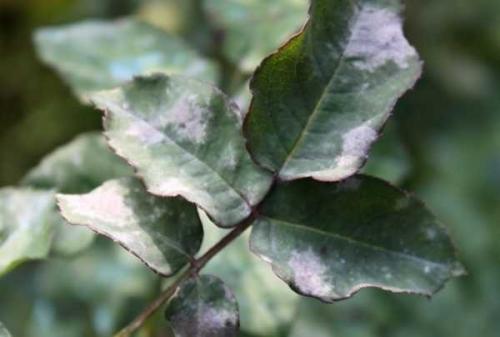
Rose and Chinese Rose powdery mildew is a fungal disease caused by the pathogen Sphaerotheca pannosa. It mainly infects young leaves, tender stems, and flower buds. White powdery lesions appear on the infected areas; in severe infections, the leaves become brittle, shrivel and curl, and then dry up.
The onset period of rose and Chinese rose powdery mildew differs from that of black spot disease. When temperatures are lower and relative humidity is higher, powdery mildew occurs more severely, usually most frequently in winter. Generally speaking, it is most likely to occur under humid climates, poor ventilation, and insufficient sunlight. Therefore, when cultivating roses in winter, powdery mildew must be controlled to ensure good rose growth. Controlling rose powdery mildew is similar to black spot disease: attention must be paid to pruning to keep the plant well-ventilated, and avoid planting roses in locations with insufficient light, or isolate them from other plants prone to powdery mildew, such as: zinnias, dahlias, etc. Choosing disease-resistant varieties can reduce the threat of powdery mildew, or spray the entire plant with Benlate (Yili) at 1000 times dilution.