Pest and Disease Control Methods for Gardenia Cultivation
Pest and disease control for gardenia cultivation:
1. Gardenia anthracnose
[Symptoms] This disease mainly affects the leaves of gardenia. It starts from the leaf tip and leaf margin, forming irregular or nearly circular brown lesions. Sometimes the entire leaf turns brown, and in severe cases it causes branch dieback or death of the whole plant. The disease mostly starts on the lower leaves of the plant. Under humid conditions, small black dots appear on the lesions on both sides of the leaf, with more black dots on the underside (the upper surface bears acervuli, the underside bears perithecia).
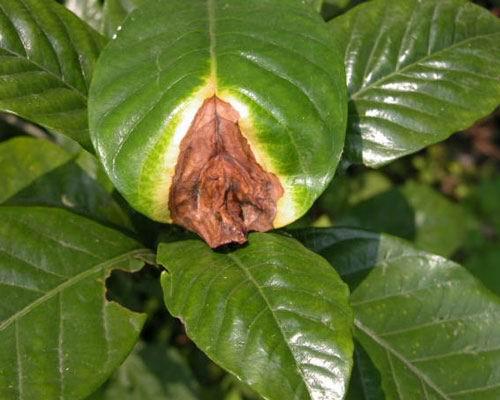
[Occurrence pattern] The fungus overwinters as mycelium latent in diseased leaves. In spring of the following year, when temperature and humidity are suitable, conidia are produced for infection. A characteristic of this pathogen is that it can also form large amounts of the sexual state, namely perithecia, during the growing season. High temperature and high humidity favor disease development. During transport, gardenia seedlings in poorly ventilated, hot and humid environments show a higher incidence of the disease.
[Control methods]
① Agricultural control. Promptly remove fallen diseased leaves and destroy them in a centralized manner. When watering, do so in the morning as much as possible, and water thoroughly each time.
② Chemical control. Before disease onset, spray 1% Bordeaux mixture for prevention to protect the plants. During disease development, spray 50% Shibaogong 1000-fold solution, or 10% Shigao 1000-fold solution, 430 g/L Haolike 2500-fold solution, 75% chlorothalonil wettable powder 500-800-fold solution, etc.
2. Iron deficiency chlorosis in gardenia
[Symptoms] This disease is a whole-plant non-infectious disorder. Symptoms mainly appear on young leaves and young shoots. At first, the young shoots and leaves turn pale yellow or white, and the leaves are thin and small, while the veins remain green. In severe cases, the veins also turn yellow or white, and eventually the leaves die. Axillary buds sprout, forming many small clustered side branches. Internodes of diseased branches shorten, forming clusters. When the disease is severe, a small tree can turn entirely yellow-white, with veins also yellow-white, and the tips of young shoots scorch and even die. Diseased plants are prone to frost damage in winter.
[Occurrence pattern] In some areas, the soil contains relatively large amounts of carbonate and shows an alkaline reaction, resulting in low levels of soluble iron; or, due to abundant rainfall, excessive soluble iron in the soil is leached away; or, in soils with heavy clay texture and an excessively high water table, the normal physiological activity of the plant roots is affected, reducing the roots' ability to absorb iron. The plant lacks available iron, which affects chlorophyll formation and leads to chlorosis.
[Control methods]
① Scientifically select the soil for planting gardenia. When choosing soil for planting gardenia, try to avoid planting gardenia in alkaline soil, and it is also unsuitable to plant it in low-lying, easily waterlogged sites, or in abandoned construction waste from old house foundations that contains relatively large amounts of lime; otherwise, root development will be affected and chlorosis is likely to occur.
② Rational fertilization. In alkaline soil, combined with fertilization, appropriately apply physiologically acidic fertilizers such as ammonium sulfate, ammonium chloride, and superphosphate to improve the soil's physical and chemical properties and increase the availability of iron in the soil. When applying organic fertilizer, add an appropriate amount of ferrous sulfate and mix it in. Once applied to the soil, the organic acids produced during the decomposition of organic fertilizer can increase the activity of iron, making it easier for the plant to absorb.
③ For diseased plants, drench with a 0.1%-0.2% ferrous sulfate aqueous solution, or apply other iron chelate aqueous solutions. Depending on the size of the tree, apply 25-100 g per plant. In the seedbed, use 500 g per 10 sq m. Once the leaf color turns green again, there is no need to continue applying it.