What to Do When Bleeding Heart Vine Leaves Turn Yellow? The Correct Way to Handle It Is Here
What to do when Bleeding Heart Vine leaves turn yellow: in summer, the sunlight is fairly intense, and exposure to the sun is one of the causes of yellowing leaves in Bleeding Heart Vine; in winter, the sunlight is not as intense, but the daylight hours are short, and a lack of light also easily causes leaves to turn yellow. Bleeding Heart Vine (Clerodendrum thomsoniae) prefers a warm, humid, semi-shaded environment with plenty of sunlight, and is not cold-tolerant. The overwintering temperature should be above 15°C; being below 10°C for a long time can cause leaf drop and even death. It is propagated by sowing or cuttings; the seeds have a short lifespan, so sow them immediately after collection.
The suitable growth temperature for Bleeding Heart Vine is 18-24°C, from February to October it is 18-30°C, and from October to February of the following year it is 13-16°C. In winter, the temperature should not be lower than 8°C; above 5°C the stems and leaves are prone to frost damage, with mild cases causing leaf drop and severe cases withering the tender stems. During the vegetative growth period, the temperature can be relatively high; at high temperatures above 30°C, as long as water is supplied adequately, it can still grow normally. For reproductive growth, that is, the flowering period, the temperature should be relatively lower, around 17°C.
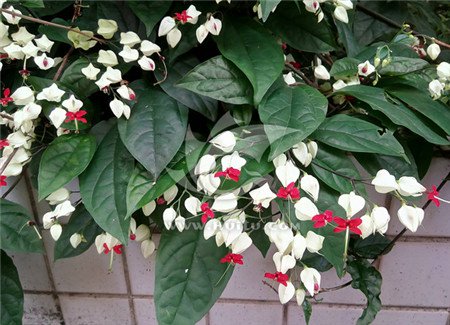
Causes of Yellowing Leaves in Bleeding Heart Vine
1. Light
Light is a key factor affecting the growth of Bleeding Heart Vine. Generally, when light is insufficient or too intense, Bleeding Heart Vine will show yellowing leaves.
In summer, the sunlight is fairly intense, and exposure to the sun is one of the causes of yellowing leaves in Bleeding Heart Vine; in winter, the sunlight is not as intense, but the daylight hours are short, and a lack of light also easily causes leaves to turn yellow.
2. Watering
Improper watering can also cause Bleeding Heart Vine leaves to turn yellow.
Bleeding Heart Vine likes to grow in an environment that stays moist; if the plant is relatively short of water and the air is relatively dry, its leaves will turn yellow. Although Bleeding Heart Vine needs a moist growing environment, if watered too frequently and the soil has standing water, it will cause Bleeding Heart Vine not to bloom, its leaves to turn yellow, and even root rot.
3. Fertilizing
Fertilizing causing yellowing leaves in Bleeding Heart Vine is mainly seen in a lack of fertilizer. If there are not enough nutrients, it is not conducive to the growth of Bleeding Heart Vine and will cause its leaves to turn yellow.
How to Handle Yellowing Leaves in Bleeding Heart Vine
1. Light Should Be Suitable
In summer, when the sunlight is fairly intense, Bleeding Heart Vine can be placed in a semi-shaded spot for care; it needs bright light and must not be kept in shade for a long time. In winter, sufficient light must be ensured, and it is best to allow it to receive full sun.
2. Water Reasonably
When watering, mainly pay attention to the dryness and moisture of Bleeding Heart Vine, keeping it within a relatively suitable range. In summer, you can water a bit more; when the air is relatively dry, you can sprinkle some water on the leaves of Bleeding Heart Vine.
3. Fertilizing
When Bleeding Heart Vine leaves turn yellow due to a lack of fertilizer, you can apply some fertilizer and at the same time apply some ferrous sulfate solution, and the leaves can turn green again.