How to care for the large indoor green plant 'Green Giant' (Green Giant Peace Lily)
Gardeners should be quite familiar with the Green Giant by now; regarding its cultivation and management methods, the plant encyclopedia editor shares a summary of their own experience.
Ornamental plant name: a perennial evergreen shade-loving herbaceous foliage plant, with a relatively short but sturdy stem, few tillers, and a plant height that can reach over 1 m; it is a large variety in the Spathiphyllum (peace lily) series. The leaves are broad, elliptical, with sturdy petioles, and the leaf color is deep green and glossy. The spathe is huge, like a human palm, rising above the leaves, and the flower can last nearly a month from opening to fading; when it first opens, the flower color is pure white, then turns green, going from light to deep, until it withers; the flowering period is late spring to early summer. It symbolizes success in career and smooth sailing.
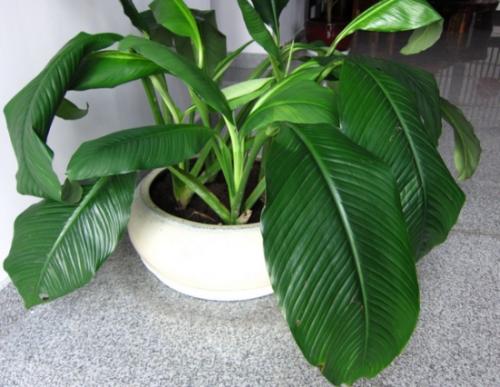
The Green Giant is also called Green Giant Peace Lily or Large-leaf Peace Lily. It is a perennial woody foliage plant in the genus Dracaena of the family Liliaceae, native to the Canary Islands in the Americas and Guinea in Africa, among other places. It features fast growth and large, thick leaves, and is a new generation of indoor foliage plants.
It likes warmth and fears cold, likes shade and fears sun, likes moisture and avoids waterlogging. The suitable growth temperature is 18-25°C. A brief low temperature of around 5°C has no direct effect on it. At 30°C or slightly higher, as long as it is not exposed to the sun, a shaded environment is provided, and sufficient water is given, it can still grow safely. It has a wide adaptability to temperature and can grow year-round in tropical and subtropical regions. The Green Giant can be propagated by division and tissue culture. Before the growing point is damaged, the Green Giant will not sprout until it reaches old maturity; after the growing point is artificially damaged, each plant can produce 3-5 tiller buds. When the new buds grow to about 15-20 cm in height, they can be cut off and inserted into perlite or coarse sand to let them grow roots. When cutting, be careful to include part of the stem, and dip the wound in charcoal ash to prevent rot.
For potted Green Tyrant, the soil should be fertile organic soil, repot once a year and apply base fertilizer, and apply a dilute liquid fertilizer once a month. Water when the soil is dry and water thoroughly; it is relatively drought-tolerant. The liquid is toxic, the same as Alocasia macrorrhizos. For Green Tyrant, the soil only needs to be kept slightly moist; Green Tyrant's drought resistance is relatively strong, so watering about once every 3 days is enough. The specific frequency needs to be judged according to the local air humidity. Add a compound fertilizer about once every 20 days.
The Green Giant has strong resistance to pests and diseases. When ventilation is poor, aphids and green stink bugs can occasionally be seen harming the heart leaves. Strengthening ventilation can prevent this; for potted plants, keep the leaves just touching. Once pests are found, they can be removed by hand or killed with insecticides.
Light: It likes shade and should be placed in a spot with plenty of diffused light. At noon in summer, provide appropriate shading to avoid scorching the leaves. When light is insufficient, it is not easy for it to bloom.
Watering: It likes moisture. During the growing season, the potting soil should remain moist, watering thoroughly every one or two days. Being too dry is not good for growth. In summer and autumn, spray the leaves more often to replenish in time and avoid leaf curling when short of water.
Special tip: Adjust the position of the flower pot every so often; this helps the plant grow evenly, and the fertilizer amount must be sufficient, otherwise it is difficult for it to grow into good condition.