Causes and Solutions for Yellowing and Dry, Withered Leaves on Leptospermum scoparium
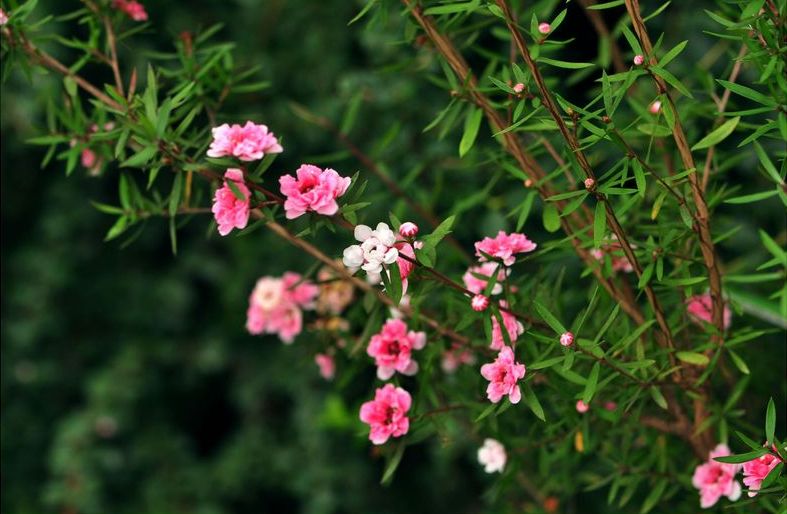
More and more flower lovers are now won over by Leptospermum scoparium. Its flowers are very beautiful and semi-double. Leptospermum scoparium prefers a cool, moist environment with plenty of sunlight and dislikes hot, humid climates, making it relatively difficult to care for. If not handled properly, yellowing and drying of the leaves will occur.
1. Yellowing leaves on Leptospermum scoparium: high temperature and sunlight
Sunburn from high summer temperatures. Leptospermum scoparium likes plenty of sunlight, but when summer temperatures are too high and the sunlight is too intense, prolonged high temperatures and scorching sun exposure will cause sunburn and localized water loss in the leaves, leading to drying and yellowing of the leaves.
2. Yellowing leaves on Leptospermum scoparium: excessive lack of water
The watering principle for Leptospermum scoparium is to water only when the potting soil is dry, and to water thoroughly each time. If the potting soil of Leptospermum scoparium is too dry, causing the leaves to lack the necessary moisture, it will also lead to withered leaves.
Leptospermum scoparium, Leptospermum scoparium leaves, yellowing leaves on Leptospermum scoparium
3. Yellowing leaves on Leptospermum scoparium: over-fertilization
Over-fertilizing Leptospermum scoparium burns the roots, which can also cause the leaves to turn yellow.
4. Yellowing leaves on Leptospermum scoparium: soil compaction and salinization
Problems such as soil compaction and salinization will damage the roots of Leptospermum scoparium, thereby causing its leaves to turn yellow.
5. Yellowing leaves on Leptospermum scoparium: temperature too low
If the temperature in winter is too low and the plant is not moved into a greenhouse in time for care, Leptospermum scoparium will suffer frost damage, which is also one of the causes of yellowing leaves.
Leptospermum scoparium, Leptospermum scoparium leaves, yellowing leaves on Leptospermum scoparium
What to do when Leptospermum scoparium leaves turn yellow
1. Provide shade in summer
During hot summer weather, Leptospermum scoparium can be placed in a cool, shaded spot that receives scattered sunlight.
During the growing season of Leptospermum scoparium, keep the potting soil moist. In hot summer weather, you can spray water mist around the plant to increase air humidity.
3. Fertilize moderately
During the growing season of Leptospermum scoparium, apply a dilute, well-rotted liquid fertilizer once every 1 to 2 months. Water appropriately as usual, keeping the potting soil moist.
4. Control soil composition
Leptospermum scoparium is suited to growing in slightly acidic soil that is rich in humus, loose and fertile, and well-drained.
When the soil is too alkaline, improve it with a 5% ferrous sulfate solution, with a pH of 6.5 to 7.0 being appropriate.
5. Maintain temperature
Leptospermum scoparium is not very cold-hardy and must be kept at a temperature above -1°C in winter. Therefore, in the north it can only be grown in pots for ornamental purposes, while in the south it can be planted directly in the open ground.