Tropical Rainforest Animal-Plant Coevolution as Seen Through the Ways Plants Disperse Their Seeds
All species on Earth have gone through the processes of origination, reproduction and evolution over the past 3.5 billion years, and some of them interacted with one another during evolution, and it is precisely this interaction that makes the natural world we see today not merely a collection of independent species, but also a place of many behaviors and phenomena such as mutual promotion and inhibition among plants, food chain relationships among animals, and mutual exploitation between plants and animals. Animals and plants have walked hand in hand along the long road of coevolution, together performing many breathtaking stories.
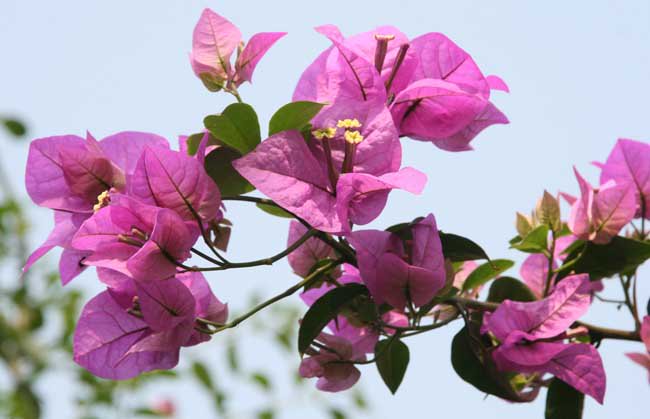
People often marvel at the brilliance of flowers and the sweetness of fruit in nature. Are they God's handiwork? Are they accidental products of nature? Now we know that they are the result of the coevolution of animals and plants over the long ages. In temperate regions, the flowers of many plants are often yellow, white, purple or blue, because insects in these places are poor at distinguishing bright red. In the tropics, however, plant flowers are often red, because the butterflies and hummingbirds there are good at distinguishing vivid colors. For insect-pollinated plants, pollination is accomplished by insects or hummingbirds. When animals search for flowers and collect nectar, their bodies pick up pollen, and when they visit other flowers the pollen from before falls onto the latter's stigma, completing pollination for the plant. In this process, the insects get food and the flowers get pollinated, so animals and plants benefit each other and bring out the best in each other. This interdependent relationship sometimes even coevolves into astonishing phenomena, in which one side among animals and plants seems to exist entirely to adapt to the other, such as how the mouthparts of some butterflies happen to fit the labellum of orchids, and how the length and shape of some floral tubes happen to match the beaks of nectar-collecting hummingbirds. This is what is called "coevolution."
Let us first look at two examples of the coevolution of pollinating animals and plants.
In the tropical rainforests of South America, hummingbirds are the pollinators of many kinds of plants. The beaks of hummingbirds can be roughly divided into two types: long and curved, and short and straight. Birds of the first type are suited to collecting nectar from slightly curved, long tubular flowers, and this type of flower is widely distributed and produces a high amount of nectar; birds of the second type are suited to collecting nectar from short, straight, short-tubular flowers, and this type of flower generally secretes less nectar and often attracts many pollinating insects. Although long-beaked hummingbirds can also feed on the nectar in short-tubular flowers, they generally prefer long-tubular flowers, and as long as they linger near short-tubular flowers, they are often driven away by other short-beaked birds. Long-beaked hummingbirds fly fast and can fly long distances back and forth to feed on nectar that short-beaked hummingbirds cannot use. Interestingly, plants that rely on hummingbirds for pollination almost all secrete the same amount of nectar, perhaps because hummingbirds disdain to visit flowers that do not produce much nectar.
In the tropical rainforests of the New World, many orchids rely entirely on a certain type of bee to spread pollen. In fact, orchids do not secrete nectar, but they can release fragrance from secretory cells in the petals. Male bees like to land on the secretory areas to "bathe" in the fragrance and carry it back to their nest chambers to store it or even let it undergo chemical reactions, thereby prompting their antennal glands to secrete hormones that attract females. Each time they enter an orchid, the male bees land on the labellum, and their heads happen to touch the sticky disc at the base of the pollinium; when they leave the flower, they can carry away a pollinium mass of gelatinous material. When the male bee flies to another flower to collect nectar, the pollinium happens to touch the sticky stigma of the orchid, thus completing pollination for the orchid. Quite interestingly, these orchids have extremely detailed requirements for their pollinating animals, and bee species that are too large or too small do not fit the shape of the orchid and therefore cannot touch its reproductive organs. Even more intriguingly, different kinds of orchids can secrete different kinds of fragrance, while different kinds of bees choose different fragrance types, so orchids living in the same area can each attract the corresponding bees to pollinate for them. Put plainly, the beauty and fragrance of flowers are not meant to adorn nature, but to advertise themselves.
Besides flowers, the phenomenon of animals and plants coordinating for mutual benefit also commonly exists in fruits. The tropical rainforests are rich in wild fruits of various colors, and yellow fruits are especially favored by many arboreal primates. Recent research shows that the visual systems of many fruit-eating primates in South America are especially sensitive to yellow. So far, the physiological mechanism of this phenomenon is not very clear, but the meaning of this trait for animals' survival adaptation has already been understood: it makes it easier for animals to find yellow fruits dotted among green leaves. We know that unripe fruits are mostly green and are not easy to find hidden among leaves, because at this time the seeds are not yet mature, and the intervention of animals can only bring losses to the plant. Once the seeds mature, the fruit skin usually turns yellow, and the striking color attracts animals from afar to come and eat the fruit; the latter often swallow the seeds along with the flesh while eating, and then excrete them afterward. Thus, the seeds move with the animals to new places, and the plant population thereby expands into new spaces. Therefore, we say that these physiological traits of animals and plants are not accidental products, but the result of their coevolution with each other.
Changes in the scent of fruit follow the same principle. When the flesh is unripe, it is bitter and tasteless; once ripe, it gives off an inviting fragrance, and the strong scent can attract nocturnal animals such as opossums and kinkajous, which are also unpaid dispersers of seeds. In South America, many kinds of bats feed on fruit, and they rely on their sense of smell to find delicious food. These flying mammals have extremely high metabolic rates, and often not long after feeding on flowers and fruits, during subsequent flight they can eject tiny seeds that have not yet been digested, making a "seed rain" fall from the sky.
In the rainforest, one can observe a great variety of interesting behaviors by which animals adapt to survive. In fact, plants also have many behaviors for adapting to survival, and although compared with animals these strategies are less conspicuous, they are equally ingenious and full of interest. Here let us look at how plants "manipulate" their seed dispersers.
The seeds of many fruits in the rainforest are spindle-shaped and covered with smooth flesh, with the flesh and seeds tightly joined together, so that when animals suck and eat the flesh, the seeds "slip" into the latter's belly along with it. For animals, these seeds are "pollutants," because they cannot provide the animals with any nutrients or energy; but for plants, having their seeds swallowed by animals and carried to new places is their way of reproducing and expanding their population, and the flesh is merely bait to attract animals.
Also in order to attract animals to disperse seeds, some plants have even evolved tricks. There is a tall leguminous plant in the rainforest whose pods split open when mature, exposing red-and-black seeds that are especially striking in sunlight. Birds in the distance often mistake them for tasty fruit, fly over, pick them up and leave, and by the time the birds realize they have been deceived and discard the seeds, the latter have very likely already been moved to a place dozens of meters away. There are even more clever tricks. A French scientist discovered in some fruits from the African jungle something called "false sugar." The chemical composition of false sugar is originally protein, but it tastes sweet. The scientist believes this is also a trick by which plants attract animals to disperse their seeds, because many primates like to eat sweet fruits.
There are also all kinds of dry fruits in the rainforest, whose fruits and seeds are often odorless and tasteless, but these seeds without "showy" tactics still encounter "kind-hearted" dispersers: rodents and ants. We know that in temperate regions, squirrels and chipmunks have the habit of storing food in autumn, preparing for the winter. In tropical regions, this type of animal also has the same habit, because although there is no distinction between autumn and winter here, there are still harsh seasons when food is scarce. So these little clever creatures bury seeds underground when fruits are abundant to "prepare for famine." Unexpectedly, the plants had long since evolved corresponding strategies, and some seeds will quickly take root and sprout once they encounter a suitable environment. At the Nouragues ecological station in the Amazon rainforest, a cameraman captured a very dramatic scene: an agouti painstakingly buried a huge seed under the roots of a tree, but after some time, when it came back to look for its "rations," the seed had already grown into a two-chi-tall seedling.
What is little known is that a type of arboreal ant also feeds on seeds. These ants build their nests by plastering mud into hollows in tree trunks. They laboriously carry seeds found here and there back to the nest, not realizing that some seeds quietly and quickly germinate as soon as they enter the nest. Thus, as days grow into years, one plant after another grows around the ant nest, and the bare ant nest also transforms into a vibrant "ant garden."
In tropical rainforests across the entire Earth, about 70% of plants rely on animals to disperse their seeds. An American tropical ecologist once systematically studied the relationship between the size and color of fruits in South American tropical rainforests and their seed dispersers, and found that fruits in the rainforest can be divided into two major categories: small red fruits and large yellow fruits. The seed dispersers of the former are birds, and those of the latter are mammals. Another French expert conducted an in-depth study of the relationship between the territory-use behavior of howler monkeys and plant succession, and found that in areas where howler monkeys often sleep, the structure of young vegetation is clearly different from that in other places, and in these places seedlings of the plant species eaten by howler monkeys are clearly denser. It turns out that howler monkeys eat a great deal and do not move frequently, so many swallowed seeds are excreted into the same area, and the seeds then develop into seedlings. After several decades, the structure of this small patch of forest will differ slightly from that of the neighboring forest, which also explains why the vegetation distribution of primary tropical rainforests is not very uniform and is more or less patchy.
In this way, with the evolution of life, nature weaves itself into an intricate web, in which all links are directly or indirectly interrelated. It seems to have made careful arrangements for every species! Nature is truly a rustic beauty, a marvelous poem, an intoxicating dream, a wondrous mystery!