How to care for Turbinicarpus alonsoi so it blooms continuously
Turbinicarpus alonsoi, family Cactaceae, genus Turbinicarpus (Acanthocalycium), native to Mexico - Guanajuato. Turbinicarpus alonsoi looks a bit like Obregonia denegrii, but its leaves are much narrower than those of Obregonia denegrii; mature plants are flat and globe-shaped. The leaves are dark green, and the leaf tips have gray or black spines that curve inward. The flowers bloom cherry red, pink or purplish red, with a flower diameter of 20-30 mm, blooming in summer, cross-pollinated
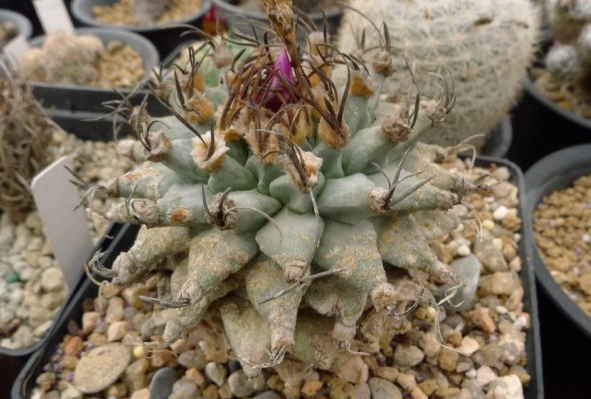
The editor's soil mix for Turbinicarpus alonsoi is fairly simple: perlite mixed with peat, plus vermiculite and coal cinders, in no fixed ratio, with breathability as the priority, and the soil surface covered with large-grained river sand. This species is not very tolerant of intense sun exposure; during the growing period, water only after the soil has dried out completely, and give mature plants as little water as possible. Normally the editor only waters once the soil is very dry, and basically waters thoroughly.
Summer is the growing period, and the plant also needs light shading and ventilation; during the high-temperature period from July to September, it is basically kept under half shade with ventilation, and from September to December water is also given only after the soil has dried out completely. Throughout the cold winter, when the temperature drops below 2 degrees, the editor gives almost no water; at this time the plant enters dormancy, and less water can also prevent frost damage and root rot caused by low temperatures. When the potting soil is dry, Turbinicarpus alonsoi is relatively tolerant of low temperatures; in the editor's sunroom at minus 4 degrees, Turbinicarpus alonsoi shows no change at all. This temperature was measured inside the sunroom, by the way. The editor generally places a basin of water in the sunroom; if the water freezes, it is time to add heat. As long as it is not outdoors, Turbinicarpus alonsoi can withstand such temperatures.
During the growing period, water is basically given only after the soil has dried out completely, and never poured over the top, since poor ventilation makes rot easy. Watering in spring must be done gradually, paying attention to weather changes. Turbinicarpus alonsoi is still fairly easy to care for. Propagation is mainly by sowing, and grafting is also used.