How to grow Pseudobombax ellipticum so its turtle-shell cracks look even more beautiful? With care experience
Green-backed turtle-shell bombax Pseudobombax ellipticum, family Bombacaceae (Bombacaceae), genus Pseudobombax (Pseudobambax). Aliases: pink bombax, pink shaving brush, green-backed turtle-shell bombax, football tree, elliptic-leaved bombax, turtle-pattern bombax. Native origin: tropical America, southeastern Mexico, Guatemala
Deciduous tree, height can reach 10 m, stem and branches thornless, many branches, with obvious leaf scars, palmately compound leaves, leaflets mostly 5, leaves opposite, entire margins, apex acute. Flowers solitary at branch tips, calyx tubular, 5-lobed, petals 5, linear, curled, reddish brown, about 15 cm long. Flowers are early-deciduous, stamens numerous, bases fused into a tube, pink, pistil 1, stigma shallowly 5-lobed, fruit elliptical, with woody hairs inside the skin.
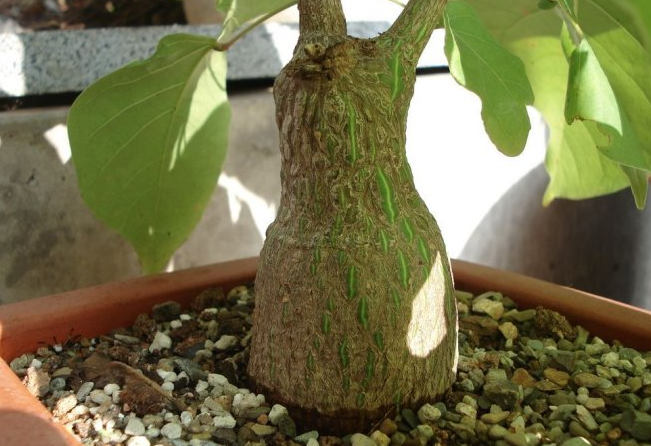
Pseudobombax ellipticum needs a sunny, cool and dry environment, tolerates partial shade, fears waterlogging, and dislikes muggy, humid conditions. It has a habit of dormancy at low temperatures in winter. Each year from March to December is the plant's growing season (the growing season also varies with different growers' environments). If light is insufficient, the plant's stems and leaves tend to grow leggy, the vertical distance between leaves will stretch out very long, making the stem very fragile. In contrast, plants grown in sunny places have a short, sturdy shape, the stem near the underground part will swell, and the leaves will be arranged relatively compactly. Pseudobombax ellipticum does not grow very fast. The editor's Pseudobombax ellipticum is grown outdoors. During the growing season, keep the soil slightly moist and avoid water accumulation. For the soil, the editor used cinder mixed with peat and a small amount of perlite, in a ratio of about 6:3:1, with granular river sand on the soil surface.
When the potting soil is dry, Pseudobombax ellipticum can tolerate low temperatures of around 2 degrees, which is an indoor temperature, not outdoor. Basically cut off water throughout winter, and once below 5 degrees you should start cutting off water. In winter, try to keep it above 0 degrees, otherwise if the temperature is too low the plant's underground stem is prone to frostbite and death, as it is relatively not cold-tolerant. When summer temperatures exceed 35°C, the editor moves it to a place with a bit of scattered light for normal care. In summer, basically water only after the soil has dried out, and prevent root rot caused by overly wet potting soil. Increase ventilation, shade appropriately, avoid blazing sun exposure that scorches new tender leaves. Basically care for it this way throughout summer, watering around 7-9 pm, when the sun has already set and will not affect the plant's roots. During cultivation, avoid prolonged rain, otherwise the stem will also rot. Pseudobombax ellipticum grows relatively not slowly, and repotting once every 2-4 years is about enough. Repot before the first watering in early spring. Pseudobombax ellipticum needs appropriate pruning of branches, so that the trunk will swell and look beautiful.