How to grow yew plum yew? Detailed growing methods and precautions
The yew plum yew bears fruit that is red on the outside and bright within, just like the love pea of the south, which is how it got its name. It is hailed as the health tree, also called the purple yew tree, and is an evergreen arbor plant of the genus Taxus. It is a shallow-rooted plant with an inconspicuous main root and well-developed lateral roots, and is recognized worldwide as an endangered natural rare anti-cancer plant, a national treasure-level plant that grows slowly and has few wild varieties. It has strong ornamental value, and its greatest feature is that it offers different ornamental qualities in different seasons. In spring and summer it is a green plant, tall in tree height and thin in trunk, and the newly sprouted branches and buds of the yew plum yew are green and tender green. The branches of mature yew plum yew trees tend toward brown, with varieties including yellow, red, and gray types. In autumn, its leaves turn green-yellow, giving excellent ornamental value. When it sprouts in winter, the leaves are slender and knife-like.
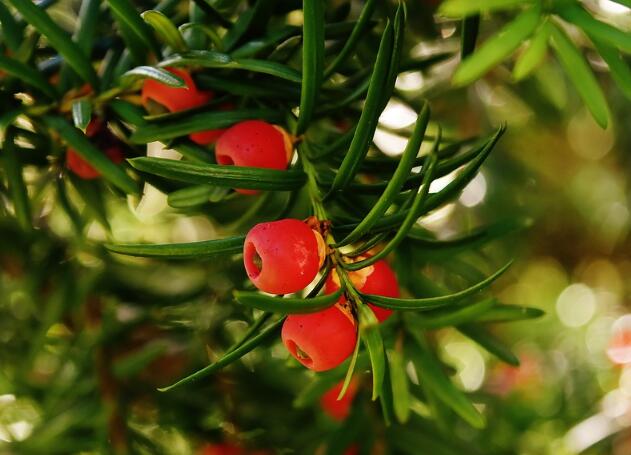
The yew plum yew is native to the Yangtze River basin and areas to the south, and by nature prefers warmth and humidity. It is a strongly shade-tolerant, slow-growing tree species, suited to acidic soil rich in humus, loose and fertile. The suitable growing temperature is 20-30°C, and it can withstand short-term low temperatures of -5 to -10°C. In the south, the yew plum yew grows in mixed woodland in humid mountain areas, mostly beneath tall deciduous trees, and cannot tolerate strong sunlight; seedlings need a shade shed. Below is a detailed introduction to how to grow the yew plum yew:
1. Soil selection for growing the yew plum yew
The yew plum yew is best planted in early spring, in mid-to-late February. Seedlings should be dug up with a soil ball and can be planted in shaded spots in the garden, often interplanted with arbor trees. For potting soil, use loose, fertile acidic soil with high organic matter content; it can be made from garden soil, peat, and sand in a 2:1:1 ratio, with 1% decomposed organic fertilizer added.
2. Fertilization method for growing the yew plum yew
For potted plants, apply decomposed cake fertilizer water. During the growing season, apply alum fertilizer water at a concentration of 1:10-15 once a month. Repot every other year, and add solid decomposed organic fertilizer at the bottom of the pot.
In autumn, from September to October, base fertilizer can be applied, with 50-100 kg of decomposed livestock manure per plant. In early spring, a compound fertilizer containing nitrogen, phosphorus, and potassium can be applied, 100-200 grams per plant, or 500 grams of superphosphate.
3. Watering method for growing the yew plum yew
The Northeast yew plum yew likes humidity and fears waterlogging. Water during the budding period; on slopes with a low groundwater table, water thoroughly 2-3 times a month. In summer, when there is a lot of rain, do good drainage and waterlogging prevention work. In autumn, water less, so that the soil is neither dry nor wet. Before winter begins, after the leaves turn purple-green, water once more.
For potted plants, water once every 2-3 days in spring; in summer, water once in the morning, and if the potting soil is still too dry, spray again in the evening with a fine-nozzle watering can. This both rinses the leaves and increases the ambient air humidity, and also lets the leftover water moisten the potting soil again, helping the plant absorb it. In autumn, water once every 3-4 days; if there is continuous autumn rain, you can also water once a week, as long as the pot soil is moist. In winter, water less; for pots placed in the open garden, rinse the leaves with clean water every 15-20 days, and just let the leftover water moisten the potting soil.
The southern yew plum yew likes humidity by nature but fears waterlogging. No matter where it is cultivated, water must be replenished at any time. Judging from the actual cultivation conditions in various places, spring has little rain and is also the plant's budding period, so irrigation should be carried out, especially on slopes or where the groundwater table is low, watering thoroughly 2-3 times a month to keep the soil moist. At the same time, combine this with fertilization, watering thoroughly so that the soil remains fertile and moist for a long time. In summer there is a lot of rain, and plants cultivated in low-lying areas should have ditches dug early to do good drainage and waterlogging prevention work; if a summer drought occurs, irrigation should also be done to ensure fruit growth. In autumn, irrigate less, so that the soil is neither dry nor wet. Before winter begins, after the leaves turn purple-green, irrigate thoroughly once more, and afterward no more watering is needed. If the winter climate is especially dry, you can irrigate early in advance in early spring to help it revive and grow earlier.
4. Temperature requirements for growing the yew plum yew
The Northeast yew plum yew can tolerate partial shade, resists severe cold, and has strong adaptability, generally withstanding low temperatures of -25 to -15°C. Once it has developed a growth habit of not fearing cold, growers, after learning about its habits, should meet its temperature needs. For yew plum yew cultivated in Northeast China, April to October is its vigorous growth period; during this period in these areas, the temperature is 18-32°C during the day and 10-25°C at night, and for the other half of the year the plant is in a dormant or semi-dormant state.
The southern yew plum yew likes warmth by nature. Its most suitable growth period is from March to November, and its most suitable growth temperature is 20-30°C. Under such temperature conditions, the plant's vegetative growth and reproductive growth proceed simultaneously. If water and fertilizer management are suitable and the sunlight is gentle, the plant will not only have luxuriant branches and leaves but also many flowers and fruits, with extremely high ornamental value. The southern yew plum yew has good cold resistance; for plants growing in Guizhou, Sichuan, and southern Shaanxi, where winter temperatures in some mountain areas drop as low as -10 to -5°C, the plants can still resist it. Therefore, when introduced and cultivated in the vast areas of the Yangtze River basin and to the south, there is no overwintering problem.
5. Light requirements for growing the yew plum yew
The Northeast yew plum yew originally grew in mountain areas with warm, cool summers, abundant rainfall, humid air, and cold winters, where the temperature difference across the four seasons is relatively large and the sunshine duration is long; the yew plum yew's growth habits and various organs have all adapted to this ecological environment. Therefore, if other places want to cultivate this plant, they should strive to create a natural ecological environment close to its original habitat, so that it can be grown well.
The southern yew plum yew is a strongly shade-tolerant, slow-growing tree species, and therefore likes a humid and warm ecological environment and cannot tolerate strong sunlight. For seedlings grown from seed, in areas with strong light, a shed should be built for shade. When cultivated in plains areas, it can be interplanted with tall arbor trees, and cultivation around houses should also be in shaded places, because the original habitat of the southern yew plum yew is mixed woodland in humid mountain areas, mostly growing beneath tall deciduous trees. In summer with strong sunlight, it is shaded by the branches and leaves of large trees; in autumn and winter, when the large trees shed their leaves, the light is sufficient, which is just right for the growth of the evergreen yew plum yew. After growers learn about this growth habit, when introducing and cultivating it, they should best choose a suitable growing environment to meet the plant's light requirements.
6. Precautions for growing the yew plum yew
(1) It is best to plant the yew plum yew before budding in late winter and early spring, and large seedlings need a soil ball. In daily maintenance and management, often loosen the soil, weed, fertilize, and irrigate, and spread dead branches and fallen leaves around the roots to help maintain the soil's acidity. It tolerates pruning; in late autumn and early winter, shaping and pruning can be carried out to maintain a good tree form; at the same time, cut away dead branches, diseased branches, broken branches, and crossing branches.
(2) When watering potted yew plum yew, be sure to pay attention to water quality. For watering flower pots, natural rainwater is best, followed by clean flowing river water and lake water. If well water must be used, be sure to pay attention to water quality; especially well water in northern areas is often too alkaline, which is not good for the growth of the yew plum yew. Next is water temperature: the water temperature for watering potted flowers should be basically close to the air temperature. Too low or too high is bad for its growth. Especially in summer when using tap water for irrigation, be sure to store the water in a vat, pool, or other container for 24-48 hours before use, otherwise it will cause physiological wilting of the plant; at the same time, this kind of physiological disorder is often difficult to remedy.
7. Propagation methods for growing the yew plum yew
(1) Seed propagation: Because the seed coat of the yew plum yew has low permeability, hindering the passage of air and water, its dormancy period is very long. Therefore, before sowing, the seeds should undergo low-temperature stratification or be stored in the open air mixed with sand for 15 months. After storage and germination promotion until more than 80% of the seeds have cracked and shown white, sow them. During the seedling stage, appropriate shading is needed; growth is slow, and they must remain in the seedbed for 2 years before transplanting, and a soil ball is needed when transplanting. One-year-old seedlings are only 8-10 cm tall. The method for storing yew plum yew seeds in the open air mixed with sand is as follows: choose a sheltered, cool, flat place that does not accumulate water, dig a soil pit 80 cm deep, with length and width depending on the amount of seeds.
Mix sterilized yew plum yew seeds evenly with river sand in a ratio of 1 part seeds to 3 parts river sand. The humidity of the river sand should be such that it forms a ball when squeezed in the hand without water coming out, and crumbles when released and touched. After the soil pit is dug, first lay a layer of stones about 12 cm thick at the bottom of the pit, then lay 6 cm of moist fine sand. Insert a perforated bamboo tube every 50 cm in the pit, then spread the sand-mixed seeds flat in the soil pit, with a thickness of 30 cm as suitable, cover with wet sand, then cover with 8 cm of soil and pile it into a roof shape. During storage, cover the soil pit with a bamboo curtain for shade. Dig drainage ditches around the pit to prevent water accumulation in the pit from causing the seeds to mold and rot, and be careful to turn them once every month.
(2) Cutting propagation: The yew plum yew can be propagated by softwood cuttings or hardwood cuttings. The rooting rate of softwood cuttings is higher than that of hardwood cuttings. Soaking the cuttings in a 100 mg/L naphthaleneacetic acid solution for 3 hours helps rooting.
Tips:
1. Give less sun, water less, and fertilize less.
2. Please do not place the bonsai at an air-conditioning vent or too close to a heater.
3. Every half month, the bonsai can be moved outdoors or to a balcony for two days of care (preferably choosing cloudy or rainy days), which is more conducive to its natural growth.
4. Never pour tea water into the pot or throw garbage into it.
5. In northern winters with underfloor heating, the bonsai should be placed on a suitable pot stand.
6. In spring when new buds emerge, some metabolism (leaf replacement, leaf drop) will occur.