"Nine-death soul-returning resurrection longevity herb" - what kind of plant is Selaginella tamariscina? Is it a fern or a gymnosperm?
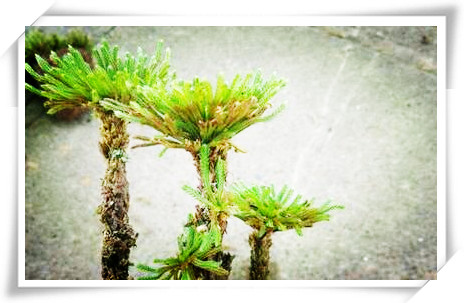
Selaginella tamariscina is recorded in the Shennong Bencao Jing. The Diannan Bencao calls it Huiyang herb, the Bencao Gangmu calls it Changsheng herb, the Fenlei Caoyaoxing calls it Huanhun herb. The Xiandai Shiyong Zhongyao calls it the nine-death soul-returning herb. The Jianjiang Zhongyao Shouce calls it the water-seeing resurrection herb. So what kind of plant is Selaginella tamariscina? According to Hunan plant records, Selaginella tamariscina is a fern. Its roots can detach from the soil by themselves, curl up into a fist-like shape, and move with the wind; when they meet water they flourish, and the roots drill back into the soil to seek moisture. Because of its extremely strong drought tolerance, after long-term drought it can unfold again as long as its root system is soaked in water, hence its name. Selaginella tamariscina is both a foliage plant and can be used medicinally; it has hemostatic and astringent effects, and is markedly effective in treating bloody stool, bloody urine, nosebleeds and so on.
The phylum Pteridophyta is a major group of higher plants. It is also a relatively lower class among higher plants. They are often tall woody plants, forming great forests, flourishing in the late Paleozoic, and by modern times mostly herbaceous. Ferns can be divided into five subphyla: Psilophytina, Lycophytina, Isoetinae, Sphenophytina, and Filicophytina.
The leaves of general ferns combine the functions of carrying out photosynthesis to produce organic nutrients and producing spores for reproduction (that is, homophyllous leaves). Ferns are the most ancient land plants. In the history of biological development, from 35000 million to 27000 million years ago, from the Late Devonian to the Carboniferous period, was the most flourishing period for ferns, when they were the main plant group on Earth; tall Lepidodendron, Sigillaria, Calamites and tree ferns together formed the ancient swamp forests. Beginning at the end of the Permian, ferns became largely extinct, and their remains were buried underground, forming coal seams.
There are about 12000 extant fern species, widely distributed throughout the world. Most are terrestrial, lithophytic or epiphytic, and a few are hygrophytic or aquatic. They prefer shady, moist and warm environments.
Ferns live in high mountains, plains, forests, grasslands, streams and gullies, rock crevices and swamps, with especially rich species diversity in tropical and subtropical regions. China has about 2400 species, mainly distributed in the provinces and regions south of the Yangtze River.