What to Do When Bean Leaves Turn Yellow? Causes and Control Methods
Many farmers encounter the problem of yellowing bean leaves, whether it is new leaves turning yellow or old leaves at the bottom turning yellow. There are many reasons for leaf yellowing, and if effective measures are not taken in time, it can even lead to total crop failure in severe cases. Below are several effective measures recommended for bean leaf yellowing under different circumstances.
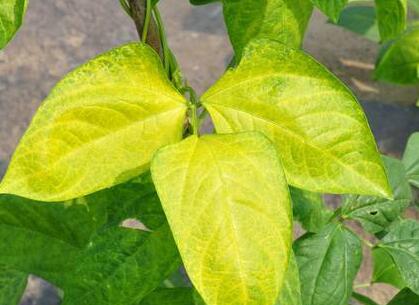
I. New Leaves Turning Yellow
If bean plants are kept for a long time under weather that turns suddenly clear after rain, or have weak root systems, or bear too much fruit, the new leaves near the growing point at the top of the plant are prone to turning yellow or white. This is mainly caused by iron and zinc deficiency.
Control measures: Once new leaves turn yellow due to a lack of trace elements in beans, foliar spray of trace element fertilizer must be applied in time, which can quickly and effectively relieve the symptoms; at the same time, farmers are advised to pay attention to supplementing organic matter and trace elements when applying base fertilizer for the next crop, so as to avoid adverse effects on the next crop caused by a lack of available trace elements in the soil.
II. Yellowing Between Leaf Veins
Interveinal yellowing is prone to occur on old leaves in the middle and lower parts, mainly showing as yellowing between the leaf veins, but it does not cause plant death. Interveinal yellowing is mainly caused by two reasons. One is a lack of available magnesium in the soil; the main symptom of magnesium deficiency in plants is chlorosis and yellowing between leaf veins, and because magnesium ions are highly mobile within the plant, it mostly occurs on leaves in the middle and lower parts of the plant. The other reason is that the plant grows weakly and prematurely ages; excessively high greenhouse temperatures, poor root growth, and unscientific fertilizer and water supply can all lead to weak plant growth, thus causing interveinal yellowing.
Control measures: For interveinal chlorosis and yellowing caused by magnesium deficiency, foliar fertilizer containing magnesium should be sprayed on the leaves in time, and attention should also be paid to supplementing organic fertilizer and magnesium fertilizer when applying base fertilizer; for plants with poor growth, Jinzhengda/Wofute/Aolindan bacterial fertilizer can be applied to promote rooting and regulate their growth. During the topdressing period, apply fertilizer and water reasonably, and prevent interveinal chlorosis and yellowing through comprehensive management.
III. Bottom Leaves Turning Yellow
Cause analysis
1. Bean root rot, commonly known as “red root disease”. This is a soil-borne disease. In the early stage, pathogens infect the root system, the plant suffers from malnutrition, the bottom leaves turn yellow, the plant wilts at noon and recovers in the morning and evening, and finally the plant dies.
2. Trace element deficiency. Leaves at the top growing point area appear yellow-white, caused by iron and zinc deficiency. Yellowing of new leaves at the top generally occurs after sudden clearing following cloudy weather, poor root growth, weather turning from cold to warm, and too much fruiting in the early stage.
3. Poor plant growth. This situation does not cause plant death. It is mainly due to poor plant growth, which causes yellowing between the veins of leaves in the middle and lower parts and can easily lead to premature aging of the plant. For example, excessively high greenhouse temperatures, poor root development, root damage, and unscientific fertilizer and water supply can all cause similar situations.
Control methods
1. For bean root rot, root irrigation with chemicals can be adopted. Chemical options include: Jiufuyu, Jinmianwei, Xiumiao, Dijunsha, etc., combined with Saoxi, Xisha, Jinmeizuo, Bilü, etc.
2. In adverse weather and during the middle and late stages of plant growth, foliar spraying can be used: Xisha, Jinmeizuo, Bilü, Bijunsha combined with Kuhuang Qiaolü, Wandaihong, Biliaoo, etc., which can effectively relieve the yellow-white color of new leaves at the top.
3. Enhance plant resistance, cultivate strong root systems, and water and fertilize reasonably (Lüyuan balanced fertilizer, Dagezi 20-20-20, Miaoguo, Yimujin, etc. can be selected) to prevent yellowing between leaf veins and premature aging of leaves. Huishengye + Teyougen can be used in combination, applied by flushing 2-3 times.
Alright, the above are the causes and solutions for bean leaf yellowing. Farmer friends, when you find bean leaves turning yellow, be sure to identify the cause in time and carry out prevention and control early, so as to avoid the death of the entire plant. The above control measures are an analysis of leaf yellowing in different parts, so everyone can apply the right remedy for the condition.