How to grow a bonsai banyan tree so it becomes thick and sturdy? Tropical woody plant care tips
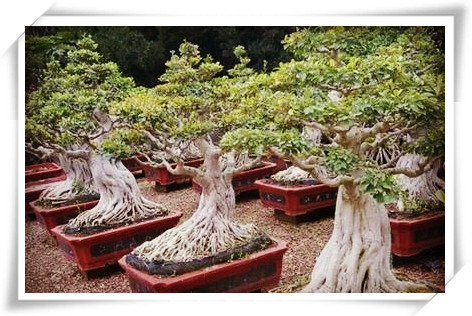
The banyan tree is a typical representative of tropical woody plants. It grows quickly and lives long, its canopy is large and easy to shape, and it has few pests, making it a good greening tree species. Ji Han of the Jin Dynasty wrote in "Plants and Trees of the South": The banyan leaves are like hemp, the fruit like holly, the trunk climbs and twists, its shade covers ten mu, and so people rest beneath it; moreover its branches are numerous and its leaves dense and fine, the soft branches like vines hang down and gradually enter the ground, and where the vine tips are worked by hand, they promptly take root and form joints, or a single large plant may have four or five roots, while horizontal branches join with neighboring trees. This shows the banyan is easy to plant, easy to keep alive, and easy to cultivate. So how do you grow a banyan bonsai so it becomes thick and sturdy?
1. Soil selection
The banyan tree likes a sunny, well-ventilated, warm and humid environment. When the weather is hot in summer, it should be shaded appropriately, and water should often be sprinkled on the ground to keep the microclimate at a certain humidity. In the north, in late autumn or early winter, the banyan bonsai should be moved indoors to overwinter.
2. Light requirements
The banyan tree likes sunny, warm and humid, well-ventilated places, and can be appropriately shaded when the weather is hot in summer. In northern winters it should be moved indoors to overwinter, with a room temperature of around 8°C. The banyan is not afraid of sunlight and is also fairly shade-tolerant; even when displayed indoors for a long time, its leaves will not turn yellow, and in winter it should be given more sunlight.
3. Fertilization method
During the growing season, apply a thin, decomposed organic liquid fertilizer once a month, and apply "alum fertilizer water" once each in May and August every year. Do not fertilize the banyan too much. Too much fertilizer makes the branches grow leggy and the leaves enlarge, which is actually unattractive. Do not fertilize when the weather is hot in summer or in winter.
Because the banyan grows quickly, once it is growing normally you can carry out foliar topdressing once a day, using decomposed human or livestock urine or rotted mature fertilizer as topdressing; basal fertilizer can also be applied when repotting, and sufficient fertilizer can make the trunk grow thick and sturdy. If the potting soil is fertile, there is no need for topdressing; instead, during the summer and autumn growing season, a nutrient solution can be sprayed on the leaves to make the branches and leaves dense and emerald green, giving people a sense of beauty.
4. Watering method
The banyan tree is a tropical plant and likes plenty of water and fertilizer. It is highly adaptable and can grow in cracks between stones and also in water, but once a banyan has grown, the potting soil should be kept moist, and water must not accumulate in the pot; in summer, watering twice a day is appropriate.
The banyan tree likes moisture, and during the growing season it should be watered often to keep the potting soil at a certain humidity, but water must not accumulate in the pot. In winter the temperature is low and water evaporates less, so watering should be appropriately reduced. The banyan tree likes moisture, and during the growing season the potting soil should be kept damp; in summer, besides watering into the pot, water should also often be sprinkled on the ground to keep the local microclimate at a certain humidity. But water must not accumulate in the pot. In winter, water less; if the potting soil is damp, there is no need to water.
5. Shaping method
Because the banyan tree has many aerial roots, it is suitable for the exposed-root and claw style and the multi-trunk and multi-leaf bonsai. When making these two kinds of bonsai, in the first year first cultivate its root base and build up its vitality; after it grows vigorously, then raise the roots and repot it into a shallow pot.
Because the banyan tree grows quickly and has well-developed roots, it can be made into a rock-clinging bonsai. Before cultivation, coil the tree with metal wire into curved shapes of varying sizes, plant it obliquely in a soil pot, and after 2-3 months, when the aerial roots have increased and the canopy has taken shape, take the sapling out, remove all the cultivation soil, and attach the sapling to a selected stone. At this point, take care that the banyan and the coiled tree-and-stone are consistent in momentum, and embed the roots into the cracks of the stone as much as possible. Wrap the roots firmly with cotton cloth strips or metal wire, and place them in a tall large pot to cultivate. A rock-clinging bonsai can, according to the tree's momentum, be created as far as possible into forms such as the stone-embracing style, the stone-piercing style, and the stone-attaching style.
6. Repotting method
A banyan bonsai that is not very old should be repotted once every 2 years, and an old-stump bonsai once every 3-4 years; the time is best from late April to early May, and repotting is not easy in winter. Remove 1/2 of the old potting soil, cut off dead roots and short roots, cut short overly long roots, thin out some overly dense roots, add some new cultivation soil with a certain fertility, and plant the banyan well. Sometimes the opportunity of repotting is used to change the tree's shape, or to replace it with a pot of higher ornamental value.
7. Propagation method
a. Banyan propagation by cuttings
Choose thick, sturdy branches, cut them for planting, and insert them into a loose, breathable, slightly acidic mixed soil of stone powder, river sand, and coal cinders, to a depth of about 3 cm; after watering thoroughly, move them to a cool, wind-sheltered place for care. For those planted in the ground, use a cover to shade the sun. If cuttings are taken in early spring when the temperature is lower, it is best to use a plastic film bag to maintain a constant temperature and make survival easier. Normally the soil should be kept moist, without water accumulation. The banyan tree first sprouts and then roots; when the sprouts grow to 5-6 cm, gradually let the stock material see sunlight, and after its sprouts and roots have grown strong, transplant it into a pot.
b. Banyan propagation by division
The banyan tree has the trait of rooting and sprouting quickly; you can choose stock material with twisting trunks and ancient, unusual character suitable for bonsai and divide and transplant it from each plant, retaining as many aerial roots as possible; after one to two years of careful cultivation, once aerial roots have grown, it can be cultivated into shape according to the grower's conception.
8. Pest and disease control methods
The banyan tree has few pests and diseases; poor ventilation and light transmission or excessive nitrogen fertilizer may trigger powdery mildew, which can be sprayed with a 500-fold solution of 50% carbendazim wettable powder. Among pests, scale insects occasionally occur, which can be sprayed with a 1500-fold solution of 80% dichlorvos emulsifiable concentrate. Or shallowly bury an appropriate amount of carbofuran granules in the potting soil, then water thoroughly for quick efficacy. (Does the above content on how to grow a banyan bonsai solve your problem? You are welcome to leave feedback and discuss below.)
9. Precautions
a. Pruning and shaping of the banyan tree is mostly done during the dormant period; during the growing season the sap flows quickly, and after pruning a large amount of white sticky sap flows out, which is unfavorable to the plant's growth. The banyan tree can be coiled and trained in all four seasons; when coiling and training during the growing season, take care not to damage the bark, so as to avoid sap flowing out.
b. During the banyan tree's growing season, keep the potting soil moist at all times, and pay special attention to raising air humidity; in dry air the leaf edges will scorch, the leaves will turn yellow, and they will gradually fall off.
c. A banyan tree displayed indoors should be placed in a ventilated spot with bright scattered light; when displayed outdoors, it should be appropriately shaded in spring and summer, and can receive more sunlight in winter. In winter the room temperature should be kept at 5-8°C, the potting soil should be prevented from becoming too dry or too wet, and once a week the leaf surface should be washed with warm water close to room temperature to keep the leaves clean and glossy green. If the winter room temperature is too high, open the windows for ventilation, otherwise a large number of leaves will fall after the plant is brought out in the following spring.