What should you do when the leaves of water-grown lucky bamboo turn yellow? How do you fix it?
Lucky bamboo is a very easy plant to grow indoors. It can survive simply by being placed in water with regular water changes, and it can tolerate low-light environments, but it is prone to yellowing leaves or root rot, so a certain amount of growing skill is needed when cultivating it. So what should you do when the leaves of water-grown lucky bamboo turn yellow? How do you fix it?
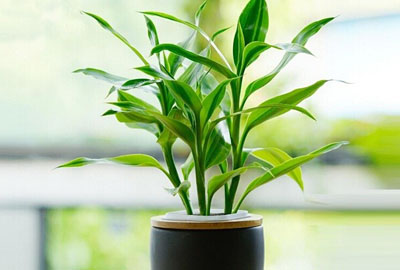
Causes of yellowing leaves in water-grown lucky bamboo
1. Check the water quality, mainly to see whether the roots are fresh. If the roots have rotted due to water quality problems, switch to cooled boiled water.
2. Check the lighting conditions of the location. Too little light, a stuffy and unventilated spot, or dry air can all cause leaves to turn yellow; but if the location receives too much light, it can likewise cause leaves to turn yellow and lose their luster.
Solutions for yellowing leaves in water-grown lucky bamboo
1. Light
If the cause is lighting, first cut off the yellow leaves and also cut away any rotten roots, then create a clean, temperature-appropriate, cool, humid environment with good indirect light for it. If the root rot is caused by unclean water, first cut off the yellow leaves, and when the symptoms are not severe, change the water frequently and place it in a ventilated spot with fairly ample sunlight for restorative care; when the symptoms are severe, appropriately spray pesticide or add a small amount of fungicide to the water container.
Temperature
It is an evergreen woody plant that likes high temperatures and high humidity, and also tolerates shade and waterlogging. It has some cold resistance, but when the winter temperature drops below 10°C, the leaves will turn yellow and fall off.
When it is kept indoors as an ornamental, nutrients are generally not added to the soaking water of lucky bamboo, to prevent the stem nodes from rotting. It is best to grow it in tap water that has been left standing overnight or in cooled boiled water, and it can be changed once every 10 to 15 days, or once every 5 to 7 days in summer, but each time only half needs to be poured out and replaced with fresh water. It is not advisable to change all of it, otherwise the roots will not be able to adapt. If you want water-grown lucky bamboo to keep growing, you can add a small amount of urea and monopotassium phosphate solution to the soaking water, with the concentration controlled at about 0.1%, changing it once every half month, or you can spray the fertilizer solution on the leaves. When it grows many new shoots, diseased shoots and pest-infested shoots should be cut off early, otherwise they will harm the whole pot of lucky bamboo; for weak shoots and "bully shoots," it is also very necessary to thin them appropriately, as long as it does not affect the overall shape and ornamental value of the lucky bamboo. It adds a quiet, warm and happy atmosphere.
Humidity
Lucky bamboo originated in the Canary Islands and the tropical regions of Africa and Asia, and is now widely introduced and cultivated in China. It likes high-temperature and high-humidity environments, is not strict about light, and enjoys light while also tolerating shade. It is suited to well-drained sandy loam. The optimum growing temperature is 20-30°C, and the overwintering temperature is 10°C.
Propagation method
Lucky bamboo is propagated by cuttings. Cuttings are mostly taken at the same time as shaping and pruning. As lucky bamboo grows taller over the years, the leaves at the base of the stem often fall off and the plant shape deteriorates; during the growing season, the stem can be cut into 5-10 cm sections as cuttings, which are inserted into vermiculite or river sand, and generally roots and sprouts appear in 1-2 weeks.
Soil
For potted lucky bamboo, equal parts of leaf mold, garden soil and river sand can be mixed for planting, or coconut coir and leaf mold plus a small amount of base fertilizer can be used as the growing medium. In terms of care, the key is to manage humidity and temperature well. During the growing season, the pot soil should be kept moist frequently, and water should often be sprayed on the leaves to maintain relatively high ambient humidity; overly dry conditions will cause the leaf tips to dry up; in winter the pot soil should not be too wet, but the leaves should still be sprayed with water often, and at the same time attention should be paid to cold protection, so that the leaves do not turn yellow, shrivel and fall off. During the vigorous growing period from May to September, apply liquid fertilizer or granular compound fertilizer 2-3 times a month to keep the leaves green and glossy. It is not strict about light and is suitable for growing in bright indirect light, and direct harsh sunlight should be avoided; if exposed to strong sun or dryness, the leaf surface will become rough and scorched, lacking luster and reducing its ornamental value.