Causes and Control Methods of Bacterial Angular Leaf Spot
According to the Huaping County Organic Late-Maturing Mango Research Center, this year's temperatures in Huaping differ from previous years. In the early period (February to April), temperatures fluctuated between high and low; from May to mid-June, temperatures were relatively high with severe sun exposure, causing severe outbreaks of bacterial angular leaf spot in some mango-growing areas. Growers sprayed pesticides over and over again but still could not bring it under control.
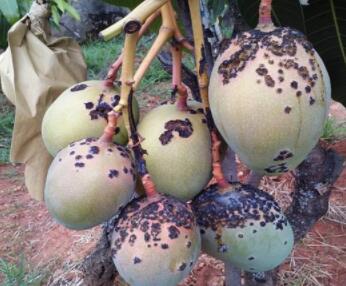
Image from the internet
Bacterial angular leaf spot mainly damages leaves and fruit. When leaves are affected, water-soaked light green spots appear first, then turn light brown, and are angular in shape due to being restricted by leaf veins. In the later stage, the lesions turn grayish-white and are prone to perforation. When humidity is high, white mucus is produced on the lesions. Lesions on stems and fruit are initially water-soaked and nearly round, then turn light gray, with cracks often forming in the center of the lesions, and bacterial ooze is produced under humid conditions. The fruit rots in the later stage and gives off a foul odor.
I. Why is mango angular leaf spot so difficult to control?
In summary, there are the following reasons: 1. The vast majority of growers emphasize treatment over prevention. Most growers rely on spraying pesticides to control mango pests and diseases, spraying only after the disease occurs, commonly using products for controlling bacterial diseases such as
organic copper fungicides, inorganic copper fungicides, agricultural antibiotics, thiazole compounds and microbial preparations, applied by spraying leaves, trees or fruit. Because the pathogenic bacteria lurk inside the tree and, when the disease occurs, exude from the inside out, spraying chemicals can only cure the surface, but the pathogenic bacteria inside the tree are not killed, so once suitable weather occurs, the disease recurs. This chemical control method can only achieve a symptomatic effect; the lesions dry up after 1-2 days and appear to have healed, but whenever rainy or high-humidity weather occurs, the lesions begin to exude bacterial ooze again. This symptomatic-only method that cannot address the root cause requires repeated spraying, costing time, effort and money, yet the effect is still not obvious.
2. Poor awareness of prevention and protection. Some growers casually discard diseased branches, leaves and fruit during production, and year after year, the sources of disease in the orchard accumulate excessively, making outbreaks very difficult to control once they occur.
3. Angular leaf spot can spread through the air. Growers generally control disease on a single-plot, single-treatment basis, making coordinated regional control difficult. However, growing areas are mostly contiguous, with orchards connected to one another, so once adverse weather occurs, a large area becomes affected.
4. Unscientific use of chemicals. Many growers do not adequately understand chemical use, often causing phytotoxicity, and phytotoxicity can also trigger large-scale outbreaks of angular leaf spot.
II. How to scientifically prevent and control mango bacterial angular leaf spot?
First, one must understand the occurrence pattern of bacterial angular leaf spot, understand the disease-inducing factors, and adopt corresponding effective control measures, with prevention as the main approach and integrated control, so that the disease can be controlled at the bud stage and achieve twice the result with half the effort. Bacterial angular leaf spot, also known as bacterial black spot or bacterial canker, is an important and commonly occurring mango disease. It often causes large numbers of leaf spots and fruit spots, seriously affecting tree growth as well as fruit appearance and commercial value. Anthracnose fungi and stem-end rot fungi often invade fruit through the lesions, inducing massive fruit rot during storage.
(1) Symptoms: Angular leaf spot mainly damages mango leaves, branches, flower buds, flowers and fruit.
On leaves, water-soaked small spots appear first, gradually expanding and turning dark brown; the edges of the expanding lesions are often restricted by leaf veins and become angular, and sometimes multiple lesions merge into larger lesions. The surface of the lesions is slightly raised, often surrounded by a yellow halo, and the midrib and petiole of leaves can also be affected and split longitudinally. On branches, the lesions are dark brown and canker-like; when the lesions expand and encircle a young branch, the shoot can die. On fruit, water-soaked small spots appear initially, then expand and turn dark brown, with a raised surface and cankerous cracking. The common symptoms of affected parts are: dark brown lesions, raised surface, often with a yellow halo around the lesions, and under high humidity the diseased tissue often exudes sticky fluid. In addition, on highly susceptible varieties, flower buds and leaf buds can also be killed. The wounds formed by this disease can also serve as entry points for anthracnose and stem-end rot fungi, inducing massive fruit rot during storage.
(2) Occurrence pattern: Angular leaf spot is a bacterial disease. Diseased leaves, diseased branches, diseased fruit, diseased plant residues, infected seedlings, and host weeds in or around the orchard are the primary sources of infection for mango bacterial angular leaf spot. The pathogen can spread through airflow, infected seedlings, wind, rainwater and so on. The pathogen invades through wounds and natural openings such as stomata on leaves and fruit, causing disease. The optimum temperature for pathogen development is 20-25°C. High temperature and abundant rain favor the occurrence of this disease. Generally, areas with strong winds, windward zones or low-lying orchards are more severely affected, while wind-sheltered orchards on higher terrain are less affected. At present, the main mango varieties differ somewhat in their resistance to bacterial angular leaf spot, but there is no immune variety.
(3) Control measures
1. Strengthen quarantine. Prevent the pathogen from spreading with infected seedlings, scions and fruit.
2. Implement disease prevention measures well. (1) Strengthen fertilizer and water management, improve the soil environment and strengthen the tree: rationally combine organic fertilizer, biological bacterial fertilizer, medium and trace element fertilizer and functional compound fertilizer to improve the soil environment, enhance the formation of soil aggregates in the orchard, activate soil organic matter, increase beneficial bacteria, suppress and kill harmful pathogenic bacteria in the soil, improve the tree's proper nutrient supply, strengthen tree vigor and improve the overall resistance of the tree. (2) Maintain good orchard sanitation: during production, promptly prune out diseased leaves, diseased branches and diseased fruit, and burn or deeply bury them in a centralized manner; after harvest, remove diseased plant residues from the orchard and do a good job of orchard cleanup to reduce sources of infection. (3) Carry out tree shaping and pruning at the proper time and to an appropriate degree, so that the canopy and orchard remain well ventilated and well lit, reducing the probability of disease. (4) During the dry-wet transition period, that is, before and after wind and rain, promptly spray copper preparations or other bacterial agents 1-2 times in succession for prevention. (5) If it is during the fruiting period, supplement pure organic calcium fertilizer on the leaves 2 times in advance, combined with bacterial agents, which can effectively prevent the occurrence of angular leaf spot.
3. Wind protection. If conditions permit, try planting windbreak forests around the orchard to reduce the impact of strong winds and rainstorms, which can lessen disease occurrence.
4. Remedial measures after disease occurrence. It is recommended to rotate the use of bacterial agents such as organic copper fungicides, inorganic copper fungicides, agricultural antibiotics, thiazole compounds and microbial preparations. Spray at least 2 times in succession, especially after wind and rain, and preferably use bacterial agents each time. A brief introduction to bacterial agents is as follows:
a. Organic copper fungicides: Common organic copper preparations include copper quinoline, copper thiodiazole, copper ammonia complex, copper abietate, copper succinate, copper nonylphenol sulfonate, copper thiosen and so on. This class of fungicides has good control effects on some bacterial diseases. Copper quinoline and copper thiodiazole are used more often. The advantages of this class of fungicides are that they are safer and generally do not cause phytotoxicity, and can also be used during the flowering and young fruit stages; their scope and timing of use are broad, and they can be applied to fruit trees, rice, vegetables and so on; their copper content is relatively low, they do not cause mite proliferation, and copper accumulation is small; they have good miscibility, are convenient to use and reduce burdens. The disadvantage of organic copper preparations is that prices are generally relatively high.
b. Inorganic copper fungicides: Common inorganic copper fungicides include copper hydroxide, cuprous oxide, Bordeaux mixture and copper oxychloride. The advantages of this class of fungicides are fast effects, relatively low price and a comparative cost advantage. Their disadvantages are that they easily cause phytotoxicity and are prohibited or restricted during the flowering and young fruit stages; miscibility is relatively poor, and traditional copper preparations are mostly alkaline and cannot be mixed with other pesticides, so they need to be used alone, increasing labor costs and making it very easy to miss the optimal disease control period. Among them, neutral (PH=7) inorganic copper preparations have better mixing compatibility.
c. Antibiotic fungicides: Antibiotic fungicides include the more commonly used agricultural streptomycin, kasugamycin, zhongshengmycin, jinhomycin, oxytetracycline hydrochloride, cycloheximide and so on, all of which are currently widely used major antibiotic varieties. When using agricultural antibiotics, suitable application methods should be chosen according to different plant diseases. For plant diseases transmitted through soil, they can be used as soil disinfectants; for plant diseases transmitted through seeds and seedlings, antibiotics can be used for soaking, such as seed soaking, root soaking, seedling soaking and so on, or spraying on seedbeds; for diseases on the aboveground parts of agricultural and forestry crops, plants can be sprayed at an appropriate time; when used on fruit trees, they are mainly made into ointments to control bacterial cankers. The advantages of this class of fungicides are that they are relatively widespread on the market and can still sell even without promotion; systemic and therapeutic effects are relatively good. The disadvantage is that they have a long history of use and products have strong resistance.
d. Thiazole compounds: Thiazole compounds include bismerthiazol, zinc thiazole and so on. They were first used to control rice bacterial leaf blight, and in recent years, because the area of cash crops has expanded and bacterial diseases occur commonly, they have regained vitality; this class of compounds has no bactericidal activity in vitro, and control of soil bacteria is limited; homogenized competition is common, and they are common products for controlling plant bacterial diseases. (5) Microbial preparations: Active microbial preparations, such as Paenibacillus polymyxa, Pseudomonas fluorescens, Bacillus subtilis and Bacillus spp., have become newly emerging microbial preparations. Such biological pesticides are generally safe for the environment and can improve soil, and can safeguard the health and safety of food, animals, plants and humans, but farmers' market acceptance is somewhat poorer.