What are the benefits of Paris polyphylla and how should it be grown
Paris polyphylla is a plant in the genus Paris of the family Liliaceae. Also known as Zaoxiu, Chixiu, Chongtai gen, Zhengxiu, Caoheche, Chongtai cao, Baigansui, Jinxian chonglou, Chonglou, Jiudaogu, Yuanyangchong, Zhihuatou, Luosiqi, Hailuoqi, Dengtaiqi, Baiheche, Luotuo sanqi, Tu sanqi, and also known as Qiye lian. Its distinguishing feature is a single flower emerging from a whorl of leaves, and the flower's shape closely resembles its leaves. It can be divided into two parts, the outer whorl of floral parts and the inner whorl of floral parts. The outer whorl of floral parts closely resembles the leaves and has about 6 segments, while the inner whorl of floral parts has about 8 segments. The phyllotaxis of Paris polyphylla is whorled, and the number of leaves varies between individuals, ranging from 4 to 14; "seven leaves" is only part of the name. The flower structure is special: the leaf center opens into a whorl-shaped flower, the calyx is green, and the petals are in the form of thin filamentous bands. In early Taiwan, China, it was used to treat snake venom and sores, ulcers, and toxic swellings.
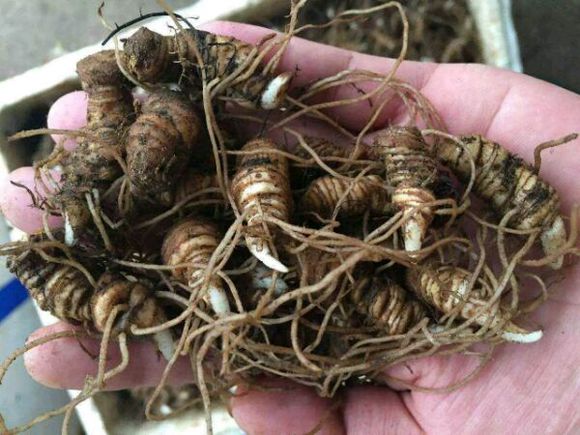
[Benefits] Counteracting toxins and fighting cancer, clearing heat and detoxifying, reducing swelling and relieving pain, clearing heat and calming fright, and relieving cough and calming asthma.
[Indications] Treats carbuncles and swellings, chronic cough from pulmonary tuberculosis, traumatic injuries, snake and insect bites, lymphatic tuberculosis, osteomyelitis, and other conditions; it is one of the main ingredients of Yunnan Baiyao.
[Planting] Seed planting is the main method, but rhizome planting can also be used.
1. Seed planting.
Direct sowing is best, but in order to save seeds and achieve high yields through close planting, seedling raising followed by transplanting can be used.
(1) Direct sowing. In mid to late May, after thorough rain, on a prepared seedbed surface, make small shallow holes 3—5 cm deep with a row spacing of 30—35 cm and a plant spacing of 20—25 cm. Make 4 rows on a narrow bed 130 cm wide and 5 rows on a wide bed 150 cm wide. Before sowing, soak the seeds in cold water for 24 hours, mix with plant ash, and sow. Put 2—3 seeds in each hole. After sowing, cover with 2—3 cm of fertile soil made of half fine manure and half fine soil. If the soil is dry, water promptly. Seedlings sprout and emerge in 7—10 days.
(2) Seedling raising and transplanting. This is an important measure for saving seeds and catching the right season. In early April, choose a seedbed in dry land or vegetable garden land with a water source. Before digging the soil, it is best to use 40% quintozene, 5—10 grams per square meter mixed with fine soil and spread, to disinfect the soil. Then repeatedly dig and turn the topsoil, level and finely prepare the bed surface, open sowing furrows about 5 cm deep on the bed surface at a row spacing of 15 cm, sow in the furrows at a plant spacing of 5 cm, then cover with 3 cm of soil, cover with 2 cm of fine manure, water thoroughly, and cover with plastic film. Seedlings can emerge in 5—7 days. One month after raising seedlings, transplant the small seedlings into the field according to the direct sowing specifications.
2. Rhizome planting.
In autumn and winter, dig up robust rhizomes free of pests and diseases and store them in sand in a cool, dry place. In mid to early April of the following year, take them out and cut them into small sections according to the characteristics of residual sprouting stems and bud scars capable of sprouting, ensuring each section has 1 bud scar. After cutting, dry them appropriately and mix with plant ash, then plant them in rows in a seedbed like sowing, and cover with film. After 15—20 days, once roots and buds have grown, transplant them into the field in mid to late May according to the direct sowing specifications. In mid to late May, thin the direct-sown plots and at the same time check the holes and fill gaps. Before thinning, water first, use a wooden stick to pry out the seedlings, and when filling gaps, water with rooting water, making full use of small seedlings to ensure a full stand and sufficient density. From late May to early June, there is a lot of heavy rain, and the soil easily becomes compacted, so drain promptly, prevent waterlogging, cultivate frequently, loosen the soil shallowly, and always pay attention to removing weeds.
3. Shading
Paris polyphylla prefers shade and fears strong light. Throughout the entire growth period, a light transmittance of 40%—50% is best. Therefore, after emergence and transplanting, shading measures must be taken. Where conditions permit, shade nets are best; where conditions do not permit, inserting branches for shade can be used, and interplanting tall crops such as corn between rows for shade can also be considered, but attention must be paid to density and the interplanting and relay-cropping methods.
4. Earthing up
Paris polyphylla usually follows a growth pattern in which the upper part flowers while the lower tuber expands, generally expanding fastest from mid to late June to August. In early June, a heavy topdressing must be applied, using 2,000—3,000 kg of decomposed farmyard manure per mu, plus 20—30 kg of superphosphate, applied to the roots and then combined with clearing the furrows and earthing up heavily. The soil used for earthing up must be loose, and no standing water should remain on the bed surface or at the bottom of the furrows.
5. Pest and disease control
No insect pests have yet been found on Paris polyphylla, which is related to its mild toxicity. However, in low-temperature and rainy weather or high-temperature and high-humidity weather, it is relatively prone to disease and must be controlled early.
1. Damping-off: This disease affects the seedling stage and is severe in April to May during low-temperature and rainy conditions. In the early stage of the disease, yellow-brown water-soaked lesions appear at the base of the seedling stem and spread around the base, causing the seedlings to wither, and in severe cases patches of seedlings die and fall over.
Control method: Strengthen field management, disinfect the soil, remove diseased seedlings after onset, disinfect the seedbed with chemicals, and spray zineb solution.
2. Sclerotinia disease: This disease is severe. It occurs every year in May when there is much rain and high humidity, harming the base. First a soft rot appearance appears, then white filamentous material appears on the diseased part, after which dark brown granular sclerotia of the pathogen appear around the diseased part, and finally the whole plant dies and falls over.
Control methods:
①. Clear the furrows and drain promptly to reduce field humidity.
②. Remove diseased plants promptly and spread lime at the center of infection.
③. Spray with the pesticides thiophanate or validamycin 2 to 3 times in succession, and in severe cases spray with chlorothalonil.
3. Black spot: The disease starts from the leaf tip or leaf base, producing round or nearly round lesions, and sometimes the disease spreads to the flower axis, forming leaf blight and stem blight.
Control measures:
①Pay attention to drainage and dehumidification, reduce air humidity, and lessen disease occurrence;
②In the early stage of the disease, spray 5% junduqing aqueous solution or 50% thiophanate-methyl suspension concentrate.
4. Stem rot: This disease mostly occurs during the seedbed stage, and is more severe during the field stage in high-temperature and rainy conditions. First, yellow-brown lesions appear at the base of the stem. After the lesions expand, the leaf tips lose water and droop, and in severe cases the stem base becomes wet and rotted and the seedlings fall over.
Control measures:
①Rotate with gramineous crops for more than 3 years;
②Before transplanting, spray the seedbed with 50% carbendazim wettable powder as a "send-off medicine";
③Thin out diseased seedlings;
④In the early stage of disease in the field, drench the holes with 95% dexon wettable powder, once every 10 days, for 2—3 times in succession.
5. Scarab beetles: Adults damage leaves, and larvae (white grubs) bite and feed on rhizomes, affecting the growth of Paris polyphylla.
Control measures:
At night, use torches to trap and kill adults, and use fresh vegetable leaves sprayed with trichlorfon and placed on the bed surface to trap and kill larvae.
Harvesting and processing:
Tubers grown from Paris polyphylla seeds are harvested 5 years later for medicinal use, and tubers grown from rhizomes are harvested 3 years later for medicinal use. Harvesting can be done in autumn before or after the plants fall over, that is, from November—December to before March of the following year. Most Paris polyphylla tubers grow in the topsoil and are easy to dig, but care must be taken to keep the tubers intact. First cut off the stems and leaves, then dig from the side with a hoe, dig out the tubers, shake off the soil, scrub clean with clean water, slice while fresh, with a slice thickness of 2—3 mm, and sun-dry. On cloudy days, they can be dried over a low fire at about 30°C.