How much does a money tree cost? Types and home care methods
The money tree is also known as Malabar chestnut, Gua li, Central American kapok, and goose-foot money. It is also distributed in the tropical regions of southern China. So how much does a money tree cost? What types are there? How do you care for it at home? In fact, the money tree is a popular potted plant; it can be sown when the temperature is above 20°C, and the germination rate from sowing is quite high. Compared with bought cutting-grown potted plants, a money tree you sow yourself is easier to care for.
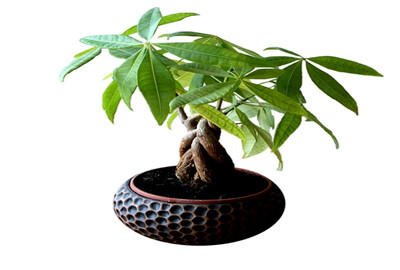
How much does a money tree cost?
1. Small ones, 10 yuan/plant 2. Large ones, 80 yuan/plant
What types of money tree are there?
1. Taiwan money tree
The Taiwan money tree, Chinese name Malabar chestnut, is native to Mexico and is most widely cultivated in Taiwan, China; most of the plants grown in mainland China are introduced from Taiwan, China.
2. Large-leaf money tree
The large-leaf money tree was originally named Queensland umbrella tree and is native to Australia.
3. Money beauty tree
The money beauty tree is Schefflera octophylla, belonging to the Araliaceae family, and is produced in Taiwan, China, Guangdong, Hong Kong, China, Fujian, Hainan Island, and other places.
All three have compound leaves. On the former, most leaf stalks bear six or seven leaflets, but some have eight; because “eight” sounds similar to “fa” (prosper), some flower shop owners prettify the name as “money tree.”
How do you care for it at home?
The money tree is a perennial evergreen shrub, native to the Malay Peninsula and the South Sea Islands. In recent years, through cultivation and selection, it has widely entered urban and rural households in China. For home cultivation, based on its living habits of liking high temperatures and high humidity and being intolerant of frost and dryness, focus on grasping the following four points:
1. Pay attention to sunlight
The money tree likes high temperatures, moisture, and sunlight, and cannot be shaded for long periods. Therefore, during care and management it should be placed in a sunny spot indoors. When placing it, the leaf surface must face the sunlight. Otherwise, because the leaves grow toward the light, the whole branches and leaves will become twisted. In addition, every 3 to 5 days, spray water on the leaves once with a spray bottle; this not only helps photosynthesis proceed but also makes the branches and leaves look more attractive.
2. Pay attention to watering
Watering is an important part of the care and management process. With too little water, branch and leaf development stagnates; with too much water, root rot and death may result; with a moderate amount of water, the branches and leaves become plump. The first principle of watering is to prefer moist over dry; the second is “two more, two less,” namely, water more in the high-temperature summer season and water less in winter; water more for large and medium plants in vigorous growth and water less for newly potted small plants. When the amount of water is too large, the plant is prone to root rot, causing the leaves to droop, lose their luster, and even fall off. At this point, immediately move it to a cool place, reduce the amount of water to the minimum, as long as the potting soil is not dry, spray water on the leaf surface multiple times a day with a spray bottle, stop fertilizer water, and after about 15 to 20 days it can gradually recover.
3. Pay attention to fertilizing
The money tree is a flowering plant that likes fertilizer, and its demand for fertilizer is greater than that of common other flowering plants. When repotting each year, the proportion of fertilized soil can account for 1/3, or even more. Fertilized soil has a wide range of sources; you can collect leaf mold from broadleaf tree fallen leaves, add a little garden soil and mixed bone meal and soybean cake residue to prepare it. This fertilized soil is highly effective, convenient, and easy to obtain, but care should be taken to fully decompose it, so as not to “burn” the leaves yellow. In addition, during the money tree's growing season (May to September), every 15 days, apply once a decomposed liquid fertilizer or a mixed flower-growing fertilizer to promote deep roots and lush leaves.
4. Pay attention to temperature and humidity
The money tree has relatively high requirements for temperature and humidity. If the temperature is relatively low or humidity is lacking, leaf drop often occurs, and in severe cases the branches become bare, which not only hinders ornamental value but also very easily causes the plant to die. Therefore, when cultivating it, pay attention to maintaining a temperature above 15°C, and frequently spray water on the branches and leaves to increase the necessary humidity. In late autumn and winter, pay attention to overwintering cold protection and freeze protection management.
Landscape uses of the money tree:
1. As a stump landscape tree
Because the money tree has a very strong sprouting rate, after some pruning work it can quickly grow new branches and leaves, so the money tree can always maintain a lush appearance. To use the money tree as a uniquely shaped stump landscape tree, during the young plant stage you need to bend and tie 3~5 plants or braid and tie them, and after the money tree grows larger, carry out trunk truncation treatment.
2. As a courtyard shade tree
In landscaping, the money tree can be used as a courtyard shade tree for shade. In early landscaping, the money tree was often planted alone or in opposite pairs to create a cool, comfortable garden environment and block the scorching sun. Later, the money tree was used in garden green spaces, and it is also often planted in some scenic spots. The money tree is an evergreen tall tree, can grow a trunk of 10m, and has a large crown width, forming a large green shade that can block the scorching sun, regulate temperature, and bring a good, highly comfortable resting environment. The money tree's leaves are flat and spreading, have no unpleasant odor, and it has strong growth and reproductive ability and can adapt to different ecological environments; the money tree's tree shape also has high ornamental value, and these characteristics determine that it can be widely used by landscaping workers. When specifically applying it as a courtyard shade tree, you can decide whether to plant the money tree in opposite pairs, alone, or in groups according to the actual size of the garden site and the height of surrounding buildings.
3. As a street tree
In garden greening work, the money tree can be used as a street tree. The money tree is a tree species that roots easily, has a developed root system, and can itself store a large amount of water; it needs little water and has strong drought tolerance, so it does not need frequent irrigation; the money tree has strong growth ability and few pests and diseases, and is easy to manage and protect in gardens; the money tree has strong adaptability, a wide application range, and rapid growth, and can undergo repeated pruning work; its tree shape is attractive and its crown width is large, so it can form a large green shade, making it very suitable as a street tree, cultivated in green belts of sidewalks or in greenways such as median dividing lines, where it can very well improve the overall ecological quality of the garden environment. For a money tree used as a street tree, it needs to grow according to its natural tree shape, and the seven branch points need to have a high height to satisfy the normal passage of pedestrians and vehicles on the road. When the street surface is relatively narrow or large vehicles need to pass, the money tree's branch point needs to be kept above 3.0~3.5m. When the street surface is relatively wide or it is in a pedestrian commercial street, the money tree's branch point can be kept between 2.5~3.0m. When the turning radius of the street is very small or there is no good field of view, the money tree should not be planted on the street, to prevent the money tree from blocking the sight lines of pedestrians or vehicle drivers.
The flower language of the money tree:
1. Bringing in wealth and treasure
Placing a pot of money tree in the southeast direction helps bring in wealth and treasure. Clear away the clutter piled in the southeast position, then move away metal-element items that would destroy wood-element energy, and you can begin planning the wealth-attracting feng shui of the southeast position. Colors that strengthen the energy of the southeast position include deep blue, which belongs to water, and green, which belongs to wood; the money tree is the best choice.
2. Feng shui meaning
Placing a money tree in a feng shui position will make the whole family more spirited. Feng shui positions are very suitable for placing potted landscapes to enhance wood-element energy. The potted landscape should be kept healthy and lush; avoid using dried flowers, because they accumulate yin energy. The money tree is the most popular choice.
3. Meaning wealth
The meaning of the name is self-evident: wealth. Because the money tree's thick leaves are rich in water, it needs a lot of sunlight and very little water. In winter, the money tree enters a dormant state and needs even less water; any fertilizer rich in potassium is suitable for the money tree. If you are lucky, the money tree will bloom in December or July, and at this time unexpected wealth is very likely to arrive.
4. Money nourishes money
Pressing a large-denomination banknote under the money tree will have the effect of using money to nourish money. The money tree is already an ornamental item with great symbolic meaning, and with money placed underneath, it is even more conducive to gathering wealth.