A Detailed Guide to Growing and Caring for Forget-Me-Nots at Home
Forget-me-nots bear small light-blue flowers that are fresh and delightful. They have great ornamental value, and many people ask whether forget-me-nots can be grown at home and how to plant and care for them. In fact, they are extremely adaptable, prefer a dry, cool climate, and are very easy to grow.
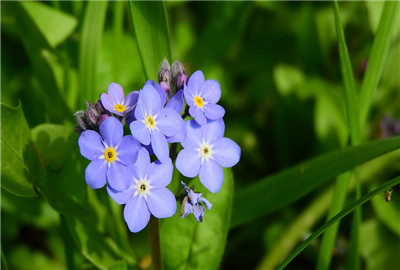
I. How do you grow forget-me-nots?
Forget-me-nots can be propagated in two ways: sowing seeds and raising seedlings through tissue culture. Sowing is generally done from September to January of the following year. The seeds are light-sensitive (photophobic), so after broadcasting the seeds, cover them with a little soil and maintain moisture. Under the optimum temperature of 15-°20℃, they germinate in 10 to 15 days. When sowing, be careful that the temperature does not exceed 25℃. After the seedlings emerge, ventilation is needed. Transplant when the seedlings have more than 5 true leaves. Tissue-cultured seedlings produced through tissue culture techniques are transplanted when they have 4 to 6 leaves.
II. Forget-Me-Not Planting Methods and Care
1. Soil
Forget-me-nots are not demanding about soil, but a loose, breathable, deep sandy loam is best. Before planting, adjust the soil pH so that it is slightly alkaline. Base fertilizer accounts for 70% of the total fertilizer amount; calculated per 100 sq m of planting bed, it should contain 1.75 kg of nitrogen, 2.0 kg of phosphorus, 2.1 kg of potassium, and 0.14 kg of boron. Use slow-release compound fertilizer and decomposed organic fertilizer as the base fertilizer, and after application, mix it evenly into the soil. Level the ground and make beds about 20 cm high. The planting spacing is 30 cm × 40 cm, in staggered double rows. If planting 3 rows, arrange the 3 rows in a staggered pattern to help ventilation and light penetration. Do not plant seedlings too deep; the planting depth should be such that the root crown is level with the soil surface. Water thoroughly promptly after planting.
2. Fertilizing
For the total amount of fertilizer used during the growing period of forget-me-nots, 70% of the nitrogen, potassium, and other nutrients is applied as base fertilizer, and 30% as top dressing; all phosphorus fertilizer is applied as base fertilizer. Top dressing is generally applied once per season. Applying potassium and boron fertilizer during the flowering period helps improve the quality and yield of cut flowers. Forget-me-nots prefer a dry environment with good drainage and are intolerant of waterlogging. Watering should be properly controlled throughout the entire growth period; otherwise, flower quality and yield will decline.
3. Temperature
Forget-me-nots prefer a cool environment and fear high temperatures. During cultivation, it is best to keep the ambient temperature between 12 and 20℃. Forget-me-not plants are fairly cold-resistant. Under the natural winter temperature conditions in Kunming, some varieties can overwinter outdoors. For most varieties, as long as the root system has grown sufficiently before winter, even if all the aboveground leaves die, the perennial roots will still sprout and bloom the following spring. However, flowering in forget-me-nots is extremely sensitive to low temperatures: only when daytime temperatures reach above 20℃ and nighttime temperatures are not below 10℃ can the flower stems grow and bloom.
4. Light
Forget-me-nots must grow under sufficient sunlight to grow normally. If the environment is shady, the clumps may be lush, but they produce few flowering stems. Therefore, plants should receive more than 4 hours of sunlight per day. If full sun can be ensured, growth will be even better.
5. Pest and Disease Control
Diseases of forget-me-nots include gray mold, powdery mildew, and viral diseases. Gray mold can be controlled by spraying 800-1000 times diluted chlorothalonil or thiophanate-methyl 3 to 4 times in succession. Powdery mildew can be controlled by spraying fenarimol and similar products. For viral diseases, the main measures are promptly removing and burning diseased plants and spraying insecticides to prevent insect transmission. Scale insects are the most common pest of Monstera deliciosa; when few, they can be cleaned off with an old toothbrush and then sprayed with a 1000-fold dilution of 40% omethoate emulsifiable concentrate.
III. Main Value of Forget-Me-Nots
Forget-me-nots have the effects of clearing heat and detoxifying, calming the heart and brightening the eyes, and nourishing yin and tonifying the kidneys. They are used for lung-related wind acne, boils and swellings, rough skin, blurred vision, constipation, and scanty dark-yellow urine, among other conditions. They have the effects of nourishing yin and tonifying the kidneys, beautifying the skin, enriching and nourishing the blood, and can promote the body's metabolism, delay cell aging, enhance immune capacity, and have antiviral and anti-cancer effects. They are also used in the treatment of conditions such as freckles and acne, low immunity, viral infections, and insufficient blood supply to the heart and brain. In addition, they can whiten the skin, clear the liver and brighten the eyes, nourish yin and tonify the kidneys, promote the body's metabolism, delay cell aging, and improve immunity. They contain vitamin C, help eliminate excess fat, and prevent the formation of wrinkles and dark spots.
Floral Meaning:
Flower language: eternal love, deep affection and friendship, a heart that never changes, everlasting memories.
Symbolism: “Please do not forget my sincere love” or it represents “Please think of me; with faithful hope that everything is not yet too late, I will return again to give you happiness.”