Where is the areca palm suitable for planting, and how does it differ from the palm tree?
We often see pre-packaged areca nuts at store counters, but in everyday life we rarely see the areca palm tree. It is mainly distributed in Central Africa and Southeast Asia. It has been introduced and cultivated in China for 1500 years, with more cultivation in the two provinces of Hainan and Taiwan, China, and it is also cultivated in Guangxi, Yunnan, Fujian and other provinces (regions). So where can the areca palm be planted? According to data, the areca palm likes a high-temperature, humid climate, tolerates fertilizer, and is not cold-tolerant. At 16°C it already shows leaf drop, and at 5°C it suffers cold damage. The most suitable growth temperature is 25-28°C. Areas with annual rainfall of 1500-2200mm are suitable for growth. During the seedling stage, 50%-60% shade is appropriate, while adult trees should have full light. Cultivation is best on sandy loam with deep soil layers and rich organic matter.
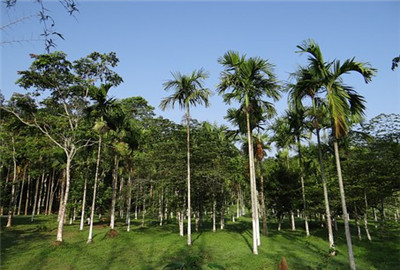
Differences between the areca palm and the palm tree
(1) Areca palm
① The stem is upright, tree-like, more than 10 m tall, up to 30 m at the highest, with obvious ring-shaped leaf scars.
The leaves cluster at the top of the stem, 1.3-2 m long, with many pinnae, hairless on both sides, narrowly lanceolate, 30-60 cm long and 2.5-4 cm wide; the upper pinnae are connate, with irregular toothed splits at the apex. Monoecious; the inflorescence is much branched, the inflorescence axis stout and flattened, the branches flexuous, 25-30 cm long, the upper part slender, bearing male flowers in 1 or 2 rows, while female flowers are solitary at the base of the branches; male flowers small, sessile, usually solitary, rarely paired, sepals ovate, less than 1 mm long, petals oblong, 4-6 mm long, stamens 6, filaments short, rudimentary pistil 3, linear; female flowers larger, sepals ovate, petals nearly round, 1.2-1.5 cm long, staminodes 6, connate; ovary oblong. Fruit oblong or ovoid, 3-5 cm long, orange-yellow, mesocarp thick, fibrous. Seed ovate, base truncate, endosperm ruminate, embryo basal. Flowering and fruiting period March-April.
② The areca palm is mainly distributed in Central Africa and Southeast Asia, such as India, Pakistan, Sri Lanka, the Malay Peninsula, New Guinea, Indonesia, the Philippines, Myanmar, Thailand, Vietnam, Cambodia and other countries. It has been introduced and cultivated in China for 1500 years, with more cultivation in the two provinces of Hainan and Taiwan, China, and it is also cultivated in Guangxi, Yunnan, Fujian and other provinces (regions).
③ It likes a high-temperature and humid climate, tolerates fertilizer, and is not cold-tolerant. At 16°C it already shows leaf drop, and at 5°C it suffers cold damage. The most suitable growth temperature is 25-28°C. Areas with annual rainfall of 1500-2200mm are suitable for growth. During the seedling stage, 50%-60% shade is appropriate, while adult trees should have full light. Cultivation is best on sandy loam with deep soil layers and rich organic matter. The seeds have the characteristic of after-ripening within the fruit.
(2) Palm tree
① The palm tree is an evergreen tree. The trunk is cylindrical, up to 10 m tall, with a stem diameter of up to 24 cm. Old leaf stalks and the lower leaf sheaths often remain; the leaves rise upright at the top of the trunk, fan-shaped, nearly circular, 50-70 cm across, with palmate splits reaching deep into the middle-lower part; the petiole is 40-100 cm long, with obvious fine teeth on both sides. Dioecious; the conical spadix is axillary, with small yellow flowers. The drupe is kidney-shaped and spherical, about 1 cm across, blue-brown, covered with white powder. Flowering period April-May, fruit ripening October-November.
② The palm tree is native to China. Except for Tibet, it is distributed in areas south of the Qinling Mountains in China, from southern Shaanxi in the north, to Guangdong, Guangxi and Yunnan in the south, to the Tibet border in the west, and to Shanghai and Zhejiang in the east. From the Yangtze River estuary, it is widely distributed along a 500-kilometer belt on the west bank of the upper Yangtze River.
③ The palm is the most widely distributed and highest-latitude species of the palm family in China. It likes a warm and humid climate and sunlight. It is extremely cold-tolerant and slightly shade-tolerant. It is suitable for growing in well-drained, moist and fertile neutral, calcareous or slightly acidic soil, tolerates light salinity-alkalinity, and also tolerates a certain degree of drought and waterlogging. It has strong resistance to air pollution. It is prone to windthrow and grows slowly.