What does the mimosa plant look like, and is it toxic? A complete guide to care methods in one article
Mimosa (Mimosa pudica) is a perennial herb or subshrub in the Fabaceae family. Because its leaves respond to heat and light and close immediately when touched by an external force, it is named mimosa. So what does the mimosa plant look like? Is it toxic? How do you care for it? Let's take a look right away.
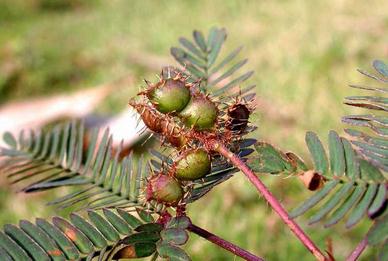
The flowers, leaves and pods of the mimosa all have good ornamental value, and it is relatively easy to keep alive, making it suitable as a potted flower for balconies and indoor spaces (eating it or excessive contact with mimosa can also cause hair loss). It can also be grown in courtyards and other places. Unlike ordinary plants, when it is touched by people, its petioles droop and its leaflets close, so people interpret this as “shyness”, which is why it is called sensitive plant, hehu cao, mimosa, zhixiu cao and pa chou cao (Cantonese). It is native to the tropical regions of South America, prefers warmth and humidity, and has average requirements for soil.
I. What does the mimosa plant look like?
The mimosa resembles a fuzzy ball in shape. After flowering it forms pods, and the fruit is flat and round. The leaves are feather-like compound leaves arranged alternately, in a palmate arrangement. It generally blooms after midsummer, with oblong capitula, 2-3 borne in the leaf axils. The flowers are white or pink, the calyx is bell-shaped with 8 tiny calyx teeth, the petals are four-lobed, there are four stamens, and the ovary is hairless. The pods are flat, with 1 seed per pod segment, and the segments fall off when mature. The flowering period is September.
II. Mimosa flower language
1. Sensitivity, a sensitive heart
2. Shyness
3. Politeness
4. Warm friendship
5. Don't say you love me
6. Knowing shame
A long time ago, there was a poor man named Han. Because he could not endure his sister-in-law's abuse, he left home and went out alone to make his way in the world. He was quite diligent, and within a few years, a heavenly fairy named Huan took a liking to him and was reincarnated to the mortal world. After Huan and Han met, they fell in love and were married. The young couple lived extremely sweetly.
However, their happy days did not last long. Because Han's sister-in-law was jealous of them, she tried every means to destroy the couple, and even viciously wanted her sister-in-law to do hard labor for her. One day, the sister-in-law demanded that Huan come to her house and weave one hundred zhang of cloth for her. At that time, Huan was close to giving birth, but she could not refuse her sister-in-law, so she went. Huan wove cloth for her sister-in-law day and night, but unexpectedly, before the cloth was finished, she was about to give birth. In the end, she had no choice but to wave toward the sky.
Incredibly, a group of fairies flew into the room and wove cloth for her… Before dawn, the cloth had already been finished. Unexpectedly, Han's sister-in-law witnessed everything, and she added exaggerated details as she told Han, scolding Huan for being a demon or monster. And Han actually believed it, and secretly killed her with a chop while she was sleeping. Later, Han discovered that Huan was actually a fairy reincarnated, and he knew he had been wrong. He felt deeply that he had let his wife down, and all day long he was both ashamed and remorseful. In the end, he died from excessive grief.
Later, a plant grew from Han's tombstone. When the wind blew or someone touched it, its leaves would close. Everyone said that this was Han's transformation, and that the leaves opened and closed because of shame. Therefore, this plant was called “mimosa”.
III. Is mimosa toxic?
The entire mimosa plant contains a small amount of toxin. This plant itself contains a substance called mimosine, and if you are in close contact with mimosa for a long time, it can make hair turn yellow and fall out. Grown as a potted plant indoors, it can purify the air and provide ornamental beauty, while also causing slight harm to the body.
During the day, mimosa does not harm the human body, but at night, mimosa cannot carry out photosynthesis and will release toxic substances. Therefore, mimosa placed indoors is best kept on a balcony, to avoid long-term contact causing harm to body and mind.
Compared with indoors, mimosa is more suitable for growing on a balcony or outdoors. Its growth requires strong light, and indoor light conditions cannot meet what mimosa needs to grow. More contact can also harm the human body, and it easily causes mimosa to drop its leaves.
1. Can a family with a pregnant woman keep mimosa?
Mimosa contains an alkaloid, and it is best not to grow it in a home with a pregnant woman. Pregnant women have a weaker constitution, and mimosa can very easily cause hair loss in pregnant women, and in severe cases may lead to miscarriage. Apart from mimosa, in a home with a pregnant woman, growing flowers and plants is generally somewhat unfavorable to the pregnant woman and can affect the fetus in her body.
2. Can a family with children keep mimosa?
Mimosa is delicate and interesting, and it will attract children's interest and attention. Long-term touching of mimosa can damage a child's skin, cause hair follicles to decline, and make hair and eyebrows turn yellow and fall out. Therefore, it is best not to grow mimosa in a home with children.
IV. How do you care for mimosa?
Mimosa is a taproot plant with very few fibrous roots. It is suitable for propagation by sowing, and it is best to use the direct sowing method to avoid damaging the roots when transplanting; if transplanting is necessary, it should be done at the seedling stage, otherwise it is not easy to keep alive. Mimosa grown as an annual is generally sown indoors in early spring.
1. Preparation before sowing: You can direct sow in a small pot, or grow seedlings in a shallow pot and then divide and transplant them. For the sowing soil, mix 2 parts leaf mold, 3 parts garden soil, and 5 parts fine yellow sand after sieving. When sowing, first fill the pot with an appropriate amount of growing medium, level and press it firm, spray thoroughly with a watering can, and sow immediately after the water has completely penetrated.
2. Planting method: For direct sowing in small pots, sow 1~2 seeds per pot. If using a shallow pot to grow seedlings, sow by dibbling at a spacing of 2cm×2cm. After sowing, cover with 3~5cm of soil, just enough to cover the seeds. Cover the pot with glass or plastic film to retain moisture, and place the pot in a bright spot with around 20°C. Afterward, when the potting soil looks dry, water by the immersion method. After about 7~10 days, the seeds germinate and sprout.
3. Seedling care: After the seedlings emerge, remove the covering from the pot and gradually let them receive sunlight. When the seedlings grow to 3cm tall, those sown in shallow pots can be divided and transplanted. When dividing seedlings, transplant with soil, otherwise they are not easy to keep alive. After the newly potted seedlings are watered thoroughly, first place them in a semi-shaded spot, and after they recover, move them to a place with ample sunlight. Those directly sown in small pots can be placed directly in a spot with ample sunlight to grow.
4. Young seedling care: In mid-April in the south and early May in the north, the seedling pots can be moved outdoors to grow, and watered promptly to keep the potting soil moist at all times. When the seedlings grow to 4 leaves, begin applying liquid fertilizer, generally applying a diluted decomposed liquid fertilizer once every 7~10 days. After the seedlings grow larger, they can be repotted once more, but the pot used should not be too large; generally, planting them into a medium-sized flowerpot of 15~20cm is enough.
Precautions
During the growth period of mimosa, along with watering, apply diluted decomposed liquid fertilizer (3-4) times about every 10 days. As a potted ornamental flower, it can easily be moved indoors to a sunny spot, and keeping the room temperature at 0-12 degrees is enough for it to overwinter safely.
Water: It likes moisture; during the summer growing period, water once a day. Fertilizer: At the seedling stage, apply a topdressing once every half month. If you do not want the plant shape to become too large, reduce the amount of fertilizer.
Soil: It requires deep, fertile, moist soil.
Temperature: It is not cold-tolerant and likes a warm climate; in winter the plant dies back on its own.
Light: It likes ample light and tolerates partial shade slightly.
Propagation: Propagation by sowing. Sow from late March to early April; seedlings grow relatively slowly, and can be planted out when the seedlings are 7-8 cm tall.