What should be noted in the cultivation of Buddhist pine, and how to shape and set its posture?
Buddhist pine (Podocarpus macrophyllus) is an evergreen coniferous tree, reaching up to 20 m tall, distributed across many provinces and regions of China, with very few wild trees, mainly cultivated in gardens as an ornamental tree. So, what should be noted in the cultivation of Buddhist pine? How to shape and set its posture?
I. What should be noted in the cultivation of Buddhist pine?
Buddhist pine prefers a warm, humid, semi-shaded environment. Its cold tolerance is relatively weak. In North China it can only be grown as an indoor potted plant. It grows well by the seaside. Buddhist pine has strong resistance to a variety of toxic gases. The soil should preferably be fertile, well-drained sandy loam.
The potting soil for Buddhist pine is mixed with 2 parts garden soil, 2 parts leaf mold and 2 parts coarse sand. Every 2 years in spring, repot and change the soil for Buddhist pine once, and at the same time carry out appropriate pruning, cutting off dead branches, residual branches and diseased leaves to keep the plant shape neat and well-proportioned. During the peak growing season, fertilize Buddhist pine 3-4 times a month; no additional fertilizing is needed in summer and autumn, to prevent excessive growth of branches and leaves that would reduce its cold resistance. For watering Buddhist pine, follow the principle of alternating dry and wet, and do not water too much; in summer, spray water on the leaves once every morning and evening to increase air humidity, and also provide appropriate shading to prevent strong sunlight exposure. In winter, Buddhist pine can be moved indoors, with the temperature required to be between 1-10°C, not too high, otherwise it is unfavorable for the next year's growth.
II. How to shape and set the posture of Buddhist pine?
The geometric shaping of Buddhist pine is relatively simple; you only need to prune according to a pre-designed pattern. For example, when pruning a three-tiered spherical shape, first choose a sapling with an obvious trunk and a relatively good upright form. If the pruning design is a three-tiered spherical shape with a total height of 2 m, then the lower tier is about 50 cm high, the middle tier is about 40 cm high, and the top tier is 30 cm high. It is necessary to cut off all branches on the trunk in the 45 cm between the first and second tiers and the 35 cm between the second and third tiers, and then prune the three spheres. It is advisable for the three spheres, upper, middle and lower, to gradually increase in size, so as to achieve coordinated proportions and better ornamental value. Generally, it is suitable to prune when new shoots grow 20 to 30 cm, and multiple prunings are needed to make each tier of spheres round, full and compact.
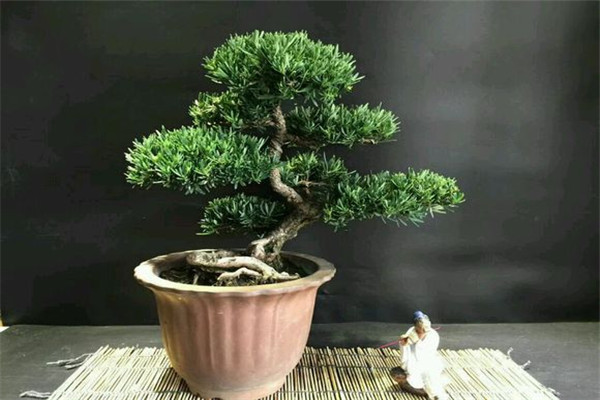
The bonsai-style shaping is much more complex, because the natural shape of each plant is different, and it must be done according to the different materials and their tendencies. A brief overview is given below. Buddhist pine is an evergreen tree and takes shape slowly, so the method of winding with metal wire is generally used to facilitate rapid shaping.
First prepare several aluminum wires of various specifications, select a Buddhist pine with a slightly curved trunk, cut off weak small branches, bar branches, some whorled branches and branches on the lower one third of the trunk, and keep the thick strong side branch above the upper one third of the trunk as the first main branch. Use aluminum wire to wind from the trunk to the first main branch, winding at 45 degrees to the end, then bend the first main branch into an S shape and form an angle of less than 90 degrees with the trunk, bind the small branches with thin aluminum wire so that they are in the same plane as the first main branch, and then prune the whole into an oval shape. After that, bind gradually upward in the same way; generally the main outgoing branches should be on the left and right of the trunk, and a small number of small side branches in front and back can slightly cover it. Usually the first main branch is the thickest and longest, gradually becoming thinner and shorter upward, and then the top is finished in a steamed-bun shape, forming an overall triangular layout. When new shoots grow to 10 cm, they need to be trimmed flat. Depending on the growth situation, generally after half a year to one year the aluminum wire needs to be removed and rebound, to prevent it from embedding into the branches and causing damage. It can take shape in three years.