How do you plant durian, jackfruit, papaya, mango, dragon fruit and avocado seeds?
Durian, jackfruit, mango, papaya, dragon fruit and avocado are all fruits that grow in tropical regions, with high nutritional value and a delicious taste that people love. So do you know how to plant their seeds? Let's find out together below.
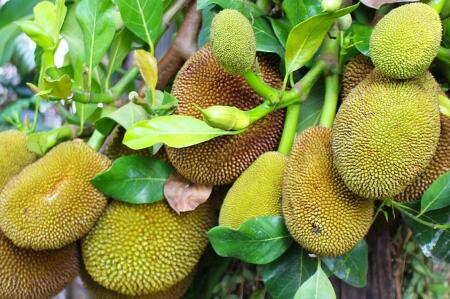
How do you plant durian seeds?
1. Sowing Durian can be sown every year, with spring being the best time. A planting spacing of 20 cm x 20 cm is suitable. During the seedling growth period, attention should be paid to weeding, combined with fertilizing, to promote seedling growth. Excellent mother plants can be propagated by air layering, which roots very easily; from ringing the branch to a finished seedling takes only 60-70 days.
2. Transplanting seedlings When seedlings reach 30-40 cm in height, they can be transplanted, with a spacing of 3 m x 5 m being suitable, applying organic fertilizer, farmyard manure and an appropriate amount of lime as a base fertilizer. They can be transplanted throughout the year, and planting with the soil ball attached is best.
3. Fertilizer management Durian trees need one key round of fertilizing each year, namely the spring flower-bud fertilizer, the summer fruit-swelling fertilizer and the pre-harvest fertilizer, with particular attention to applying the fruit-swelling fertilizer well. After harvesting the fruit, apply organic fertilizer once deeply.
4. Shaping and pruning Because durian trees have very strong sprouting ability, attention should be paid to shaping in the 1-2 years after planting, and timely pruning after harvesting the fruit, to maintain a good tree shape.
5. Harvesting the fruit When the durian fruit turns orange-yellow or orange-red, it is ripe and can be harvested. After harvesting, the fruit cannot be eaten fresh directly; it needs 4-7 days of after-ripening until the flesh becomes soft before it can be eaten.
6. Because durian needs a year-round high-temperature climate to grow and bear fruit, even in equatorial regions, at highlands above 600 m in altitude, due to the drop in temperature, durian cannot be planted or cannot bear fruit.
How do you plant jackfruit seeds?
The key to cultivating jackfruit lies in raising seedlings. Raising seedlings is also divided into two different stages: the cultivation of rootstock seedlings and the cultivation of grafted seedlings. To cultivate jackfruit rootstock seedlings, you must first select seeds and sow them in a sand bed to sprout. Sprouting can be done from June to October every year. For large-scale planting, it can be done in September-October.
1. Seed selection
The first thing before sprouting is, of course, seed selection. For the seeds, it is best to choose seeds of local jackfruit varieties with strong stress resistance and adaptability. Use fresh seeds extracted from the fruit, and the time must not exceed 48 hours. The seeds are required to be mature, plump, smooth on the outside and spotless. No external injuries, no damage from pests or diseases. Using such healthy seeds can ensure the germination rate. After seed selection is completed, proceed with seed treatment.
2. Washing the seeds
The first step in seed treatment is washing the seeds. The selected seeds should be put into clean water immediately, and rubbed and washed by hand, preferably for 2-3 minutes. They must be washed clean. Rub and wash twice like this, to wash off the pulp and sugar on the seeds. If the seeds are cleaned before sowing, ants will not be attracted, and no other pests or diseases will occur.
3. Sterilizing and disinfecting the seeds
After washing the seeds, the seeds must be disinfected. For the disinfecting and sterilizing agent, use carbendazim 500-800 times solution plus Xin Gao Zhi Mo (new high-lipid film) 800 times solution; add 15 kg of clean water to the prepared solution, pour the seeds into the solution, and let the seeds soak for 2-3 minutes. Next, do the preparatory work for sand bed sprouting.
4. Making the sand bed
The area of the sand bed can be determined according to the number of seeds. Use fine river sand for the sprouting bed, with a required humidity of 25%. It should not stick to the hand when squeezed, and should immediately scatter apart; only river sand like this can be considered qualified. First spread 10-15 cm thick sandy soil as the bottom sand; it must be spread flat, and scraping it flat with a thin wooden board is best. For ease of management, generally make a bed surface 10 m long and 1 m wide.
5. Sprouting
Once the bottom sand is spread, slowly spread the treated seeds on the sand bed, and let the seeds scatter so as not to hinder sprouting. After spreading the seeds, cover the seeds with a layer of surface sand. A thickness of about 2 cm is enough. Next, spread a layer of dry branches and weeds over the sprouting bed, to further achieve the purpose of shading and moisture retention, and also to increase temperature.
6. Sand bed management
If the temperature is between 18-30°C, about 20 days of sprouting is enough. If the weather is 8-18°C, sprouting takes about 35 days. Observe the dry and wet condition of the sand bed and water it in time. The number of waterings is not fixed; the principle is to keep the soil surface moist. After sprouting, uncover the weeds. At this point we will see that the young sprouts have grown to 3-5 cm tall.
How do you plant papaya seeds?
1. To grow tropical plants, you need nutrient-rich potting soil, or add 25-50% compost to ordinary soil. As long as drainage is good, there are no special requirements for the soil. Papaya can grow in sandy soil, loam and stony soil.
2. You can dig the seeds out of a papaya, or buy seeds from a garden store. Rub the seeds in a strainer to open the sac outside the seed, but do not rub through the seed. Wash thoroughly, then place on a paper towel and dry in a shady place.
3. You can plant directly in the garden, saving the step of transplanting later; or plant in a flowerpot first, so that after the seeds germinate it is easier to manage the space. Bury the seeds 1.25 cm deep in the soil, with 5 cm between seeds. If you have the space, sow as many as possible to increase the chance of female and male plants germinating. Later you can remove the weak and diseased ones. Before sowing, it is impossible to distinguish whether they are female, male or hermaphroditic.
4. Water more in the first few days after planting, but do not let it overflow the soil. In the following weeks, water when necessary, keeping the soil moist but not soggy.
5. 2-5 weeks after sowing, some seeds will germinate, break through the soil and become seedlings. After observing for 1-2 weeks, remove the thin, shriveled, spotted or otherwise unhealthy seedlings.
6. After the plants flower, remove the excess male plants. If there are still quite a few seedlings left, wait until they grow to about 0.9 m and distinguish their sex.
How do you plant mango seeds?
1. Choose a fully ripe mango; this is very important. Although such a fruit is no longer very tasty, it can ensure that the pit is fully developed and rich in nutrients, and it affects whether the mango seed can ultimately germinate and grow well. Then, use a small knife to cut off all the mango flesh, leaving the seed for later use
2. Use a small knife to pry open the outer shell of the seed, that is, from the small gap at the side, cut it open with the knife, then force it apart into two pieces. Soak the extracted seed embryo in water.
3. Prepare a standard planting soil mix in a flowerpot, then half-bury the seed in the soil
4. Plant the mango seed with the embryo-bearing end facing down into the soil; this helps the seed germinate and protects the embryo from being bitten and damaged by ants or snails. After planting, put the flowerpot in a warm, humid, sunny place, and pay attention to looking after it and keeping the soil moist.
5. Under normal temperature and suitable humidity conditions, on the fifth or sixth day after burying the seed, you should begin to observe whether the mango seed is showing signs of activity; you can see the top of the seed begin to sprout and grow larger day by day.
How do you plant dragon fruit seeds?
1. The germination temperature for dragon fruit seeds is around 25°.
2. Choose a relatively fine-textured potting soil, or you can use commercially available sowing soil instead.
3. Be sure to clean off the pulp and gel attached to the seeds completely, otherwise mold easily grows during germination.
4. To make a small shaped potted plant, the seeds should be spread fairly densely, especially at the edges; otherwise what grows will be sparse and loose, and it will lose its beauty.
5. If the pot has no drainage hole at the bottom, do not water directly with a watering can to avoid overwatering; spraying with a spray bottle once every 2-3 days is enough.
How do you plant avocado seeds?
1. Cut the avocado gently, being careful not to cut the pit; wash clean the pulp remaining on the pit.
2. Stand the seed upright, with the large end of the pit facing down, and insert three to five toothpicks shallowly into the pit, about 5 mm deep is enough.
3. Find a transparent, clean cup and add water; rest the avocado pit with the toothpicks on the rim of the cup, with 1/3 to 1/2 of the pit resting above the water.
4. Put the cup in a well-lit, warm, sunny place, and change the water once every 2-3 days.
5. After about a few days or weeks, the top of the avocado begins to dry and crack, and the seed starts to sprout! Wait another 2-3 weeks, and it begins to grow roots.