A Detailed Guide to the Grafting Time and Methods for Buddhist Pine
Buddhist pine, also known as soil fir, belongs to the Podocarpaceae family and is an evergreen coniferous tree. It is distributed across many provinces and regions of China and is cultivated in gardens as an ornamental tree. So, do you know when Buddhist pine is grafted? What grafting methods are there? According to available information, Buddhist pine is generally grafted about ten days before the beginning of spring, and grafting can be carried out at the end of February or the beginning of March, with a very high success rate.
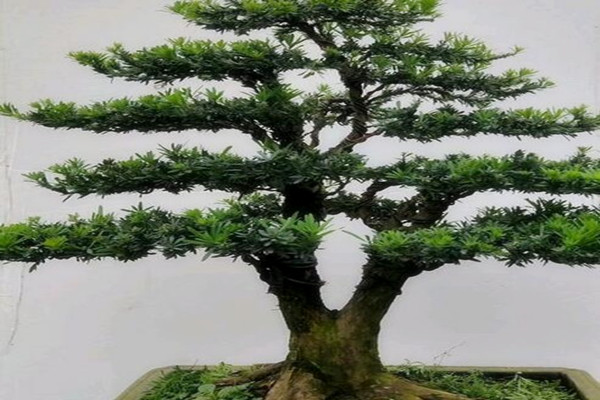
Grafting Methods for Buddhist Pine
1. Tools and materials to prepare before grafting
Single-edged razor blades, because they are sharper and have thinner edges than grafting knives; plastic cling film bags, used to bag the scions and grafted sites to retain moisture; medical disinfecting alcohol, used to disinfect and sterilize the grafting blade; nylon cord, used to tie and secure the scions.
2. Softwood grafting method
Use a 2-year-old potted large-leaf Buddhist pine as the rootstock. Before grafting, prune the rootstock appropriately, cutting away opposite branches, front-facing branches, and other branches that are not conducive to shaping. Then select softwood branches of fine-leaf Buddhist pine, 3-4 cm long, as scions; any parts that are too long can be cut into sections and kept for later use. The cutting method for the scions is the same as for conventional grafting. Pay special attention to aligning the cambium of the scion with that of the rootstock. The other operations and post-grafting management are the same as for other grafting methods. If managed properly after grafting, the survival rate can reach about 95%.
3. High-branch grafting method
Use a relatively large large-leaf Buddhist pine as the rootstock, and graft fine-leaf Buddhist pine onto the parts where branches are needed using the cleft grafting method. The specific operation is the same as the general cleft grafting method. However, the survival rate of this grafting method is relatively low, so multiple scions need to be grafted around the same branching site.
4. Side grafting method
Use a 2-year-old or 3-year-old large-leaf Buddhist pine as the rootstock. The specific operation and management are the same as the five-needle pine grafting method. If managed properly, the survival rate of this grafting method can reach about 90%. Regardless of which of the above methods is used for grafting, the scions all need to be bagged to retain moisture. Although fine-leaf Buddhist pine can be grafted throughout the year, if grafting is carried out in the scorching heat of summer or the cold of winter, management must be extremely careful to ensure the survival rate.
5. Pest and disease control
Spray with a 500-fold dilution of 50% thiophanate-methyl wettable powder. Pests include scale insects, red spider mites, and large bagworm moths, which can be killed by spraying with a 1500-fold dilution of 40% omethoate emulsifiable concentrate.
Note: When grafting skills are not yet proficient, it is better to first use 2-3 year old large-leaf Buddhist pine for side grafting, and then from April to July carry out softwood grafting or softwood high grafting, as this helps improve the grafting survival rate.
Main Values of Buddhist Pine
1. The wood is fine and uniform in texture and easy to process. It can be used for furniture, utensils, stationery, and farm tools, etc.
2. A forest-style Buddhist pine bonsai, paired with grazing scenery, can give people the enjoyment of wild charm. If cultivated properly, it can remain flourishing for decades or even a hundred years without decline, becoming an excellent Buddhist pine bonsai.
3. In Guangdong, China, household consumption is the main focus. In Guangdong, households have become the main force in Buddhist pine consumption, with a purchase proportion of about 30%, tending to choose mid-to-high-end products, followed by landscaping units at about 20%, enterprises and institutions at about 20%, collectors at about 15%, and other uses at about 15%.