How much is a jin of money tree seeds, how do you plant them so they sprout, and can you eat them?
The money tree, botanical name Pachira aquatica, is a small tree, 4-5 m tall, with a rather loose crown, and is a very popular indoor foliage plant. So how much is a jin of its seeds? How do you plant them so they sprout? Can you eat them? According to the Changsha flower market, the market price of money tree seeds varies quite a bit, generally around 100-200 yuan per jin. The money tree is native to Mexico in Central America through to Costa Rica; it flowers from April to May, and the fruit ripens from September to October. The capsule is nearly pear-shaped, containing 10-20 seeds, which are large, irregularly shaped and light brown; the seeds germinate naturally after falling to the ground.
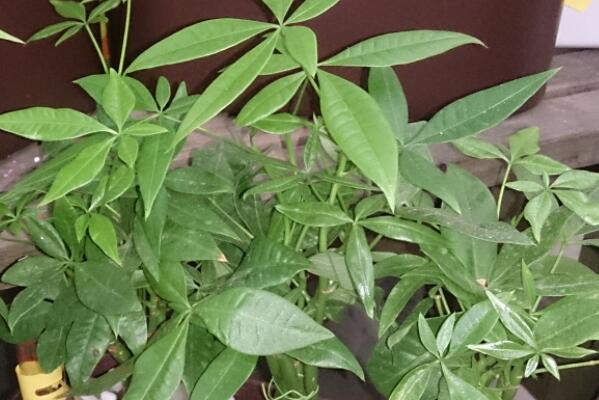
How do you plant money tree seeds so they sprout?
Money tree seeds must be shelled properly. Sowing without shelling them can also work, but germination takes longer and the germination rate is only about 50%, which wastes too many seeds.
1. Once the seeds arrive, shell them promptly (ideally finish shelling them the same day). When shelling, do not tap seeds that have not split open too hard; tap them lightly twice, and leave those that still have not split for 1-2 days before shelling again. Shelling should be divided among several people working together. When shelling, do not strike the seed shell too hard, so as not to damage the embryo of the seed. After shelling, spread the seeds out in a cool, shaded place, so they do not heat up and damage the seed embryos. Sow the seeds as soon as they are shelled; they must not be stored, otherwise the germination rate drops sharply day by day, and after sowing keep them away from cold air. To promote seed germination, raise the germination rate and germination vigour, and avoid seeds carrying bacteria or virus, the seeds need pre-treatment. Soak the seeds for 1 hour in a 500-fold dilution of 50% carbendazim wettable powder, or disinfect the money tree seeds for 10 minutes with a 100-fold formalin solution. The container used for disinfection must not contain acid, alkali, oil, salt or similar substances.
The specific sowing method for money tree:
1. Sowing time: some flower growers wonder when the right time to sow money tree is. In fact, temperature control conditions are plentiful nowadays, so as long as the temperature can be kept above 20°C, you can sow at any time. In places without heating in winter, be careful! In the north, where there is heating, you can ignore this warning.
2. Sowing medium: flower growers can choose according to their own situation; peat, nutrient soil, peat + vermiculite and so on are all fine.
3. Germination time: from sowing to germination generally takes about 10 days, and then you can see the seedlings.
4. Other points to note: after sowing, cover with soil about 1-2 cm deep, water thoroughly after sowing (the pot must drain well, do not let water accumulate), and place in a semi-shaded environment; then decide according to the temperature whether to cover with film. Under conditions of high temperature and high humidity, the germination rate of the seeds will be higher.
5. After germination, when the seedlings grow to 25 cm, flower growers should consider thinning them out, removing weak and diseased seedlings and keeping the high-quality ones. Do not be reluctant to do it; only by thinning can the good seedlings grow better.
Can money tree seeds be eaten?
The money tree is native to Mexico in Central America through to Costa Rica. It is cultivated in Xishuangbanna, Yunnan, China. The fruit peel is edible when unripe, and the seeds can be stir-fried and eaten.
Appendix: How to grow the money tree
1. Light: the money tree should be placed in a spot indoors with plenty of sunlight, and when positioning it, make sure the leaf surface faces the sunlight; it must not be kept in shade for a long time, otherwise the branches and leaves will twist and deform. It is best to spray water on the money tree leaves once every 3 to 5 days, which both helps photosynthesis and makes the branches and leaves more attractive.
2. Watering: the money tree adapts well to moisture. The first principle when watering the money tree is to keep it moist rather than dry; water more in the hot summer season, water less in winter, water more during the vigorous growth period, and water less for small, newly planted specimens. Under normal conditions, watering once every 15 to 20 days is enough.
3. Fertilising: the money tree has a high demand for fertiliser. When repotting, the proportion of fertiliser soil can be one third; fertiliser soil includes a mix of decomposed leaf litter, ground miscellaneous bone, soybean cake residue and so on. During the money tree's growth period (that is, from May to September), apply a decomposed liquid fertiliser or flower-growing fertiliser once every 15 days, so that it develops deep roots and lush leaves.
4. Temperature: if the temperature is too low or the humidity is insufficient, the money tree may drop its leaves, and in serious cases the branches may become bare, and it may even cause the plant to die. Keep the temperature above 15°C and frequently spray the branches and leaves with water to increase humidity. In late autumn and winter, take care to protect it from cold and frost.
5. Repotting: newly acquired money tree plants do not need repotting in the same year, to prevent the tree shape from going off form. The suitable repotting season is spring, and you can also repot in July or August, taking advantage of the plant's semi-dormant state during the high-temperature period. The potting soil requirements are fairly strict; it should be slightly moist and well drained, and an acidic sandy loam containing humus can be used.