How long must a sago palm be grown before it blooms? Detailed guide to care methods and taboos
The sago palm, whose scientific name is Cycas revoluta, also known as bihuojiao, fengweijiao, fengweisong and fengweicao, is a plant of the family Cycadaceae and the genus Cycas. So do you know how long it takes to bloom? How should it be cared for? What taboos are there? From Li Jianhua, a nursery grower in Suqian, Jiangsu, we learned that the sago palm generally blooms and sets seed in the south after about 10 to 20 years. In other regions, because of lower heat, it is very difficult for it to bloom, and the flowers generally last about two months; by the fourth month, white fresh fruits grow out, and after one month the fruits ripen and turn orange-red.
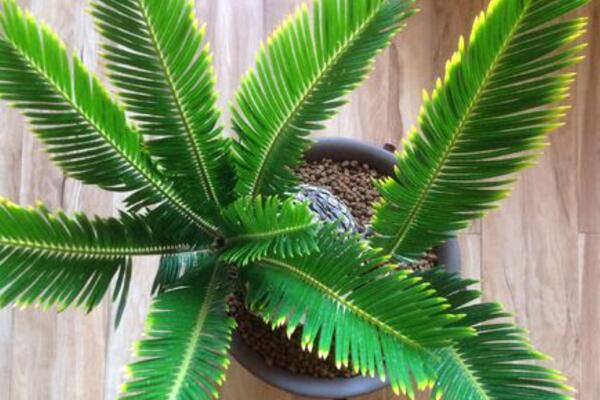
How is the sago palm cared for?
1. Soil selection
The sago palm grows best in fertile, slightly acidic sandy soil. The growing medium can be prepared with 1 part coarse sand and 4 parts garden soil, or 5 parts leaf mold and 1 part fine gravel, or 2 parts sandy soil and 2 parts leaf mold, among other mixes.
The sago palm is a plant that likes iron. When preparing the growing medium, a small amount of iron filings can be mixed in, or in early spring iron filings can be scattered on the pot soil or buried in the pot. The iron gradually seeps in and is absorbed. A 0.5% ferrous sulfate spray can also be used to supplement iron, making the leaves firm and emerald green. Before planting, place a 5 cm thick layer of coarse sand or crushed stone at the bottom of the pot as a drainage layer, and use decomposed soybean cake fertilizer as the base fertilizer. After planting, water thoroughly, place in a cool place for half a month, and then it can be used for ornamental purposes.
2. Fertilization method
During the growing period from May to October, a compound fertilizer or urea can be applied 1 to 2 times per month. Urea is best diluted with water 1000 times and sprayed on the leaves; when applying foliar fertilizer, the principle of “small meals, more often” should be followed. The daily rice-washing water from home, as long as it is not contaminated with oil, can be collected in a bucket or basin, left overnight and then used as liquid fertilizer for watering, and it has a certain fertilizing effect. During the growing period, the sago palm should be given decomposed, diluted soybean cake liquid fertilizer once every 20 days. To make the leaves glossy and deep green, a small amount of ferrous sulfate can be added to the fertilizer water.
3. Watering method
After the temperature stabilizes in late April, move the sago palm pot outdoors and water thoroughly once; afterward, control watering appropriately for a period, and only increase the amount of water after new leaves appear. After the new leaves unfold, the lower withered and yellow leaves should be pruned off to make the plant full of graceful color. In the peak growing period in summer, water once every 1 to 2 days, and apply decomposed cake fertilizer or human waste once a month, to keep the soil with sufficient moisture and nutrients. After autumn begins, the temperature gradually drops, the plant grows more slowly, and it is best to water twice every 3 to 6 days. Before Frost's Descent, move it indoors to overwinter, control watering, and keep the pot soil in a semi-dry state.
The sago palm grows slowly and does not like heavy watering. In particular, in spring, autumn and winter, watering must strictly follow the principle of alternating wet and dry, that is, after watering once, wait until the pot soil looks dry before watering a second time. In summer, except on rainy days, water once a day and spray water on the leaf cluster, but avoid waterlogging, otherwise the roots will rot and cause death.
For watering work, in the vigorous growing seasons of spring and summer, watering can be slightly more to keep the soil moist; after autumn begins, growth gradually slows, so water should be controlled and a certain degree of dryness maintained to facilitate overwintering.
4. Temperature requirements
The suitable growing temperature for the sago palm is 20 to 30°C, but it is relatively tolerant of both high heat and severe cold. In winter, at around minus 5°C, it can still overwinter outdoors; below minus 10°C, protection is needed for overwintering. The sago palm fears snow, so if it snows, move it indoors or cover it with plastic film, otherwise the old leaves will turn yellow the following spring and lose their ornamental value.
The sago palm likes a sunny, highly humid and well-ventilated environment. In the north, it can be moved outdoors in early April and moved into a greenhouse to overwinter before Frost's Descent in November; the room temperature should be kept between 7 and 10°C, but it can also withstand low temperatures of 0 to 5°C without freezing damage.
5. Light requirements
The sago palm relatively likes a sunny, fairly warm and humid environment, and should usually be placed in a spot with direct sunlight. However, potted sago palms cannot withstand harsh sun exposure, especially the new leaves of the sago palm, which are very easily scorched and withered yellow. Therefore, after new leaves grow and in midsummer, a certain amount of shade should be provided.
The sago palm is a sun-loving tree species and is best kept in an environment with sufficient sunlight. In midsummer, when the sunlight is strong around noon, it should be shaded appropriately. Especially during the growth of new leaves, it must not be placed under strong light, otherwise the new leaves will show scorched edges or withered tips.
6. Pest and disease control
① Leaf spot disease: a fungal disease. In hot and rainy weather, this disease spreads easily. After the leaves are infected, small light brown spots first appear, then spread into nearly round or irregular shapes with a diameter of 1 to 5 mm, causing the leaves to wither and break apart. For control, water more with clear water in summer, remove diseased and old leaves promptly, and in the early stage of the disease spray 75% baiyinqing wettable powder at 800 times dilution, or 50% thiophanate wettable powder at 800 times dilution, about once every 10 days, with good results.
② Scale insects: when grown and cared for on a balcony, ventilation and light transmission are not good enough, and the leaves are often easily harmed by scale insects. Repeatedly wipe the affected leaves lightly with alcohol, which can kill adults and larvae; dip a cotton ball in rice vinegar and lightly wipe the affected leaves to kill the scale insects.
What taboos are there in keeping a sago palm?
1. Avoid keeping it on a balcony
If a sago palm is kept on a balcony, it will have a bad effect on overall fortune.
2. Avoid hanging red objects beside the sago palm
The functions of red objects in feng shui include: driving away evil, warding off evil, increasing good fortune, and having the special effect of improving health fortune.
3. Avoid keeping it in an environment with many people
The sago palm does not bloom. Although we now often see sago palms bloom, whenever a sago palm blooms, it is a moment when the surrounding fortune drops significantly.
4. Indoor potted sago palms must never use clayey soil.
The sago palm likes fertilizer, especially iron fertilizer. To keep the leaf color moist, dark green, radiant and glossy, apply a thin liquid fertilizer once or twice in late spring and early summer, with added ferrous sulfate solution. People often use broken iron filings as a base fertilizer. In early spring, place broken iron filings on the pot soil, and through normal watering and care, the iron rusts and gradually seeps into the pot soil, which also has a certain effect.