How much is a pot of Cymbidium sinense? Care methods and solutions for yellowing leaves
Cymbidium sinense, also called the New Year orchid, is a terrestrial plant of the genus Cymbidium in the orchid family. It grows under forests, in shrublands, or in moist but well-drained shaded places beside stream valleys, at an altitude of 300-2000 m. It is distributed in China, India, Myanmar, Vietnam, Thailand, and the Ryukyu Islands of Japan, among other places. So, how much is a pot of Cymbidium sinense? How do you care for it? What should you do if the leaves turn yellow?
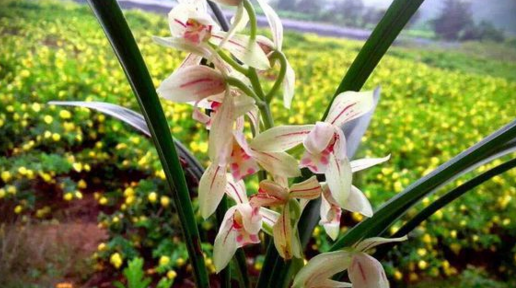
I. How much is a pot of Cymbidium sinense?
According to Mr. Lu of the Zhejiang Flower and Tree Market, the general price of Cymbidium sinense on the market is about 50-150 yuan per pot.
II. How do you care for Cymbidium sinense?
1. Potting
After the pot is chosen, before planting, first cover the drainage hole at the bottom of the pot with a large piece of broken tile, and lay a window screen over it. Then spread coarse mountain soil granules, and the orchid plant can be placed in (the root system of the orchid plant should be distributed evenly and spread out, and should not touch the pot wall). Then fill the pot with humus soil and bury it up to the leaf base of the pseudobulb. On the surface of the soil, cover another layer of white stones or Selaginella uncinata, which is both attractive and helps keep the surface soil moist. Then use the bottom-watering method to make the soil thoroughly wet, take it out, rinse the soil off the leaf surfaces with a spray bottle, place it in a shaded spot to recover, and after one week move it to normal care.
2. Watering
For watering Cymbidium sinense, rainwater or snow water is best. If tap water must be used to water Cymbidium sinense, it must be exposed to the sun for one day before use. Use a spray bottle for watering, and do not spray water into the flower buds, so as to avoid causing rot. In summer, absolutely avoid rain showers hitting it, and film must be used to block the rain. In summer and autumn, water around sunset, and it is best for the leaf surfaces to be dry before nightfall. In winter and spring, watering around sunrise is best, and misting is also needed to increase air humidity to benefit the growth of Cymbidium sinense. During the growing period, a relative air humidity of 75%-80% is needed, and in winter a relative air humidity above 50% is needed. When the surface of the substrate is somewhat dry, water as soon as possible, and do not let it stay too dry for too long.
III. What should you do if the leaves of Cymbidium sinense turn yellow?
1. In winter and spring, watering around sunrise is best, and misting is also needed to increase air humidity to benefit the growth of Cymbidium sinense. In summer and autumn, water around sunset, and it is best for the leaf surfaces to be dry before nightfall.
When the surface of the substrate is somewhat dry, water as soon as possible, and do not let it stay too dry for too long. Also, the watering method must be correct; watering along the edge of the pot is better.
2. Fertilizing should be moderate, not too much. During the growing period, fertilize once a week. In autumn and winter, Cymbidium sinense grows slowly, so fertilizing once every 20 days is enough. When fertilizing, do not pour it onto the leaves. After fertilizing, pour a small amount of clean water to wash away the fertilizer remaining in the soil. Fertilizing must be done in the evening on a sunny day; fertilizing on cloudy days risks root rot.
3. Pay attention to protecting Cymbidium sinense from freezing, and do not place it outdoors in winter. The most suitable temperature for the growth of Cymbidium sinense is 18°C~28°C. Below 10°C in winter, growth slows and it enters dormancy. But the winter temperature also must not be too high; above 25°C will affect the dormancy of Cymbidium sinense and affect the next year's growth.
4. Give it appropriate exposure to more sunlight, especially the morning light before 9 a.m., which is very beneficial to the growth and flowering of orchids. On sunny days in winter and spring, there should be 40%-50% shading, and on sunny days in summer and autumn, there should be 80%-90% shading.