Where does evening primrose grow? Introduction to its effects, functions and cultivation methods
Evening primrose is a species in the genus Oenothera of the family Onagraceae, native to North America (especially Canada and the eastern United States), introduced to Europe early on, and then rapidly spread to temperate and subtropical regions of the world. So, where does evening primrose grow? What effects and functions does it have? How is it cultivated?
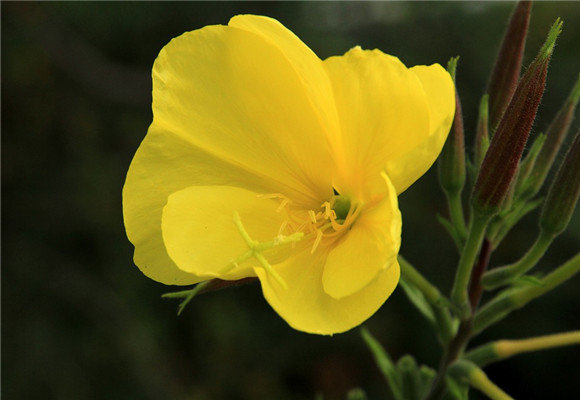
I. Where does evening primrose grow?
Evening primrose often grows on open barren slopes and roadsides. It is drought-tolerant and tolerant of poor soil, and black soil, sandy soil, loess soil, young forest land, mildly saline-alkali land, wasteland, riverbank land and hillside land are all suitable for planting.
II. What effects and functions does evening primrose have?
Evening primrose can dispel wind-dampness and strengthen sinews and bones. It mainly treats wind-cold-dampness impediment; soreness and weakness of sinews and bones, activates blood and unblocks collaterals; extinguishes wind and calms the liver; reduces swelling and promotes healing of sores. It mainly treats chest impediment and heart pain; stroke with hemiplegia; internal stirring of deficient wind; hyperactivity in children; rheumatic numbness and pain; abdominal pain and diarrhea; dysmenorrhea; Houhuo; sores and ulcers; eczema.
III. How is evening primrose cultivated?
1. Land preparation and site selection: For land preparation, evening primrose is naturally vigorous, cold-tolerant, drought-tolerant, tolerant of poor soil, fond of light, and averse to waterlogging. Land with fertile soil and good drainage that previously grew beans or melons and gourds should be selected for planting, and continuous cropping is possible. However, land with residues of herbicides such as chlorsulfuron, chlorimuron-ethyl, Pursuit and clomazone cannot be used to plant evening primrose. For land preparation, bean stubble and mixed stubble can be directly harrowed and ridged in autumn.
2. Sowing time: Sowing can be done in both spring and autumn. The autumn sowing period is from mid-October to before the ground freezes. If there is heavy winter snow, autumn sowing is better than spring sowing; if there is little winter snow, it is likely to cause missing seedlings and broken rows. Spring sowing can be carried out before wheat sowing, when the soil has thawed 2-3 cm. During sowing, because the sowing rate is low, 60 kg of diammonium per hectare is used as a filler mixed with the seed; if this is insufficient, a certain amount of dry sawdust or roasted wheat, rapeseed, etc. can be added for sowing. The sowing depth is 1-2 cm, and it should be done promptly after sowing. The seed rate per hectare is 6 kg, and the seedling stand per hectare is 400,000-500,000 plants. The sowing density must not be too low, otherwise branching will occur and the maturity period will be uneven.
3. Field management: Before the second pair of true leaves unfolds, the seedlings are very similar to weed seedlings and are easily mixed in, so intertillage and weeding cannot be done at this time; it can only be done after the second pair of true leaves has unfolded. When the seedlings grow to 5-6 leaves and there are many grass weeds, haloxyfop and quizalofop-p-ethyl can be sprayed to kill the weeds. During the growth period, 2 rounds of hoeing and 2 cultivations should be carried out. Hoeing and ridging must stop before flowering, and the first round of hoeing and cultivation is carried out when the seedlings cover the ridges. In late July and early August, manual pulling of large weeds is carried out twice so that there are no weeds in the field taller than the evening primrose plants.
4. Evening primrose pests and diseases: For the control of rot disease, after onset the plant roots gradually discolour and rot, the leaves wilt and dry up, and eventually the whole plant dies. Control method: 1% lime water can be used, or 50% thiophanate-methyl 1500 times solution, or 75% chlorothalonil 1000 times solution can be poured on the plants.
5. Harvesting: Evening primrose has an indeterminate inflorescence, and the fruits mature successively. Usually, when 3-4 basal pods have turned yellow and are about to split, this is the best harvest period, specifically in mid-to-late September; if later, the early-maturing fruits will have dried and split. The seeds scatter on their own. Manual harvesting or swathing with a swather can be used. After drying for 5-7 days, a combine harvester can be used to pick up the grain, or manual threshing (beating) can be used. The harvested seeds are suitable for graded cleaning with a grain cleaner to remove impurities, and after drying until the moisture content drops below 11%, they can be bagged for storage or sale.