Where does Cymbidium ensifolium grow? How many times does it bloom a year and how to care for it
Cymbidium ensifolium is native to many parts of China and widely distributed across Southeast Asia and South Asian countries, reaching as far north as Japan. This flower is cultivated and has high horticultural and herbal value. So, where does Cymbidium ensifolium grow? How many times does it bloom a year? How to care for it?
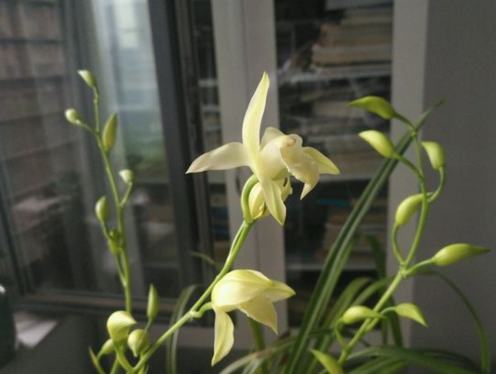
I. Where does Cymbidium ensifolium grow?
Orchids generally grow on the mid-slope valley walls of deep mountains and secluded valleys, on sloped hillsides or in rock crevices with good water permeability and water retention, beside sparse mountain grass, and under the shade of secondary mixed woods. Or in places with shade, short sunlight hours or only scattered flecks of light. In places with high air humidity where air circulates, sometimes they also grow on cliffs beside mountain streams.
II. How many times does Cymbidium ensifolium bloom a year?
The flowering period of Cymbidium ensifolium is usually from June to October, and most can bloom twice a year, with the flowering period from June to October, usually opening in two rounds about one month apart; the first flowering begins in early July, with peak bloom in mid-July; the second flowering begins in early August, with peak bloom in mid-August; plus, one stem bearing many flowers consumes a great deal of nutrients. Therefore, in care, follow the principle of light but frequent fertilizing, and fertilize relatively frequently, so that Cymbidium ensifolium grows robustly and blooms properly.
III. How to care for Cymbidium ensifolium?
Cymbidium ensifolium prefers a warm, humid and semi-shaded environment, has poor cold tolerance, and the overwintering temperature should not be below 3°C. It fears direct strong light, is not tolerant of waterlogging or drought, and is suited to loose, fertile leaf mold with good drainage. Wild Cymbidium ensifolium mostly grows at forest edges on slopes or under sparse woods on hilltops in places full of sunlight. Therefore, Cymbidium ensifolium is an orchid species that relatively likes ample light; in daily care it can be placed in the topmost, most light-exposed spot on the orchid shelves in the orchid room, with as little shading as possible, otherwise it is not easy to produce flowers, and some Cymbidium ensifolium varieties even need full sun exposure in daily care to bloom.
The flowering season of Cymbidium ensifolium is generally in the high-temperature season from July to September, when thrips and aphids are most likely to attack flower buds and flowers, causing buds not to grow, to turn brown and die, and flowers to be gnawed beyond recognition, seriously affecting ornamental value. Therefore, from bud formation to full bloom, Cymbidium ensifolium should rely mainly on prevention, combining prevention and control, and promptly spray pesticides for control to avoid pest damage.
Wild Cymbidium ensifolium mostly grows in the warm, humid subtropical regions south of the Yangtze River, where low temperatures below 0°C rarely occur, so it is relatively afraid of freezing. When cultivated in areas north of the Yangtze River, it should be kept in a closed orchid room in winter, and the temperature must not be below 0°C, otherwise frost damage easily occurs.