When is the best time to propagate figs by cuttings? Detailed explanation of cutting methods and rooting time
Fig, also known as Tian Sheng Zi, is a fruit and medicinal health fruit, generally ripening in autumn and winter, and the market price is around 20 yuan per jin, so it is a bit expensive, for this reason many people use cuttings to plant figs to increase yield. When is the best time to propagate figs by cuttings? How to do cuttings? How long after cutting can they take root?
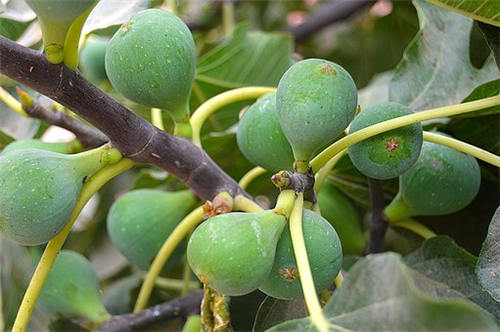
Fig cutting time and rooting time
Environments and climates vary from place to place, so cuttings should be taken in early spring when the plant has just sprouted, that is, when the daytime temperature is around 20 degrees. From the mother plant, select vigorous branches that are l~3 years old and have not yet sprouted, with short internodes and a branch thickness of 1~1.5 cm, cut them into 30~50 cm long cuttings, open a furrow at a row spacing of 50 cm, insert them diagonally into the soil for two-thirds of their length, leaving the rest exposed above the soil, fill and compact the soil, and water to keep the soil moist.
For summer cuttings, semi-lignified green branches can be used for cutting. After cutting, they take root in about 1 month. After 1 year of cultivation, they can be transplanted. The cuttings can also be stored in wet sand for 1 month to form callus tissue before cutting.
Fig cutting methods
Fig branches easily produce adventitious roots, so cutting propagation is mostly used in production. Hardwood cuttings of figs are generally carried out from March to April, when the average daily temperature reaches above 15°C. Select fully mature one- to two-year-old branches (when the cutting diameter reaches 1.5 to 3.0 cm, the cutting survival rate is above 80%). Cut them into 15 cm long cuttings containing two to three plump buds. When cutting the cuttings, cut the upper end of the branch into a flat cut 1 cm away from the bud. Cut the lower end into a slanted cut to increase the contact surface with the soil, which helps rooting and also makes it easy to identify the upper and lower ends of the cutting, so as to avoid inserting it upside down. To promote rooting of the cuttings, soak them in clean water for 12 to 24 hours. The soaking time depends on the degree of water loss of the cuttings; if the cut is relatively fresh and green, the water loss is less and the soaking time can be shorter, while if the cut is whitish, the water loss is greater and the soaking time can be longer. Then soak the base of the cuttings 2 to 4 cm in naphthaleneacetic acid at 200 to 800 mg per liter for 3 minutes. Take them out and dry them in the shade, then wait to insert them. When inserting, the depth into the soil should be about 1/3 of the cutting. After inserting, water and cover with grass; after they survive, pay attention to weeding and topdressing.
Propagation methods
1. Fig propagation: division
Fig division: root suckers often sprout at the root zone. In spring and autumn, dig open the surface soil, dig out the root suckers around the mother plant's root zone together with their roots, and plant them separately.
2. Fig propagation: layering
This method is relatively simple, so it will not be introduced in detail; it is the same as the ordinary layering method for flowers and plants.
Key points for cutting:
1. Selection of cuttings: choose branches that are 1~3 years old and have not yet sprouted, with short internodes and healthy, disease-free growth. The length should be about 30 cm, the cut should be smooth, the knife should be sharp, and do not crush them! Before cutting, soak them in water for three to five days, after which they can be inserted directly, or they can first be buried in wet sand for one month and then taken out for cutting.
2. Selection of soil: sandy loam with fertile soil and soil with high organic matter content are best. Air permeability and water permeability should be good.
3. Cutting process: this is all about the same; fill soil, make holes with a wooden stick, insert the cuttings, generally inserting to a depth of about 2/3. Compact the soil and water thoroughly.
The cutting steps are complete, and what follows is later management: maintain a certain humidity and do not water too frequently. Generally, they can take root in about 15 days. After they are completely established, they can be transplanted. Generally, they can bear fruit in the second year! Then you can eat the figs you grew yourself!