Where is Thalia geniculata originally from, what environment suits it, and how do you grow it in pots?
Thalia geniculata, also known as water bamboo taro and water lotus banana, is a perennial emergent herbaceous plant that produces purple flowers at the tips of its stems, resembling bait tied to a fishing rod, with a very distinctive shape. So, where is Thalia geniculata originally from? What environment suits its growth? How do you grow it in pots?
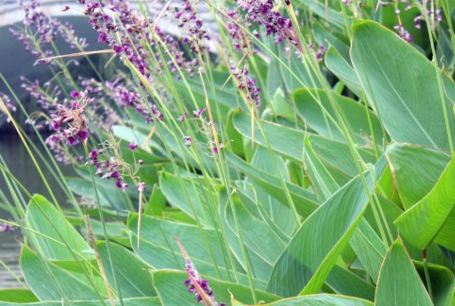
I. Where is Thalia geniculata originally from?
Thalia geniculata is a tropical plant native to the southern United States and Mexico. Main cultivation cities in China: Haikou, Sanya, Qionghai, Kaohsiung, Tainan, Shenzhen, Zhanjiang, Zhongshan, Zhuhai, Macao, China, Hong Kong, China, Nanning, Qinzhou, Beihai, Maoming, Jinghong.
II. What environment suits the growth of Thalia geniculata?
Thalia geniculata mainly grows in waterlogged lowlands such as rivers, paddy fields, ponds, lakes, swamps and coastal mudflats, and is suited to slow-flowing and still water bodies. From shallow water 0.6 m deep to the waterside, it grows well as long as water can cover the base. Thalia geniculata prefers warm, humid and sunny environments, is not tolerant of cold or drought, tolerates partial shade, and grows well in slightly alkaline soil. The optimum growth temperature is 20-30 degC; below 20 degC growth is slow, and below 10 degC it almost stops growing; it can briefly tolerate a low temperature of -5 degC. Below 0 degC the aboveground parts gradually die off, and it overwinters as rhizomes in the mud. Thalia geniculata has a high propagation coefficient, fast growth, strong water and nutrient uptake capacity, and relatively tall plants, so it strongly shades and invades other aquatic plants, and very easily forms a single dominant community of Thalia geniculata.
III. How do you grow Thalia geniculata in pots?
The substrate used for planting Thalia geniculata can be lake or pond silt, or garden soil can be used directly, especially garden topsoil. If raw soil is used, it is best to mix in a certain amount of organic fertilizer as a base fertilizer when planting. If specially prepared artificial nutrient soil is used, it is even more favorable for plant growth. Soilless cultivation methods can also be adopted, such as using substrates like sphagnum moss, peat and vermiculite, combined with the root-wrapping method for cultivation.
For container-grown Thalia geniculata, the water layer should mainly be shallow in spring to help raise the substrate temperature and promote rooting and sprouting; in summer it should mainly be deep to prevent excessively high water temperature from harming the plants. In autumn and winter, water should be appropriately controlled to help it overwinter safely.
Because the nutrient conditions of the substrate in the planting container are limited, in addition to the base fertilizer, the frequency of topdressing must be noticeably greater than in open-field production. "Apply light fertilizer frequently" is the basic principle; the type and concentration of fertilizer should be determined according to the different growth stages of the plant, generally with inorganic fertilizer as the main type, while organic fertilizer should also be appropriately applied as a topdressing.