Typical yield per mu of honeysuckle and its 2018 planting profit prospects, costs and profits
Honeysuckle, also known as Japanese honeysuckle, honeysuckle vine, silver vine, two-color flower vine, erbao vine, right-turning vine, zifeng vine, mandarin duck vine, and erhua, is distributed in every province of China. So what is its typical yield per mu? Is it profitable to grow in 2018? What are the prospects, costs and profits? According to Master Gao, a honeysuckle grower in Anhui, the yield of woody honeysuckle is generally closely related to the number of years of cultivation and the growing conditions. If the environment of the growing area is suitable and cultivation is good, one-year-old seedlings begin to produce flowers in the second year after planting, with a typical yield per mu of about 100 kg, and after reaching full production in three years, the average yield per mu of dried flowers reaches 150-200 kg.
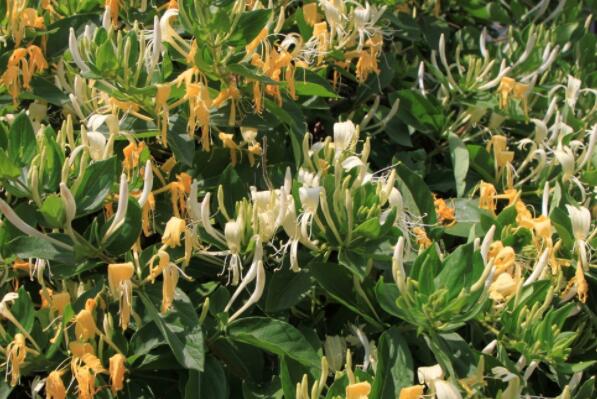
Is it profitable to grow honeysuckle in 2018?
Honeysuckle is an excellent product for modern people's health care and disease prevention. It has fairly high nutritional value, and new honeysuckle products are not only selling well in the domestic market, but are also generally welcomed and favored especially in foreign markets. Honeysuckle is a commonly used bulk variety with demand exceeding ten thousand tons. Because there are many production areas and many specifications, the market is mostly handled by specialized dealers, and under normal circumstances prices are mainly stable. But because it is an essential medicine for clearing heat and detoxifying, every time an epidemic arrives, it always drives price fluctuations, so among commonly used bulk varieties, honeysuckle is also a relatively active variety.
What are the prospects, costs and profits of growing honeysuckle?
Prospects:
Honeysuckle is one of the bulk traditional Chinese medicinal materials and has many economic uses. As usage increases year by year, many areas have carried out large-scale planting, cultivation techniques have continuously improved, and comprehensive development and utilization have gradually deepened, initially forming a honeysuckle industry that has played an important role in adjusting the rural industrial structure and developing local economies. However, due to the lack of comprehensive planning, a complete and systematic industrial chain has not yet been formed, and there are not many flagship products with market competitiveness, which to a certain extent has limited the development of honeysuckle production. Comprehensively analyzing the current state of the honeysuckle industry, identifying existing problems, and further raising its level of industrialization are of great significance for promoting the development of the entire traditional Chinese medicine industry.
Costs:
1. 10% of the total pre-production investment in honeysuckle. For example, if the pre-production investment in growing honeysuckle is 3000 yuan, then 300 yuan should be added to that year's cost.
2. Land rent. Generally 400-600 yuan per mu.
3. Agricultural inputs: pesticides, chemical fertilizers, herbicides, etc., generally about 100 yuan per mu.
4. Depreciation of production tools, depreciated at 10% of total production. These tools include: picking tools, fertilizing tools, spraying tools, cultivating tools, weeding tools, irrigation tools, drying tools, transport tools, storage tools, etc.
5. Labor. This includes labor for fertilizing, weeding, disease and pest control, picking, drying, storage, etc.
Profit:
Let us do the accounts based on a yield of 150 kg of dried flowers per mu. 150 kg is roughly 800 kg of fresh flowers. Assume one person picks 10 kg of fresh flowers, with labor costs at 100 yuan. 800/10*100=8000 (this is the labor cost), plus expenses such as 2000 yuan for medicine, for a total of 10,000. And 150 kg of dried honeysuckle flowers can sell for 15,000 yuan, which means the net income per mu is 5000 yuan. In my view, a net profit of 5000 yuan per mu is already quite good.