What color flowers does winter jasmine bloom? Cuttings propagation and differences from forsythia explained clearly at once
Winter jasmine, also known as Yingchun, Huang Suxin, and golden belt, is a deciduous shrub that grows in clumps, with a flowering period from February to April. It is named because it blooms earliest among all flowers, and after it blooms, spring arrives with all flowers blooming together. So, what color flowers does winter jasmine bloom? Can it be propagated by cuttings? What are the differences between it and forsythia?
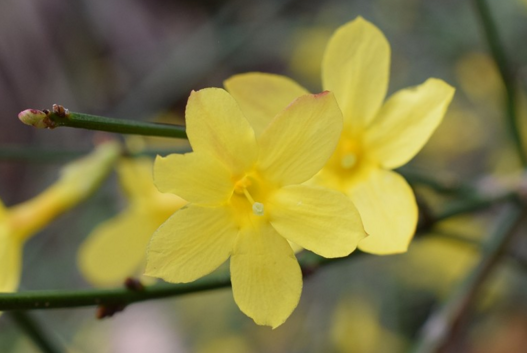
I. What color flowers does winter jasmine bloom?
Winter jasmine blooms small golden-yellow flowers. The flowers are borne singly on branches grown in the previous year and open before the leaves, with a delicate fragrance. Together with plum blossom, narcissus, and camellia, it is called the “Four Friends in the Snow” and is one of the common flowers in China.
II. Can winter jasmine be propagated by cuttings?
Winter jasmine is mainly propagated by cuttings, and can also be propagated by layering and division. Cuttings: can be done in spring, summer, and autumn. Cut semi-lignified branches 12-15 cm long, insert them into sandy soil, keep moist, and they will root in about 15 days. Layering: bury longer branches shallowly in sandy soil, no wounding is needed, they will root after 40-50 days, and in the following spring separate them from the mother plant and transplant. Division: can be done in spring when buds begin to swell. When transplanting in spring, cut off part of the aboveground branches and stems, and keep the original soil. Dry insertion is also possible, that is, insert cuttings in a prepared seedbed and then water thoroughly. Cuttings can be done from mid-October to mid-November or in spring. After rooting, divide and plant, and propagation can also be by division or layering.
III. What are the differences between winter jasmine and forsythia?
1) The old branches of winter jasmine are grayish brown, and the young branches are four-angled, slender, arching in growth, and green. The leaves are all trifoliate compound leaves, growing symmetrically in a cross shape, with smaller leaves, ovate-elliptic, entire, with a narrow and abruptly pointed tip. The flowers are solitary, yellow, salverform, and borne in the leaf axils of branches grown in the previous year. In contrast, forsythia branches are round, the young branches are light brown, the stem is hollow inside, often drooping, and the leaves are larger, ovate to oblong, with neat serrations on the upper part and entire margins on the lower part. Leaves are simple or opposite in threes, among which the terminal leaf is larger and the two lateral leaves are smaller. The flowers are golden yellow, and the petals are wider.
2) The young branches of winter jasmine are green, while the young branches of forsythia are darker in color, generally light brown.
3) Each winter jasmine flower has 6 petals, while forsythia has only 4.
4) Winter jasmine rarely bears fruit, while forsythia bears fruit.