Anthurium growing methods and precautions: Is it toxic? Causes of yellowing leaves with scorched edges and drying
Anthurium, also known as flamingo flower and painter's palette, is deeply loved by everyone because of its broad green leaves, spadix shaped like a Buddhist flame, and petals red as fire, full of auspicious and festive meaning. So how do you grow anthurium? Now let's introduce the growing methods and precautions for anthurium:
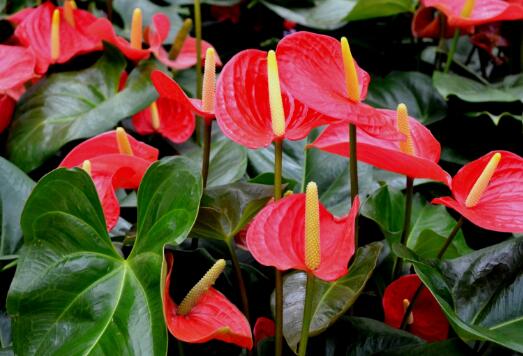
Anthurium is a perennial evergreen herbaceous plant of the Araceae family. Its leaf surface has a waxy layer, and the center of the heart-shaped leaf is decorated with a spadix inflorescence surrounding an orange spiral-shaped spadix, so it is also called “flame rose” or “ox tongue.” It can bloom all year round. Generally, once the plant grows to a certain stage, flower buds can emerge from each leaf axil and bloom.
Anthurium can also absorb waste gases exhaled by the human body and absorb various harmful gases left over from renovations. At the same time, it can keep the air moist and prevent the nasal mucosa from drying out. When anthurium blooms, it looks like a small palm and also like a small flame, making it very suitable for ornamental viewing.
The flower language of anthurium: great prospects, passion, hot blood.
Home cultivation of potted anthurium
Soil selection
Before planting, the soil must be sterilized. However, if the soil you have prepared is professional soil bought from a specialty store, this step can be skipped. Sterilization is to give anthurium a smaller chance of suffering from pests and diseases in the later stages of growth.
Temperature requirements
The most suitable growing temperature for anthurium is 14~35°C. When the winter temperature is below 10°C, anthurium is prone to frost damage, so increase the temperature in time. When the summer temperature is above 35°C, sprinkle water around the anthurium to cool it down. Summer temperatures are high, so pay attention to ventilation and sprinkling water; in winter, cultivate it in a greenhouse.
Light factors
Anthurium likes sunlight. During the vegetative growth stage, increase light to promote growth; during the flowering period, reduce light to prevent the buds from changing color and affecting the ornamental value. During the growing period, it is difficult to bloom if sunlight is insufficient, but anthurium is not suitable for direct sunlight, which can scorch the leaves. The best method is to place the anthurium in a shaded place to receive diffused light, but be careful not to make it too shady. This avoids scorching by strong light while still allowing refracted sunlight for photosynthesis.
Fertilization instructions
Anthurium likes fertilizer and has a higher demand for magnesium fertilizer. It is best to go to a professional flower shop to buy foliar fertilizer with a higher magnesium content for use together. Or choose a water-soluble compound fertilizer diluted into liquid fertilizer to fertilize the anthurium. Anthurium generally uses root topdressing, applying liquid fertilizer about once every seven days. When fertilizing, adhere to the principle of “light fertilizer applied frequently,” preferring less rather than more, because too much will directly burn the seedlings.
Watering matters
Natural rainwater is the best water source for watering flowers; tap water needs to be left to stand. Keep the soil moist often, especially during the medium and large seedling stage, when the demand for water is greater; water less during the flowering period. Watering anthurium needs to be done according to the dryness of the potting soil. The general watering pattern is once every three days in spring and autumn, and once every two days in summer, and note that at noon in summer, use a sprayer to mist the leaf surface to increase humidity. In winter, watering once every 5~7 days is enough; when the weather is cold, water between 9 a.m. and 4 p.m. When watering, pay attention to alternating dry and wet conditions, and avoid watering when there is severe water shortage, which would affect the growth and development of the anthurium.
Control humidity
High temperature and high humidity are the environment anthurium likes. Humidity is related to temperature. When the room temperature is above 28°C, we need to manually increase indoor humidity. You can use a humidifier or sprinkle water to increase humidity. When the temperature is below 20°C, just maintain the indoor environmental humidity; there is no need to water. In winter, even if the indoor temperature is relatively high, it is best not to cool and moisturize too much. If the leaves are too wet at night, the plant's cold resistance will be reduced, causing frost damage and making it unfavorable for overwintering.
Pest and disease control
The pests that most often occur on anthurium are red spider mites, nematodes, cabbage caterpillars, whiteflies, thrips, snails, and scale insects, among which red spider mites, nematodes, and cabbage caterpillars are especially the main ones. However, anthurium is very sensitive to insecticides. If insecticides must be used, it is best to choose low concentrations. One thing to pay special attention to is that all pesticides containing copper, such as dimethoate, dichlorvos, malathion, parathion, and methamidophos, will be toxic to anthurium, so it is best not to use them.
How to prune
In order to prevent the anthurium from consuming too much, we should promptly cut off dead branches and residual branches during the growing period of the anthurium. As for the pruning techniques for anthurium, there is the saying of “three adjustments and two cuts,” namely adjusting direction, adjusting the plant, cutting suckers, cutting flower buds, and cutting old flowers.
Precautions for growing anthurium
Proper humidity for a beautiful posture
When growing anthurium, attention should be paid to moisturizing. Only after truly keeping the humidity needed during the anthurium's growing period under our control can we have enough confidence to let the anthurium grow robustly.
Insufficient sunlight makes blooming difficult
Anthurium likes sunlight. During the growing period, it is difficult to bloom if sunlight is insufficient, but anthurium is not suitable for direct sunlight, which can scorch the leaves. The best method is to place the anthurium in a shaded place to receive diffused light, but be careful not to make it too shady. This avoids scorching by strong light while still allowing refracted sunlight for photosynthesis.
Unsuitable temperature makes it hard to keep alive
When growing anthurium, pay attention to temperature control. The maximum temperature should not exceed 35°C, and the minimum temperature should not be lower than 14°C. Below 10°C, frost damage can occur at any time, so 18°C~28°C is best. Summer temperatures are high, so pay attention to ventilation and sprinkling water; in winter, cultivate it in a greenhouse.
What is going on when anthurium leaves turn yellow, have scorched edges, and dry up
Anthurium leaves turning yellow, with scorched edges and drying up——the plant's own growth
Metabolism
If you find that anthurium leaves are turning yellow, pay attention to observing the condition of the other leaves. If the leaves are fresh, tender, yellow-green, and the flowers are growing well, it means new leaves are growing, and old leaves turning yellow and falling off is a normal phenomenon.
Therefore, during the flowering period, promptly remove old leaves and cut off yellowing leaves. Promptly clean up dead branches on the surface of the potting soil so as not to affect flowering.
Pathogen infection
If anthurium shows symptoms of yellowing and drying leaves, it is very likely to have been harmed by bacteria. You can spray a 0.3% garlic juice solution, 0.2% vinegar, or use special agents such as carbendazim and chlorothalonil for treatment.
Anthurium leaves turning yellow, with scorched edges and drying up——external environment
Unsuitable soil
The soil and water in most northern regions contain relatively high salinity and alkalinity and lack the soluble iron needed for plant growth. If the soil is not changed for a long time, the plant's nutrients will be lacking, and the leaves will gradually lose green color and turn yellow.
You can buy professional acidic soil at a flower shop, or treat the original soil. Add oxalic acid to the soil to change its acidity and alkalinity. You can also water it with acidic water once a week, using diluted lemon water or edible vinegar.
Dry air
The growth of anthurium requires relatively high air humidity. In winter, when the air for indoor flower growing is too dry, leaf tips often dry up and turn yellow, or leaf edges become scorched, or leaf spots and curled edges appear.
According to the growth characteristics of anthurium, appropriately increase air humidity and frequently mist the leaves and the surrounding environment. In winter care, try to keep the plant away from radiators and air conditioner vents.
Insufficient light
If anthurium is placed in a shaded area or a place with insufficient light for a long time, it will lead to weak growth, thin and yellow leaves, and no flowering or very little flowering. During the flowering period, the plant should be placed in a place with ample light but no direct sunlight for care, and the light intensity can be appropriately increased.
Unsuitable temperature
If the indoor temperature is too low in winter, the leaves will turn yellow; if the room temperature is too high, the plant will transpire excessively, and the roots will not be able to supply enough water and nutrients, which will also make the leaves turn yellow. In winter, people usually move the plant indoors to a position near doors and windows. As doors open and close, sudden cold and heat will cause the leaves to turn yellow. Therefore, the indoor temperature should be kept relatively stable.
Anthurium leaves turning yellow, with scorched edges and drying up——artificial care
Overwatering
If the new leaves of anthurium turn yellow while the old leaves remain normal, this situation is generally caused by watering too much and too frequently, making the soil in the pot too wet for a long time, or even waterlogged, causing some fibrous roots to rot, hindering normal respiration and nutrient absorption, and causing the leaves to gradually turn yellow and fall off.
The accumulated water in the pot should be drained in time. If the plant has been in an environment with overly wet soil for a long time, you can take the plant out of the pot, dry the soil, and replant it. After that, water normally, and the leaves will gradually regain their green color.
Uneven fertilization
Too little fertilization, or not changing the pot or soil for a long time, leads to a lack of nutrients such as nitrogen in the soil, causing weak branches and leaves and thin, yellow leaves. In addition, excessive fertilization can also cause new leaves to become thick and uneven, while old leaves dry at the tips, become scorched, and fall off.
If fertilization is too little, add trace mineral elements. You can use complete water-soluble fertilizers such as “Flower Duoduo.” For leaf yellowing caused by excessive fertilization, stop fertilizing immediately and increase watering. In severe cases, you can remove part of the old soil, replace it with new soil, replant, and then manage normally.
Is anthurium toxic?
Flower lovers who want to grow anthurium should first understand whether anthurium is harmful to people. So here the editor wants to tell everyone that anthurium is toxic, but it won't kill you! Anthurium belongs to the Araceae family. Most plants in this family are toxic. Its toxicity is contained in the sap. Usually pay more attention and do not get too close to it. Remember to wash your hands after pruning branches and leaves. Of course, wearing gloves is better.
12