How to care for the Malvaceae money tree? A detailed guide to watering methods, precautions and yellow leaf treatment
The money tree (Pachira aquatica) symbolizes festivity and rolling wealth, and in recent years it has been deeply loved by flower lovers, who place it in homes, offices or shops. So how do you care for a money tree? What are the cultivation methods and precautions? What should you do if the leaves turn yellow?
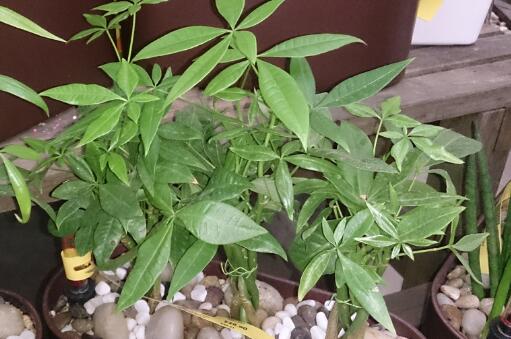
Cultivation methods for the money tree
1. Choosing potting soil for the money tree
Flower pot: most flower lovers know that when growing flowers you should look at the size of the pot, its breathability and its depth, and choose according to the plant's habits. Because the money tree's root system is not well developed, you cannot choose a pot with poor breathability that is too deep and too large and prone to water accumulation, as this easily leads to root rot from watering problems. You can also use the method of a large pot holding a small pot to grow the money tree; this solves both the aesthetic problem and the water accumulation problem.
Soil: the money tree generally uses loose garden soil or peat soil, leaf mold, coarse sand, plus a small amount of compound fertilizer or chicken manure as base fertilizer and culture soil.
2. Water and fertilizer management for the money tree
Watering: watering is an important part of the money tree's care and management. With little water, the branches and leaves grow slowly; with too much water, root rot and death may result; with a moderate amount of water, the branches and leaves are plump. Watering should adhere to the principle of preferring wet over dry, and secondly the “two more, two less” principle, namely water more in the high-temperature summer season and water less in winter; water more for large and medium-sized plants growing vigorously, and water less for newly potted small plants.
Fertilizing: the money tree is a flowering plant that likes fertilizer, and its demand for fertilizer is greater than that of common flowering plants. When repotting each year, apply sufficient base fertilizer, with a fertilizer-to-soil ratio of about 1:3, or even more. May to September is the money tree's growing season; fertilize once every 15 days, using decomposed liquid fertilizer or a mixed flower fertilizer, to promote deep roots and lush leaves
3. Light and temperature for the money tree
Light: the money tree likes high temperatures, humidity and sunlight, and cannot be shaded for long periods. In home care it should be placed in a spot indoors with plenty of sunlight. When placing it, the leaf surface must face the sunlight. Otherwise, because the leaves are phototropic, the whole branch and leaf structure will become distorted. Also, do not move it suddenly from long-term shade into sunlight, as the leaves are easily scorched.
Temperature: the best temperature for money tree growth is between 20 and 30 degrees, so in winter the money tree is rather afraid of cold; when the temperature drops to 10 degrees it should be brought indoors, and below 8 degrees cold damage will occur, with mild cases losing leaves and severe cases dying. In winter, pay attention to doing a good job of cold protection and warmth.
In addition, every 3 to 5 days, use a spray bottle to spray water on the leaves once, to increase leaf moisture and raise air humidity; this both helps photosynthesis and makes the branches and leaves look more attractive.
4. Propagation methods for the money tree
There are mainly two propagation methods for the money tree: sowing or cuttings. Sowing propagation can be carried out as long as the temperature is kept above 20 degrees, and cuttings can be taken from May to June by removing branches as cuttings for propagation.
Precautions for growing the money tree
1. Repotting the money tree
As needed, repot in spring, and prune the branches and leaves once, to promote renewal of branches and leaves.
2. Common pests and diseases of the money tree
The common diseases of the money tree are mainly root rot and leaf blight, and during growth there can also be damage from the larvae of the sugarcane borer moth. In addition, note that the money tree can also show yellowing leaves and leaf drop, so observe promptly and prevent early.
3. Pruning the money tree
If the money tree is planted outdoors, there is no need to prune it; just let it grow. But if it is grown in a pot as a foliage plant, then without timely pruning it is prone to growing too fast and affecting its ornamental value. Timely pruning can control its growth rate and at the same time change its shape, making the plant more ornamental.
Causes of yellowing leaves on the money tree and solutions
Cause one: improper watering
The money tree likes a warm, humid climate, and both overwatering and underwatering can cause the leaves to turn yellow.
When overwatered, the soil in the pot stays too wet for long periods, the money tree's roots cannot breathe freely, the rhizome rots, and this gradually spreads to the branches and stems, and finally the leaves turn yellow, wither and drop, and in severe cases the whole plant dies.
When underwatered, the potting soil is wet on top and dry below, which not only affects nutrient absorption but also causes the leaves to become dull and lusterless and to gradually turn yellow and drop from the bottom upward. The money tree is silently protesting your laziness~
Solution: ventilate promptly, repot or replenish water
When overwatered, place it by the window and ventilate well, and loosen the soil more. If the potting soil cannot dry out in a short time and becomes muddy, you can place a layer of absorbent cotton cloth at the bottom of the flower pot and replace it with a new one once soaked, or use a fan on a low setting. If after trying every method the soil still has not dried, then change the soil.
When underwatered, the soil surface cracks; if it has not all turned yellow, replenish water gradually. First moisten the soil surface, watering a little every hour, gradually watering thoroughly. Avoid watering thoroughly all at once, so that the roots do not swell from absorbing water and affect growth.
Cause two: improper light
The money tree likes sunlight, but it is not tolerant of strong direct light; scorching sun exposure or long-term shade can also cause the leaves to wither and yellow.
Placing the money tree in an indoor corner and placing too much emphasis on ornamental effect, causing the money tree to remain in a shaded environment for a long time, will cause new branches and leaves to grow leggy and pale yellow, and old leaves to become dull and drop in large numbers. In the blazing summer, you can only blow cold air indoors; how can the money tree withstand the impact of the scorching sun? If you forget to move it to a shaded place at noon, then you can only accept the miserable sight of yellowing leaves.
Solution: move it to a semi-shaded place.
For the situation where the money tree's leaves turn yellow due to suddenly receiving sunlight, the chance of saving it is not great. When leaves turn yellow due to excessive sun exposure, the leaves' moisture evaporates severely and it is hard to recover in a short time; it is recommended to move it to a semi-shaded place. With proper watering, the yellowed leaves will slowly drop, and once new buds grow it will be fine.
Cause three: too much fertilizer
If you are impatient, you must be very afraid that the money tree will become malnourished from lack of fertilizer, right? But excessive fertilizing is also no good. The nutrients the money tree absorbs are a fixed amount; if too much fertilizer is applied, after the plant absorbs sufficient nutrients, the remaining fertilizer will scorch the money tree's rhizome, causing the leaves to turn yellow.
Solution: trim the roots and change the soil
When excessive fertilizing causes the money tree's roots to rot, take the plant out of the pot, clean up the rotted parts, change to new soil, and replant. Or dilute the nutrients in the soil by watering, to reduce the fertilizer strength.
Cause four: unsuitable temperature
Some people hate summer and winter, because one has too high a temperature and the other too low; actually plants are the same. The suitable temperature for money tree growth is 20°C~30°C, and too high or too low will affect its growth.
If the temperature in the money tree's growing environment is too high, transpiration is too strong, and the roots cannot supply enough water and nutrients, the leaves will gradually dry up and turn yellow. But if the temperature is too low, for example when the winter temperature is below 16°C, the leaves easily turn yellow and drop, and below 10°C it is very likely to die.
Solution: cool it down or warm it up
In summer, when yellow leaves on the money tree are caused by too high a temperature, promptly move the plant to a cool place and sprinkle water to cool it down; if the yellowing is not serious, it will slowly resume growth. In winter, appropriately raise the care temperature to avoid freezing damage to the plant.
Cause five: pests and diseases
When the money tree is attacked by fungi or bacteria, it triggers leaf spot disease, with local necrosis on the leaves producing yellow patches or spots, and in severe cases the whole leaf withers and yellows and drops.
Not only do pathogens covet the money tree; there are also many pests such as red spider mites and scale insects that can also cause the money tree's leaves to wither and yellow, so observe carefully.
Solution: spray pesticides
Strengthen ventilation and spray pesticides promptly. For different pests and diseases, choose the corresponding fungicide, spraying once every 5~7 days, and after 3~4 sprays it will basically improve. (Recommended agents: carbendazim, chlorothalonil, Huahuashen)
Cause six: branches and leaves too dense
The money tree has strong growth ability, so its branches and leaves grow vigorously. If you do not have the habit of pruning regularly, then the branches and leaves hidden at the bottom will turn yellow and droop due to insufficient light and inability to ventilate.
Solution: prune promptly
Many flower lovers' money trees have grown into a straw hat shape and still are not pruned. As a foliage plant, lush branches and leaves are certainly important for the money tree. But if there are too many leaves and they hinder the plant's growth, then that is your fault.
The money tree grows relatively fast. For potted plants with luxuriant branches and leaves, you can prune off a portion of the branches; there is no need to be reluctant, as new buds will soon grow and the plant will grow even more luxuriantly.
Cause seven: soil on the alkaline side
Soil is an essential factor for money tree growth. Most areas in the north have soil with relatively high salinity and alkalinity, but the money tree likes acidity; not adapting to the soil is a big deal. When the soil lacks the iron element the money tree needs, the result of malnutrition is yellowing leaves.
Solution: acidify the soil
The money tree is suited to growing in acidic soil, and promptly changing the soil's acidity and alkalinity can remedy a yellowing money tree. There is no need to take it out of the pot or change the soil; you only need to apply a certain amount of ferrous sulfate into the soil, sprinkling it directly into the flower pot, which both increases the soil's fertility and acidifies the soil, achieving two things at once.
In the process of acidifying the soil, note that you should not use vinegar. Vinegar can indeed quickly make the soil acidic, but because the method of change is aggressive, it will damage the organic matter in the soil and lower the soil's fertility.
12