Symptoms and Chemical Control of Early Blight and Anthracnose in Tomatoes
Early blight and anthracnose are among the more common tomato diseases, occurring widely in all regions and causing serious harm to tomatoes. So what symptoms do these diseases show? What chemicals should be used? How should they be controlled? Let's take a look below.
Early Blight of Tomatoes
Symptoms:
1. Tomato early blight occurs in Northeast China, North China, East China, Southwest China and other regions. Its most distinctive feature is that the lesions, whether on fruit, leaves or the main stem, all have obvious concentric rings, which is why it is also called ring spot disease. Fruit lesions are often near the fruit stalk, stem lesions are often at the branching points, and leaf lesions occur on the leaf mesophyll.
2. It mainly damages leaves, but can also harm seedlings, stems and fruit. When seedlings are infected, dark brown lesions form at the base of the stem, slightly sunken with concentric rings. When leaves of mature plants are affected, the disease mostly spreads from the lower leaves upward. Initially, water-soaked dark green lesions appear, which after expanding become round or irregular ring-spotted lesions, mostly with a light green or yellow halo at the edges and concentric rings in the center. In humid conditions, a black mold layer (conidia and conidiophores) grows on the lesions, and in severe cases the leaves drop off. When the stem is infected, the lesions are mostly at the branching points and the base of the petioles, appearing as brown to dark brown irregular round or oval lesions, sunken, with concentric rings, sometimes cracking, and in severe cases causing branch breakage. When green fruit is infected, it mostly starts near the calyx, initially as oval or irregular brown or black spots, sunken, and later the fruit cracks, the diseased part is rather hard, and densely covered with a black mold layer. When petioles and fruit stalks are infected, the lesions are grayish brown, elongated oval, slightly sunken.
Control Measures:
1. Selection of varieties
Choose disease-resistant varieties. Varieties such as Diliya, Oudili and Kaixuan 158 are relatively resistant and can be used in severely affected areas. Generally, early-maturing varieties and narrow-leaf varieties are less affected, while tall plants, large seedlings and large-leaf varieties are more affected.
2. Pay attention to crop rotation
Since the pathogen can survive for more than a year, crop rotation should be emphasized. Generally, rotate with non-solanaceous crops for more than two years. When choosing seedling beds, sufficient attention should also be paid.
3. Seed treatment
On the basis of selecting and keeping seeds from disease-free plots and disease-free plants, in addition to combining with the prevention of other diseases, treat the harvested seeds with dry heat at 70°C for 72 hours (note that the seeds should be given a certain after-ripening period after harvest); before sowing, treat with 52°C warm water, allowing it to cool naturally, for 30 minutes, then soak the seeds in cold water to promote germination.
4. Chemical control
(1) Agricultural control
(1) Cultivate strong seedlings: adjust the temperature and humidity of the seedling bed well, and prick out seedlings when they reach the two-leaf-one-heart stage, being careful to prevent the seedlings from growing leggy. This can prevent disease during the seedling stage;
(2) Rotation and stubble change: tomatoes should be grown in a three-year rotation with non-solanaceous crops;
(3) Strengthen field management: adopt high-ridge cultivation, apply fertilizer reasonably, and after transplanting and seedling recovery, ridge up promptly to promote new root growth. In greenhouses, control temperature and humidity well and strengthen ventilation and light transmission management. During the fruiting period, regularly remove lower diseased leaves and bury them deeply or burn them to reduce the chance of disease transmission;
(2) Chemical control
With prevention as the priority, spray chemicals every 7-10 days starting from the seedling stage, and transplant with the chemical treatment. The effect is remarkable.
Treatment chemicals:
1. In the early stage of disease, promptly remove diseased leaves, diseased fruit and severely diseased branches, and begin spraying fungicides. To prevent resistance and improve control efficacy, rotation, alternation or combined use is recommended. Spray once every 7 days, for 2 to 3 consecutive sprays.
2. When the disease is relatively severe, remove the central diseased plants, diseased leaves, etc., and promptly adopt a control method combining Chinese and Western approaches.
3. Strengthen management. Apply sufficient fully decomposed organic base fertilizer and plant at a reasonable density. When cultivating in sheds or greenhouses, pay attention to ventilation and light transmission and reduce humidity. When cultivating in the open field, pay attention to timely drainage after rain. Practice a 2-3 year rotation with non-solanaceous crops. In the early stage, promptly remove diseased leaves and diseased fruit and take them out of the field for centralized destruction. After tomato vines are pulled, promptly clear residual plants, fallen flowers and fallen fruit from the field, and combine with plowing the soil to do a good job of field sanitation.
4. In greenhouses, pay attention to heat preservation and ventilation. After each watering, ventilation must be carried out to reduce the air humidity inside the greenhouse. Especially when transplanting in early spring, the day-night temperature difference is large and relative humidity is high, making condensation likely, which favors the occurrence and spread of this disease. Therefore, properly coordinating water, heat and air inside the greenhouse is an effective means of preventing early blight.
Anthracnose of Tomatoes
Symptoms:
1. The anthracnose pathogen infects before the fruit colors and remains latent until after coloring, when disease develops. Initially, transparent small spots appear, and then the lesions gradually expand and turn black, slightly sunken, with small black dots borne on them. Under humid conditions, the diseased part also secretes red slime, and finally the fruit rots and drops off. In the middle and late growth stages and during storage, transport and sales after harvest, it can also cause fruit rot and losses.
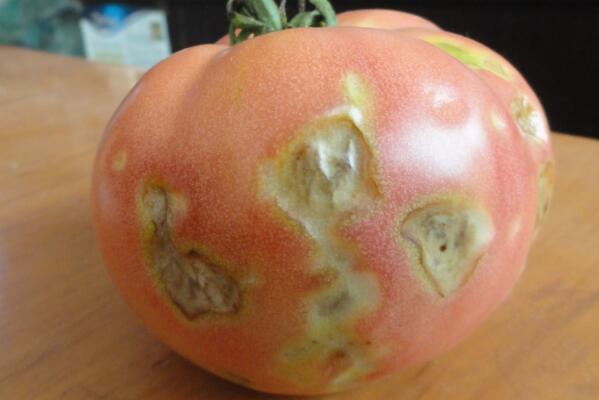
2. Anthracnose mainly harms nearly mature fruit. Any part of the fruit surface can be infected, generally with more infection on the middle part. Infected fruit first shows moist, discolored small spots, which gradually expand into nearly round or irregular lesions, 1-1.5 cm in diameter, with the middle part slightly sunken and turning dark brown, with concentric rings and small black grains growing on them. Under relatively high humidity, pink sticky small dots also grow in the later stage, and the lesions often crack in a star shape, with a ring of orange-yellow halo around the lesion (Figure 1). When the disease is severe, diseased fruit can rot and drop off in the field. Quite a few fruits that were infected but did not develop disease can successively show symptoms during storage, transport and sales after harvest, causing the number of rotten fruits to continuously increase.
Control:
1. Strengthen cultivation and disease control management
(1) After harvest, do a good job of clearing the garden and destroy diseased residues;
(2) Deeply plow and sun the soil, combine with land preparation to apply sufficient high-quality organic base fertilizer, and plant on high beds with deep furrows;
(3) Tomato is a crop with a relatively long growth period, so it must be carefully managed. Promptly prune, remove side shoots, tie vines, and weed frequently to facilitate field ventilation and reduce humidity. Harvest promptly at the fruit ripening stage to improve harvest quality, and take diseased fruit out of the field for timely destruction.
2. Chemical control: one preventive spray can be applied at the young fruit stage.
(1) Starting from the green fruit stage, spray 36% thiophanate-methyl suspension concentrate at 500 times dilution, 50% carbendazim-sulfur suspension concentrate at 500 times dilution, 50% thiophanate-methyl wettable powder at 500 times dilution, 50% carbendazim wettable powder at 800 times dilution, or 70% thiophanate-methyl wettable powder at 1000 times dilution plus 75% chlorothalonil wettable powder at 1000 times dilution. The control effect is better than using the above fungicides alone.