What pesticides to use for aphids and fruit borers before and after peach trees bloom? Analysis of the evil-warding belief
The peach tree is a small deciduous tree; its leaves are narrowly elliptical to lanceolate. It originated in China and is widely cultivated in all provinces and regions. It is planted throughout the world. So do you know why peach trees are said to ward off evil? What pesticides should be used for pests such as aphids and fruit borers before and after blooming? Let's find out together below.
Why are peach trees said to ward off evil?
The belief that peach wood can ward off evil comes from legend.
Legend one
In ancient Chinese mythology, it is said that there was a world of ghosts, in which there was a mountain, and on the mountain stood a giant peach tree covering three thousand li, with a golden rooster on its topmost branch. Whenever the golden rooster crowed at dawn, the ghosts that had wandered out at night had to hurry back to the ghost realm. The gate of the ghost realm was located to the northeast of the peach tree, and beside the gate stood two deities named Shen Tu and Yu Lei, each holding a peach branch, whose special duty was to capture demons and seize evil spirits.
If a ghost had done something outrageous during the night, Shen Tu and Yu Lei would immediately discover it, seize it, bind it with a rope made of reed grass, and send it to be fed to a tiger. Therefore all the ghosts in the world feared Shen Tu and Yu Lei. So people carved their likenesses out of peach wood and placed them at their own doorways to ward off evil and prevent harm. Later, people simply carved the names of Shen Tu and Yu Lei onto peach wood boards, believing that this could likewise suppress evil and drive away wickedness. Such peach wood boards were later called “peach charms”, and are also regarded as one of the origins of the art of New Year pictures.
Legend two
Ancient books record that Hou Yi was killed by a blow from a peach wood club, and after death was enfeoffed as the deity Zongbu. This deity often stands under a peach tree, leading a tiger, and every ghost must come forward for inspection; if Zongbu Shen sniffs out an evil ghost, it will be eaten by the tiger. One version relates this to Kuafu; legend says that Kuafu died of hunger and thirst while chasing the sun, and before dying he threw away the staff in his hand, which transformed into a Deng forest, that is, a peach grove, so that those who chased the sun in later generations could eat sweet and delicious peaches. The reason is that Kuafu had a close connection with the sun, so ghosts fear peach wood.
This originates from ancient times, which say that peach wood is the essence of the five woods and can suppress evil.
What pesticides to use for pests such as aphids and fruit borers before and after peach trees bloom?
1. Before and after blooming
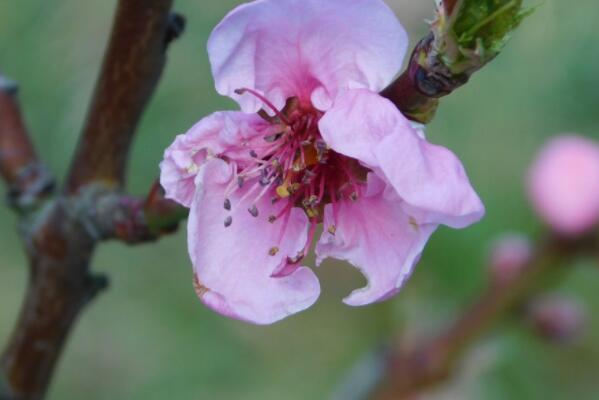
From late March to early April, most peach varieties in North China enter the blooming period (Figure 3-105). Because pollen and stamens are sensitive to many pesticides, it is generally not suitable to spray chemical pesticides. However, this period is an important time for flower thinning, flower preservation, fruit thinning and fruit setting; measures for flower thinning and fruit setting should be determined according to flower quantity, tree vigor and nutritional status, so as to ensure high and stable yields of the fruit trees.
(1) Flower thinning measures. Peach trees have many flower buds, and many varieties have a high fruit-setting rate; especially for mature trees, fruit set can easily exceed the tree's carrying capacity. Excessive fruiting inevitably produces a large number of small fruits, reducing fruit quality and fruit utilization rate, so timely flower and fruit thinning should be carried out; generally the effect of flower thinning is best after full bloom. Within 10 days after full bloom, spraying naphthaleneacetic acid at three concentrations of 20, 40 and 60 mg/kg gave flower thinning rates of 26.6%, 30.1% and 58.4% respectively; spraying naphthaleneacetic acid at three concentrations of 20, 40 and 60 mg/kg 2 weeks after full bloom gave flower thinning rates of 20.8%, 23.6% and 35.7% respectively.
(2) Measures to preserve flowers and fruits. Because peach trees bloom relatively early, normal blooming and pollination are often affected by rainy, windy and cold weather in production; or because flower bud formation last year was affected by certain factors, there are fewer flower buds. Measures should generally be taken to increase the pollination rate and reduce flower drop, thereby ensuring high and stable yields. At the same time, taking measures to preserve flowers at the flowering stage is the simplest and most effective. This is because after peach flowers drop, there are three fruit-drop periods at 3 to 4 weeks after flowering and in late May, and the cause of most fruit drop is failure to be pollinated or cessation of development of the fertilized embryo. Therefore, applying hormones and micro-fertilizers at this stage to promote flowering and pollination is the key period for preserving flowers and fruits. According to the flowering situation and weather conditions, generally bees can be released artificially during the flowering period, and at full bloom a 0.3%-0.5% borax solution + 0.3% urea solution, or a 0.3%-0.5% borax solution + 0.1% granulated sugar solution, can be sprayed; spraying once when 6%-7% of the central flowers are open can preserve flowers and also promote pollen germination and prevent peach fruit shrinkage disease. In addition, spraying 2,4-D at 20 mg/kg, triacontanol at 1-2 mg/kg, or gibberellin at 20-50 mg/kg from the flowering stage to the young fruit stage can increase the pollen germination rate and promote fruit set. At the flowering stage, spraying 3000-fold Fengchan Su solution or 3000-fold Aiduoshou solution may also be used in combination.
2. Aphids
(1) Trunk smearing. Take 1 part of 40% omethoate, add 1 part of multi-functional plant synergist, add 2 parts water, and mix into a liquid. Use a brush to apply a 10 cm wide medicated ring on the trunk. If the bark is rough, first scrape off the old protruding bark and then apply the medicine. After application, wrap it well with newspaper or plastic film.
(2) Trunk injection. That is, use an iron awl to pierce holes diagonally downward from top to bottom on the main trunk, deep enough to reach the xylem, then inject 40% dimethoate with a No. 8 syringe and seal the hole openings; after 2-3 days more than 95% of the aphids can be killed.
(3) Spraying pesticides. There are many pesticides that can be selected, and those commonly used in production include: 1500-fold 35% endosulfan emulsifiable concentrate; 3000-4000-fold 50% pirimicarb; 1500-fold 50% phoxim emulsifiable concentrate; 1500-fold 40% omethoate; 1000-fold 50% malathion emulsifiable concentrate; 5000-fold 10% imidacloprid wettable powder, etc. To improve control effectiveness, a certain amount of spreader can be added to the liquid, and several pesticides should be used alternately, avoiding the use of a single pesticide as much as possible.
3. Fruit borers
(1) Do a good job of orchard sanitation, that is: scrape the old protruding bark of peach trees clean and dispose of it centrally, so as to eliminate overwintering larvae.
(2) Fruit bagging: bag the peaches; for early-maturing varieties, before bagging, spray once in combination with the control of other diseases and pests, so as to eliminate the eggs laid by the early peach fruit moth.
(3) Destroy fallen fruits and remove infested fruits to eliminate the larvae inside the fruits.
(4) Spray control: grasp the peak egg-laying periods of the first and second generation adults for spraying. 1000-fold 50% fenitrothion emulsion; 1000-fold 50% phoxim emulsifiable concentrate; 5000-fold 25% deltamethrin emulsifiable concentrate; 3000-fold 2.5% kung fu emulsifiable concentrate.