What pesticide should be used to control cotton bollworm on corn, tomatoes and cotton?
Corn, tomatoes and cotton are all common crops, and they are also prone to diseases during their growth, which can lead to reduced yields or even death of the crops. So if cotton bollworm appears, what pesticide should be sprayed? How should it be treated?
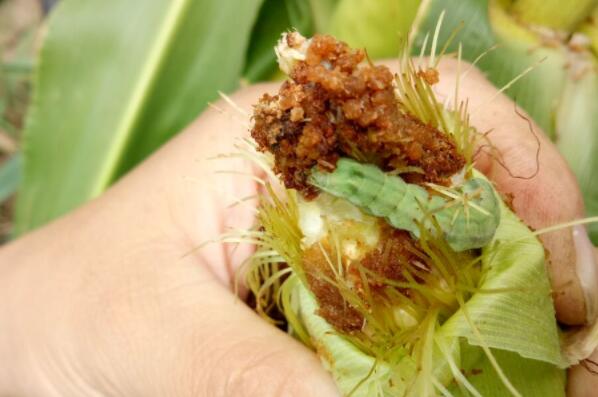
What is cotton bollworm? How do you identify it?
1. Cotton bollworm belongs to the family Noctuidae, order Lepidoptera. It damages many crops. In addition to cotton, it also damages corn, tomato, flax, sunflower, pea, pepper and other crops as well as many weeds. Cotton bollworm has many alternative names; when it damages corn it is called corn earworm. In recent years, in some areas where cultivation patterns have changed and multiple cropping areas have expanded, the damage caused by cotton bollworm to corn has shown a worsening trend, especially in southern Liaoning, the Yangtze River basin and **some areas.
2. Adult: a grayish-brown medium-sized moth, body length 15-20 mm, wingspan 31-40 mm, compound eyes spherical, green (the compound eyes of the closely related tobacco budworm are black). Female moths are reddish brown to grayish brown, male moths are bluish gray. The forewings and hindwings of cotton bollworm can serve as the model for adult moths of the family Noctuidae. On its forewings, outside the outer transverse line there is a dark gray broad band, with 7 small white dots on the band, and the kidney-shaped mark and ring-shaped mark are dark brown. The hindwings are grayish white, with a dark brown broad band along the outer margin, and in the center of the broad band there are 2 connected white spots. On the front margin of the hindwing there is 1 crescent-shaped brown spot.
Egg: hemispherical, height 0.52 mm, 0.46 mm, top slightly raised; the surface is covered with longitudinal and transverse ridges. Seen from the top there are 12 longitudinal ridges. In the middle, between the 2 longitudinal ridges there are 1-2 short ridges and mostly 2-3 branches, so viewed from the middle there are 26-29 longitudinal ridges.
Larva: there are 6 instars in total, sometimes 5 instars (those feeding on pea seedlings and sunflower heads). The mature 6th-instar larva is about 40-50 mm long. The head is yellowish brown with indistinct markings. The larval body color is variable and is divided into 4 types: 1) Body color pale red, dorsal line and subdorsal line brown, spiracular line white, hair tubercles black. 2) Body color yellow-white, dorsal line and subdorsal line pale green, spiracular line white, hair tubercles the same color as the body. 3) Body color pale green, dorsal line and subdorsal line indistinct, spiracular line white, hair tubercles the same color as the body. 4) Body color dark green, dorsal line and subdorsal line not very distinct, spiracles pale yellow. Above the spiracles there is a brown longitudinal band formed by rows of sharp minute spines (the minute spines of the tobacco budworm are blunt and rounded and are not arranged in a line). On abdominal segments 1, 2 and 5 of the larva there are 2 particularly obvious hair tubercles on each.
Pupa: 17-20 mm long, spindle-shaped, reddish brown to dark brown, with a pair of anal spines at the end of the abdomen, and the bases of the spines are separated. The spiracles are relatively large, and the peritreme plate is tubular and protrudes relatively high. The punctures on abdominal segments 5-7 are semicircular, relatively coarse and sparse (the spiracles of the tobacco budworm are small, the bases of the spines are joined, the peritreme plate is not high, and the punctures on segments 5-7 are fine and dense, with both semicircular and circular forms). It enters the soil 5-15 cm deep to pupate, covered externally by an earth cocoon.
What pesticide should be sprayed when cotton bollworm appears on corn, tomatoes and cotton? How should it be treated?
Corn:
1. Physical control
Poplar branch bundles to attract moths: during the adult moth emergence period, this should be carried out over a large area, especially in cotton fields, and can eliminate large numbers of adult moths, playing a relatively large role in reducing local insect sources.
High-pressure mercury lamps and frequency-vibration insect-killing lamps to attract moths have the characteristics of attracting and killing large numbers of cotton bollworms and causing little harm to natural enemies, and are suitable for use in areas where cotton bollworm outbreaks are severe and during the peak emergence period.
2. Biological control
Release of Trichogramma: during the peak egg-laying period of cotton bollworm, release the wasps 2 times, at 300,000 per hectare, with 60 release points (release 20,000 wasps per mu, with 4 release points). Put the Trichogramma cards that will emerge the next day into open paper bags and hang them on the middle and lower parts of the plants.
3. Chemical control
Before the third instar, spray the leaf surface with 2.5% cyhalothrin emulsifiable concentrate at 2000 times dilution, 5% beta-cypermethrin emulsifiable concentrate at 1500 times dilution and other chemical pesticides. In late June, apply insecticidal granules into the corn whorl; the pesticide and application method are the same as for corn borer.
4. Agricultural control
Autumn plowing and winter irrigation reduce the overwintering insect population base. Optimize crop layout to avoid the migration and reproduction of cotton bollworm from adjacent crops. Plant corn trap strips at the edges of cotton fields and on canal banks, and choose early-maturing corn varieties, with about 2200 plants per 667 sq m. Taking advantage of the habit of adult cotton bollworms liking to rest and lay eggs in the corn funnel leaf stage, have a dedicated person beat the whorl leaves every morning to kill adult moths and reduce insect sources.
Tomatoes:
Plow the land before winter and irrigate to flood the field to reduce overwintering insect sources. According to insect monitoring and forecasting, during the peak egg-laying period of cotton bollworm, combine with pruning to remove insect eggs and burn them.
When the number of eggs reaches 20—30 per 100 plants, pesticide application should begin. If there are more than 5 larvae per 100 plants, pesticide application should continue. Generally, pesticide application begins when the fruit starts to swell.
Cotton:
1. Bifenthrin emulsifiable concentrate 3000-5000 times;
2. Emamectin benzoate microemulsion 7500-15000 times;
3. 52.25% cypermethrin·chlorpyrifos emulsifiable concentrate 1500-2000 times;
4. 28% fenpropathrin·phoxim emulsifiable concentrate 1000-1500 times;
5. 48% chlorpyrifos emulsifiable concentrate 500-800 times;
6. 2.5% beta-cyhalothrin emulsifiable concentrate 1500-2000 times;
7. 40% trichlorfon·chlorpyrifos emulsifiable concentrate 1000-1200 times.
Where to spray pesticide when cotton bollworm appears
When cotton bollworm lays eggs, it generally lays them on the top of the cotton plant, on the tender leaves at the tips of the fruiting branches, on the bud stalks and on the bracts. When spraying, the focus should be on the top of the cotton plant and the tender tips of the fruiting branches, the bud stalks and the bracts.
Time to spray pesticide:
The hatching pattern of cotton bollworm is that the eggs are white on the first day, yellow on the second day, black on the third day, and hatch on the fourth day. After hatching, on the second day they damage the growing point, and on the fourth day they migrate to damage young buds. Cotton bollworms are mostly active and feeding from 8-11 a.m. and after 4 p.m., and are rarely active during the high-temperature period at noon. The suitable control period should be after the peak of egg laying until most eggs turn black or before hatching and migration, and it is best to apply pesticide from 8-11 a.m. and after 4 p.m. Avoid applying pesticide during high temperatures; pesticide applied during high temperatures is prone to volatilization and decomposition, which not only makes it easy for operators to be poisoned, but also gives poor efficacy.
Alternate pesticides:
Do not continuously use one pesticide, in order to prevent cotton bollworm from developing resistance to the pesticide.
Pesticide concentration:
Prepare the pesticide concentration according to the instructions, and do not arbitrarily increase or decrease it. Increasing the concentration easily causes pesticide damage to cotton plants, and decreasing the concentration reduces efficacy.
Amount of pesticide solution:
If the amount of pesticide solution is small, the cotton plants will not be sprayed evenly, and the insect control effect will be poor. When controlling the second generation of cotton bollworm, the amount of pesticide solution per mu must not be less than 40 kg; when controlling the third and fourth generations of cotton bollworm, the amount of pesticide solution per mu is 80-100 kg. Only when all parts of the cotton plant are evenly covered with pesticide is the effect good.