Causes of wheat yellow leaf disease and its medication control methods
After the beginning of spring, wheat leaves show varying degrees of yellowing, commonly known as wheat yellow leaf disease. Symptoms generally begin to appear in late February to early March. So what medicine should be used for wheat yellow leaf disease? What causes the yellowing? How should it be controlled?
Wheat yellow leaf disease is a soil-borne viral disease, namely wheat yellow mosaic virus disease, also known as spindle streak mosaic disease. The disease spreads mainly through diseased soil, diseased root residues, and water flow from diseased fields, and can also spread through sap rubbing inoculation. The natural vector of wheat yellow mosaic virus is Polymyxa graminis. The disease infects during the autumn seedling stage but does not show symptoms, and begins to develop when wheat seedlings turn green the following year. The suitable temperature for disease development is 5-15°C, and when the soil temperature is above 20°C the disease stops developing.
After wheat is infected, the green-turning, jointing, heading and maturity stages are delayed, plants are dwarfed, the earing rate is low, ears are small, and grains are shriveled. It generally can cause a yield reduction of 10-30%, and in severe cases a reduction of more than 50% or even total crop failure. This disease infects extremely quickly; from sporadic incidence to death in patches takes only 3-4 days. Therefore, after a cold wave, wheat is in a “weak” stage with relatively poor immunity, and as temperatures gradually rise, pathogens hidden in the soil begin to invade at suitable temperatures. If the disease-causing temperature lasts too long, the probability of wheat infection greatly increases and creates a huge risk of yield reduction.
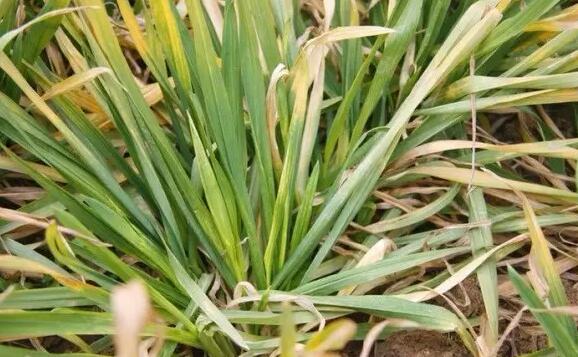
There are many causes of wheat yellow leaf disease, mainly the following situations:
1. Drought and lack of soil moisture
When the underlying soil moisture is insufficient and sowing is done by seizing moisture, the water absorbed by the wheat root system from the soil is difficult to compensate for consumption, growth and development are affected, and leaves turn yellow, dying in severe cases. In the field, the whole wheat field appears relatively uniformly yellow, tillering is slow, growth is slow or stagnant, new leaves are short and small, and roots are small and thin. For management, urea can be applied at 7-8 kg per mu in combination with watering.
2. Soil leaning acidic
At present, farmland generally uses excessive chemical fertilizers, causing soil to lean acidic. Acidic soil causes the root system to turn black, reducing its ability to absorb water and nutrients, which in turn causes wheat seedlings to turn yellow. Quicklime at 50-70 kg per mu or plant ash at 50-100 kg per mu can be applied to neutralize soil acidity.
3. Incomplete straw crushing or insufficient plough layer for straw return
Straw return can improve soil and build soil fertility. If the plough layer is less than 20 cm when returning straw to the field, and the returned straw is not thoroughly crushed, after wheat emerges the root system rests on loose straw and is suspended, making it difficult to absorb nutrients from the soil and causing wheat seedlings to turn yellow. Watering can be carried out to firm the soil, and nitrogen fertilizer can be added to accelerate straw decomposition, while also allowing seedling roots to penetrate fully downward. At the same time, when preparing the land, thorough crushing and deep ploughing and deep turning are advocated. Deep ploughing should be carried out once every 3 years, with a depth reaching 25 cm.
4. Nutrient deficiency
Deficiency of elements such as nitrogen, phosphorus, potassium, calcium, iron and magnesium in wheat can all cause yellow leaves at the seedling stage. The more common ones are nitrogen deficiency and phosphorus deficiency. When wheat turns yellow due to nitrogen deficiency, plants are short, thin and weak, tillering is few and weak, and seedling leaves then turn yellow. About 5 kg of urea per mu can be topdressed at the green-turning stage, and another 12-15 kg of urea per mu can be topdressed at the standing-up or jointing stage. When wheat turns yellow due to phosphorus deficiency, it shows very few secondary roots, few tillers, dark green leaf color, and yellow leaf tips. At the same time, yellowing due to phosphorus deficiency in wheat can also lead to small ears and few grains, reduced thousand-grain weight, and serious impact on yield. Diammonium phosphate at 10 kg per mu or superphosphate at 45-50 kg per mu can be applied in furrows. After accurate diagnosis of nutrient deficiency symptoms, supplementation can be carried out by soil application or foliar spraying according to the principle of supplementing whatever is lacking.
5. Excessive wheat sowing density
High wheat sowing density affects wheat photosynthesis and intensifies competition for water and fertilizer, which in turn leads to yellow and weak seedlings. Therefore, sowing should be done in appropriate amounts according to the season and temperature.
6. Sustained low temperature and freezing damage
With sustained low temperature and little light, the overall wheat seedling condition is relatively weak, and yellow leaf symptoms appear under the influence of low-temperature freezing damage. Management should be strengthened when a cold wave arrives, and foliar fertilizer should be sprayed.
7. Causes of pests and diseases
Underground pests, wheat aphids, red spiders and other pests can all cause wheat seedlings to turn yellow. For aphids, 5% imidacloprid 1000-1500 times solution can be used for control; for red spiders, 1.8% abamectin 3000 times solution can be used for control; for underground pests, 48% chlorpyrifos emulsifiable concentrate 1000-1500 times solution or 40% phoxim emulsifiable concentrate 1000 times solution can be used for spray drenching and root irrigation.
The main wheat diseases are sheath blight, take-all and root rot. They are all fungal diseases, and all can show yellow leaves in the early stage of occurrence, but the parts where lesions occur and lesion shapes differ. Sheath blight mainly damages leaf sheaths; take-all mainly damages the stem base and roots; root rot occurs only on the roots. They are all diseases spread by soil. Tebuconazole and propiconazole can control these three diseases simultaneously.
8. Phytotoxicity
The most common is yellow wheat seedlings caused by herbicide phytotoxicity. Regulators, foliar fertilizers or detoxifying agents should be sprayed promptly to stimulate wheat seedling growth and reduce phytotoxicity. One irrigation can also be combined with additional tillering fertilizer, which can similarly play a role in mitigating phytotoxicity.
9. Adverse climate effects
Yellow leaves are caused by meteorological factors such as low temperature, strong wind and frost. Their occurrence is often closely linked to weather changes, with a relatively large range, and the whole field appears relatively uniform. When symptoms are mild, no control is needed; in severe cases, quick-acting fertilizer can be topdressed to promote growth.