When does the "famous Chinese flowering tree" white magnolia bloom? How do you care for it best? How much does one tree cost?
White magnolia is the white-flowered variety of magnolia, a famous Chinese flowering tree and an important early-spring ornamental tree in the north. It is cultivated extensively in Fujian, Guangdong, Guangxi, Yunnan and other provinces and regions of China, as well as in the provinces and regions of the Yangtze River basin. So when does the white magnolia tree bloom? How do you care for the tree best? How much does one tree cost?
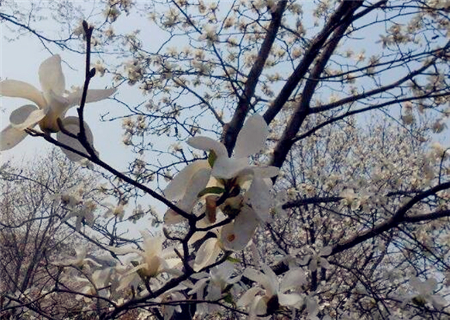
The flowering period of white magnolia is from April to September.
How to care for a white magnolia tree best
1. Propagation: White magnolia trees can be propagated by sowing, cuttings, layering and grafting. Sowing is mainly used to grow rootstock. For grafting, seedlings grown from seed are used as rootstock, with cleft grafting, side grafting or bud grafting. Cuttings can be taken in early June, when the lateral buds on the new shoots are plump. For seedlings grown from seed or grafting, apply a heavy base fertilizer and control the density; sparse flower buds can be seen in 3 to 5 years. Two to 3 years after planting out, the tree enters its full flowering period.
2. Potting soil: White magnolia trees like loose, fertile acidic or slightly acidic soil. For cultivation, use a mix of leaf mold and vegetable garden soil in equal amounts as the growing medium, and add 50—150 grams of bone meal or NPK compound fertilizer to the soil. The pot is best slightly deeper and larger, and some broken hard plastic foam blocks should be placed at the bottom of the pot to improve air and drainage capacity and prevent root rot. Repot and change the soil once a year or every other year after the flowering period, keeping 1/2—1/3 of the old soil.
3. Water: White magnolia trees like moisture and fear waterlogging, so they need to be watered at the right time and in the right amount. From the start of spring to the flowering period, the potting soil should be kept moist but not wet; after flowering, the potting soil should stay moist without standing water; after the leaves drop, the potting soil should be kept slightly moist and not dry. White magnolia trees must never be drought-stressed or waterlogged at any time, especially in the rainy season, when drainage and waterlogging prevention need attention.
4. Fertilizing: For white magnolia trees, fertilizing should focus on the two key periods: February before flowering and May after flowering. During these two periods, apply NPK compound fertilizer about once every ten days. The former can make the flower buds swell and the blooms open brightly, while the latter can promote more bud formation and more flowers the following spring. When the leaves drop in early winter, apply a fertilizer mainly of phosphorus and potassium once to strengthen the white magnolia tree's cold resistance for overwintering; at other times, apply little or no fertilizer. White magnolia trees dislike being given nitrogen fertilizer alone.
5. Light and temperature: White magnolia trees like light. Usually they should often be placed in a sunny courtyard or roof garden to get more sunlight, so that they can grow luxuriantly and vigorously. Under semi-shaded conditions, white magnolia trees can still grow, but they look rather weak and bear few flowers; if kept in a dark place for a long time, they will not flower. White magnolia trees are relatively cold-hardy trees and can overwinter outdoors in Beijing and areas to its south.
6. Pruning: White magnolia trees have very strong root sprouting ability. If propagation is not needed, then prune as they grow, keeping 3 main stems per pot. For branches that are too tall or too long, cut them short after flowering, when the leaves have just unfolded. Because white magnolia trees heal wounds poorly, apply sulfur powder after cutting to prevent rot; if not necessary, do not prune. After flowering, if the seeds are not needed for propagation, cut off the spent flowers together with the base. Pruning and shaping can keep the magnolia's tree form graceful and make the flowers larger and more colorful the following year.
7. Pest and disease control: White magnolia trees commonly suffer from diseases such as black spot, leaf blight and leaf spot. In usual care, pay more attention to ventilation, fertilizer and water management, etc. If disease occurs, take timely measures to treat it so as not to affect plant growth. The common insect pests of white magnolia trees mainly include large bagworms, camphor silkworms and frost hawk moths, etc. Prevention should also be noted during cultivation. If pests occur, promptly spray the corresponding insecticide to kill them.
How much does one white magnolia tree cost
White magnolia price reference: white magnolia with a ground diameter of 2 cm-6 cm costs 8-70 yuan, white magnolia with 7 cm-11 cm costs 90-420 yuan, and white magnolia with 12 cm-15 cm costs 600-2200 yuan.