When does the frangipani tree bloom, how many years until it bears fruit, and how is it grown
The frangipani tree is cultivated in Guangdong, Guangxi, Yunnan, Fujian and other provinces and regions in China, and in the mountains of southern Yunnan it has escaped cultivation and become wild. So when does the frangipani tree bloom? How is it grown? After how many years of growing does it bloom and bear fruit? The details are compiled as follows:
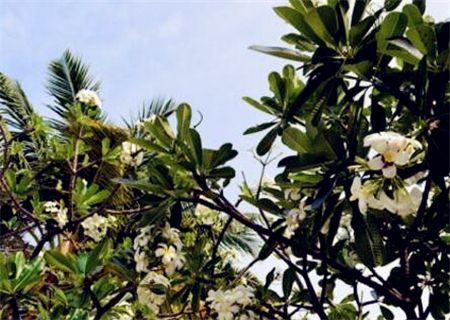
When does the frangipani tree bloom
The frangipani tree blooms in August and September each year.
How to grow the frangipani tree
Frangipani likes a hot and humid climate, tolerates drought, and prefers to grow in limestone rocky areas; it is extremely easy to propagate by cuttings. Generally, in mid to late May, cut a branch 20-30 cm long from the base of a branch; white latex will flow from the cut, so it needs to be placed in a cool, ventilated place for 2-3 days so that the wound forms a protective film before cuttings are taken, because taking cuttings while latex is still flowing makes them prone to rot. Insert it into clean vermiculite or a sand bed or a shallow sand pot, then spray with water, and place it indoors or under an outdoor shade shed, spraying water once every other day to keep the medium moist. After 15-20 days, move it to a semi-shaded place so it receives weak light; it will root in 30-35 days, and can be potted in 45 days. After the small cutting-grown seedlings have rooted and survived, they should be transplanted promptly into pots with a diameter of 20 cm. Frangipani is not strict about soil and is best planted in loose soil rich in humus. When planting, the roots may be slightly exposed when potting. After planting, place it indoors, expose it to weak light after 1 week, and after another half month it can be placed in a place with ample sunlight. Frangipani grows rapidly and needs to be repotted once every spring, generally into a flowerpot with a diameter of 30 cm. The potting soil can be mixed from 4 parts garden soil, 4 parts horse manure soil and 2 parts river sand, and 100 g of cake fertilizer or sauce residue and 50 g of superphosphate or bone meal should also be added to each pot. After repotting, water thoroughly, and around Grain Rain move it outdoors to a sunny place. Frangipani likes a warm, humid growing environment with ample sunlight; in summer it does not need shading and can be placed outdoors in full sun. Summer and autumn are the periods when frangipani grows and blooms; water 1-2 times every evening, and if it rains in summer or autumn, promptly pour out any accumulated water in the pot. From June to November, apply decomposed liquid fertilizer once about every 10 days at a concentration of 15%. In the south, frangipani is planted in the open ground, sheds its leaves in winter, and grows new leaves again the following spring. In the north, potted plants should be moved indoors to a south-facing window in mid to late October, taking care to provide ventilation and light. The room temperature should be above 10°C; low temperatures and poor indoor ventilation will cause the plant to drop its leaves. When indoors, water once every two weeks.
For potted frangipani, it is best to use a clay pottery pot with good permeability. If a plastic pot is used, put a layer of broken bricks and tiles or broken hard plastic foam blocks at the bottom of the pot to enhance air permeability and drainage. Its root system is relatively well developed and it grows quickly. Small seedlings can be planted in a medium pot with an inner diameter of 20 cm, and as the plant grows, it can be moved into a pot one size larger. It is not very strict about soil, and grows best in loose, fertile sandy loam. For home potting, use equal parts leaf mold and vegetable garden topsoil mixed together, then add a small amount of sand. Repot and change the soil once every spring before germination.
Frangipani likes moisture and also tolerates drought, but fears waterlogging. Therefore, watering should be moderate, following the principle of not watering when dry, watering as soon as it dries, watering thoroughly when watering, and never allowing waterlogging. In spring and autumn, water once every 1 to 2 days when the soil is dry; on sunny days in summer, water once every morning, and in the evening water again if the soil is dry; in the rainy season, be sure to pour out accumulated water from the pot to prevent root rot; in winter, water once every ten days to half a month, keeping the potting soil slightly moist rather than dry. It likes fertilizer. When potting or repotting and changing soil, it is best to add 20 g to 30 g of bone meal and 50 g to 80 g of superphosphate to the culture soil (because it likes to grow in calcareous soil, attention should be paid to calcium supplementation). From May to October, apply a dilute decomposed organic fertilizer or nitrogen-phosphorus-potassium compound fertilizer once every 10 to 15 days. Do not apply nitrogen fertilizer alone, to prevent excessive vegetative growth. Do not fertilize in winter.
Frangipani is a strongly sun-loving flower; the more ample the sunlight, the more luxuriant its growth and the more numerous and fragrant its flowers. Except for the 7 to 10 days of shade needed after potting or repotting and changing soil, it should be placed in a place with ample sunlight at all other times. Because it originates from the tropical regions of the Americas, it is not cold-tolerant; shedding its leaves in winter when cultivated in temperate zones is a manifestation of its poor cold tolerance, and it should be moved indoors to overwinter. Before the minimum temperature drops to 10°C, move it indoors and place it in a place with ample sunlight, maintaining a room temperature of 10°C to 15°C. Keeping it away from television radiation and air-conditioning warm air can prevent leaf drop, but if the temperature is below 8°C or ventilation is poor, it will also drop its leaves. As long as it is kept above 5°C, it will not freeze to death, and the following spring it will sprout and grow leaves.
When frangipani is grown in temperate zones, it generally does not set seed, so cutting propagation is used. From late May to early June, cut a branch about 20 cm long from a branching point as a cutting. White latex will flow from the cut; if it is inserted without treatment, the cutting is prone to rot. It can be placed in a well-ventilated, cool place, and after 2 to 3 days, once a protective film has formed at the wound, insert it again, or dip the wound in plant ash or sulfur powder, and after it dries slightly, insert it into vermiculite or a plain sand pot, place it in a ventilated shaded place, and frequently spray water on the cutting to keep it moist. After 20 days, move it to a semi-shaded place where it can see the sun in the morning or evening. It can root in 30 to 40 days, with a high survival rate, and can be potted in autumn or the following spring.