When are chili peppers harvested, why do they grow pointing upward, and what pesticides should be used for pests and diseases before and after flowering?
Chili pepper, also known as small chili and skyward pepper, has white flowers and a flowering period from early May to the end of July. The whole plant is used as medicine; the rhizome is warm in nature and sweet in taste, and can dispel wind and scatter cold, relax muscles and activate collaterals, and also has insecticidal and anti-itching effects. So when are planted chili peppers harvested? Why do they grow pointing upward? What pesticides should be used for pests and diseases before and after flowering?
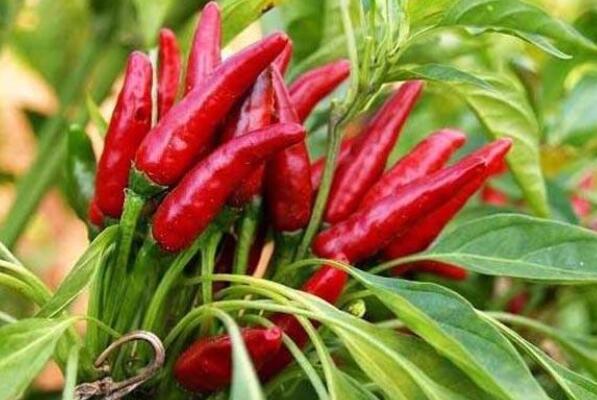
When are planted chili peppers harvested?
1. Chili peppers are generally grown as annuals, planted in spring and harvested in autumn. The sowing season is March to April in spring.
2. Chili peppers can flower and fruit multiple times and be harvested multiple times. They should be picked when the fruit is fully mature and the capsaicin, lycopene, and vitamin C reach their highest content, when the peel looks bright and vivid red. This is the best time to pick! After picking, apply topdressing fertilizer, and you can harvest continuously!
3. From flowering to commercial fruit maturity (green-ripe stage), the fruit needs 25~40 days. Different varieties require different numbers of days: early-maturing varieties need 25~30 days, while late-maturing varieties need 35~40 days. From flowering to physiological maturity, 45~60 days are needed, but in protected cultivation in winter when the temperature is very low, 60~100 days are needed from flowering to physiological maturity, and some late-maturing varieties take as long as about 110 days.
4. The fruit of five-color peppers grown in open fields generally begins to mature successively in mid-to-late August and should be picked and cut in time to promote growth and improve economic returns. The cut mature peppers can be sold on the market or strung up and hung in a ventilated and dry place to dry into dried peppers, to be kept for eating or sold as commercial peppers.
Why do chili peppers grow pointing upward?
The flowers of chili peppers are on the tips of the branches. Because this is beneficial for pollen dispersal, their fruit is also on the tips of the branches. They are also sun-loving plants, so they grow pointing upward. The fruit is light, and the fibers of the branches and leaves are highly tough, so the fruit grows pointing upward and does not droop. Ordinary chili peppers droop because they contain a lot of water and the fruit is heavy.
What pesticides should be used for pests and diseases before and after chili peppers flower?
1. A common disease is Phytophthora blight, which can infect both seedlings and adult plants. When seedlings are affected, the stem base shows dark green water-soaked soft rot and damping-off. Spray or drench in time with 50% metalaxyl wettable powder at 800 times dilution, or 64% sandofan wettable powder at 500 times dilution for control. Cottony leak can occur in both seedlings and adult plants.
2. Viral disease. In the early stage of occurrence, use virus A, virus spirit, agricultural streptomycin, etc. for spray control, and at the same time add insecticides such as imidacloprid, acetamiprid, veratrine, and kungfu.
3. Pepper anthracnose. You can use prochloraz manganese salt, procymidone, dithianon, difenoconazole + azoxystrobin, or Akron (picoxystrobin) plus foliar fertilizer for spray control. Spray once more at an interval of 5 days.
4. Pepper stem base rot. You can choose fludioxonil, or copper ammonia complex, or hymexazol, or metalaxyl-hymexazol, Bacillus subtilis, ethylicin, or thiram to spray and irrigate the roots for control, once every 5~6 days, alternating medications, for 2~3 consecutive treatments.
5. Chili pepper little leaf disease. Choose moroxydine hydrochloride, ningnanmycin, moroxydine copper acetate, shiitake polysaccharide, amino-oligosaccharin + cell division agent + zinc for spray control, then spray again at an interval of 5-7 days, for 2-3 consecutive sprays.