What month does cockscomb (Celosia) bloom, and when is the best time to sow the seeds?
Cockscomb likes full sunlight, heat and humidity, and cannot tolerate frost or poor, barren soil. It is widely cultivated in many places as an ordinary garden plant. It also has high medicinal value. So when does cockscomb bloom? And when is the best time to sow the seeds? The details are summarized below:
When does cockscomb bloom
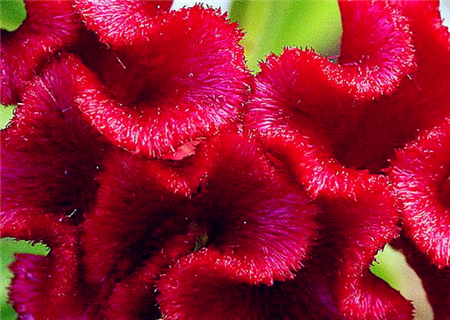
Cockscomb is an annual herbaceous plant. Its spike inflorescences are highly variable, growing at the tip of the stem or the ends of the branches, often shaped like a cockscomb, in colors of purple, red, pale red, yellow or mixed colors. When the utricle ripens it splits transversely, containing 2 to several small black seeds. The flowering period of cockscomb is generally from July to September. The fruiting period is from September to October. Therefore, the flowering period of cockscomb is every year in summer.
Sowing and propagation of cockscomb is best done in April-May, when the temperature is 20°C-25°C. Before sowing, some cake fertilizer, barnyard manure or compost can be applied in the seedbed as a base fertilizer. When sowing, mix some fine soil with the seeds and broadcast them, because cockscomb seeds are very small; covering with 2-3 mm of soil is enough, and it should not be deep. Before sowing, keep the soil in the seedbed moist. After sowing, spray a little water with a fine-rose watering can, then shade the seedbed, and do not water for two weeks. Generally, seedlings emerge in 7-10 days. When the seedlings grow 3-4 true leaves, thin them once, pulling out some weak and overcrowded seedlings. When the seedlings are 5-6 cm tall, they should be transplanted and set out with soil around the roots.
1. Seed propagation method: around Qingming (since it is outdoors, it is best after the frost-free period), choose a good plot, apply enough base fertilizer, plow finely and harrow evenly, level and make beds, scatter the seeds evenly over the bed surface, cover the seeds lightly with fine soil, firm the soil and water thoroughly, and keep the soil moist; generally at a temperature of 15-20°C, seedlings emerge in 10-15 days.
2. For summer sowing after Mangzhong, sow at a row spacing of 30 cm. When the seedlings are 6 cm tall, thin them to a plant spacing of 20 cm. The thinned seedlings can be transplanted to other fields, and they must be watered after transplanting. During the seedling stage, be sure to weed and loosen the soil, and water as little as possible when it is not too dry. When the seedlings are 30 cm tall, apply a top dressing once. After the rows close, remove some old leaves as appropriate. When flowering and heading, if the weather is dry, water appropriately, and strictly prevent waterlogging in low-lying areas during the rainy season. After heading, the flower buds in the leaf axils of the lower part can be removed to help nutrients concentrate on the growth of the main spike at the top.
3. Of course, it can also be grown in a greenhouse, as long as attention is paid to humidity and temperature; but when plants grown in a greenhouse are moved outside, after they sprout and grow four leaves, they must be taken outside at night to harden off, that is, to let them learn to adapt to the cold environment, otherwise they will grow slender and delicate and soon die.
Planting
In spring, when the seedlings have grown 2-4 leaves, plant them in pots. When planting, set them slightly deep, leaving only the cotyledons above the soil surface, and keep the potting soil slightly dry to induce the inflorescences to appear earlier. After the inflorescences appear, move them into 16 cm pots. Before repotting, water thoroughly. If you want especially large flower heads, you can move them into 23 cm pots, and at the same time pay attention to matching the pots. Small pots are for dwarf varieties, and large pots are for tall varieties such as the plume cockscomb. For dwarf, heavily branching varieties, pinch the tips after setting out to promote branching; upright varieties that can branch do not need pinching.
2. Light and temperature: it likes warmth and dislikes cold. During the growing period it needs sufficient light, with at least 4 hours of light every day. The suitable growing temperature is 18-28°C. When the temperature is low, growth is slow, and after winter begins the plants die.
3. Fertilizing and watering: the potting soil should be fertile, made by mixing half fertile loam and half rotted barnyard manure. During the growing period it must be watered appropriately, but the potting soil should not be too wet; moist and slightly dry is best. Prevent excessive vegetative growth that produces no flowers or delays flowering. In the later growth stage, add phosphate fertilizer and give more sunlight, which can promote robust growth and large inflorescences. At the seed maturation stage, water and fertilize less to help the seeds mature and to keep the flower color deep and vivid for a longer time.
Key cultivation points
Suitable germination temperature: 20-30°C Sowing period: autumn, spring
Suitable growing temperature: 10-30°C Flowering period: year-round
Raising seedlings: scatter the seeds on potting soil, keep the soil moist, and they sprout in about 6-8 days. After thinning, transplant when the true leaves number 4-5. Transplant carefully and do not break the taproot.
Planting: the growing medium should be potting soil with good drainage. This plant is heat-tolerant and needs full sunlight; in flower beds the plant spacing is 15 cm. Both the seedling stage and the growing stage require nutrient fertilizer, such as organic fertilizer, compound fertilizer or flower fertilizer, all of which are suitable.
Cultivation-related
Cockscomb likes sunlight, tolerates poor soil, fears waterlogging, and cannot tolerate cold; it grows well under high-temperature, dry climate conditions. Under normal conditions it does not need watering or fertilizing. Cockscomb can be used as a potted ornamental flower. When potting, seedlings are generally not raised in pots; instead, at flowering time, plants are selected from field-grown cockscomb and potted. When potting, plant them slightly deeper, so that the leaves are close to the potting soil surface. When transplanting, do not let the root ball break apart. After planting, water thoroughly, start fertilizing 7 days later, and apply liquid fertilizer once every half month. Before the inflorescence forms, the potting soil should be kept somewhat dry to help the inflorescence develop. After the flower buds form, apply liquid fertilizer once every 7-10 days and water appropriately.
If you want the cockscomb plant to be sturdy and the flower crown large, thick and brightly colored, you can move it into a larger pot after the inflorescence forms, but note that the root ball must not break apart during transplanting, because its roots are extremely weak, otherwise it will not easily survive.
Cockscomb is cross-pollinated, and varieties easily hybridize and vary. Therefore, varieties kept for seed should be isolated during the flowering period. When saving seeds, collect the seeds from the lower part of the inflorescence, which can preserve the characteristics of the variety.
Scientific care
① Potting soil: use fertile, well-drained sandy loam, or a mixed medium prepared from leaf mold, garden soil and sand in a ratio of 1:4:2.
② Potting: at flowering time you can directly select plants from field-grown cockscomb and pot them; when potting, be careful not to let the root ball break apart, plant slightly deeper, and keep the leaves as close to the potting soil surface as possible.
③ Watering: water thoroughly after planting, then water appropriately; when watering, try not to let the lower leaves get splashed with mud.
④ Fertilizing: after the flower buds form, apply a thin compound liquid fertilizer once every 10 days.
How to make cockscomb colorful and beautiful
There are many varieties of cockscomb; plant types come in 3 kinds: tall, medium and dwarf; shapes include cockscomb-like, torch-like, pom-pom-like, feather-like and fan-like; flower colors include bright red, orange-yellow, dark red, purple, white and mixed red-and-yellow; leaf colors include dark red, emerald green, yellow-green and red-green, all extremely attractive, making it a commonly used flower bed plant in summer and autumn.
During cultivation, if management and care are improper, it often blooms sparsely with dull colors, affecting the ornamental value of cockscomb.
To make cockscomb flowers large and brightly colored, pay attention to the following in cultivation and care:
① Plant it in sandy loam on high, dry, sunny, fertile, well-drained ground.
② During the growing period, do not water too much; control watering after flowering; water appropriately in dry weather, and drain promptly on rainy days.
③ From the seedling stage, remove all axillary buds.
④ After the cockscomb forms, apply a thin compound liquid fertilizer once every 10 days (2-3 times).
Disease control
If root rot occurs at the seedling stage, quicklime can be broadcast over the field. During the growing period, the cotton geometrid is likely to appear; spraying the leaves with diluted detergent, dimethoate or pyrethroid pesticides can help control it. Propagation and cultivation.
(1) Ring spot
Main symptoms: large round lesions with brown edges appear on the leaves; the lesion surface has obvious concentric rings, and later the center of the lesion becomes grayish brown with scattered small black dots
(2) Phytophthora blight
Main symptoms: at first small dark green spots on the leaves, which then enlarge; at high humidity the lesions become soft and rotting, and at low humidity they become light brown and dry.
(3) Leaf spot
Main symptoms: lesions on the leaves are polygonal or round, 1-5 mm in diameter, with dark brown edges and a light brown center.
(4) Damping-off
Main symptoms: the pathogen mainly infects the root crown. If it occurs before emergence, the seed sprouts rot in the soil, showing as missing seedlings on the ground; if it occurs after emergence, the affected root crown appears dark brown, softened and water-soaked, and later the top of the plant wilts and finally dies. When the disease is severe, leaves touching the ground also easily develop large dark green to brown water-soaked spots, causing leaf rot.
(5) Stem rot
Main symptoms: this disease mostly harms the base of the stem; at first yellow-brown spots appear at the affected area, then gradually enlarge into oval or elongated lesions with brown edges and a yellow or grayish white center, and finally small black dots form on the lesions.
Chemical control
1. Spray promptly at the early stage of the disease for control; the chemicals include 1:1:200 Bordeaux mixture, 50% thiophanate-methyl wettable powder, 50% carbendazim wettable powder 500-fold spray, 40% junduqing suspension concentrate 600-800-fold spray; or drench with zineb wettable powder 300-500-fold.
2. In modern methods of removing pests that protect the environment, besides using diluted detergent, you can also plant some plants around that keep insects away, or release some beneficial insects that eat those pests.