When does wax begonia bloom? How to make it bloom year-round and overwinter safely
Wax begonia, also known as perpetual begonia, is a plant of the genus Begonia in the family Begoniaceae. Wax begonia is the most common and most widely cultivated species among begonias. So when does wax begonia bloom? How do you make it bloom year-round? And what is the best way to care for it in winter? The details are organized as follows:
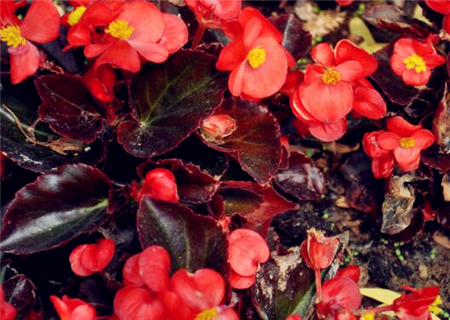
Which month does wax begonia bloom?
The flowering period is from December to May of the following year, and it is mostly used for potted plants and flower bed decoration.
If you want wax begonia to bloom on New Year's Day, you should take cuttings for seedling propagation in early to mid-April, and after getting through the summer, plant them out in mid-September, then switch to open-air care in mid-October. If you want it to bloom at Spring Festival, sow in mid-August (it takes 145 to 160 days from sowing to flowering), move it to open-air care in mid-October, and pot it up for planting out in mid-November. To make wax begonia bloom on "May Day", carry out sowing and seedling propagation in mid-October at natural temperature. For cutting propagation (it takes 120 to 150 days from cutting to flowering), do it in a protected setting in early to mid-December, and plant out in late February, but you must protect it from the cold to keep the seedlings alive. Using growth inhibitors can also promote flowering.
How to make wax begonia bloom year-round
Choosing suitable growing soil for wax begonia in spring
The choice of growing soil is crucial for wax begonia. For a wax begonia that blooms for a long time, the growing soil should be prepared by mixing half leaf mold and half garden soil, plus a small amount of river sand. Of course, you can also add a small amount of bone meal as cake fertilizer, which can make the begonia grow more robustly.
Potted wax begonia
Reasonable light and ventilation for wax begonia in spring
In early spring, wax begonia should be placed in a sunny spot on the balcony, and ventilation should be maintained and monitored at all times. Observe it frequently, and after some time, rotate the flower pot 180° in place.
After the late frost, wax begonia should be moved to a position with only scattered sunlight. Do not water too much; keep it moist, and apply a dilute nitrogen-phosphorus-potassium liquid fertilizer once every 1-2 weeks.
Potted wax begonia needs to stay ventilated
Humidity in summer is especially important for wax begonia
Wax begonia likes a warm and humid environment, and this should not be changed for it. During its growing period, it is most suitable to place it in a cool, ventilated place with scattered light for care.
In summer, watering should be controlled and fertilizing stopped, to prevent the leaves from turning yellow due to sunlight exposure. Spray water daily on the leaves and the surrounding ground to ensure the surrounding humidity and lower the temperature.
Wax begonia after watering
Proper fertilizing for wax begonia in autumn
After late autumn, place wax begonia in a spot with partial light, strengthen the management of water and fertilizer, and keep the potting soil rich in nutrients, applying a well-rotted dilute nitrogen-phosphorus-potassium liquid fertilizer once every 7-10 days.
Maintaining room temperature for wax begonia in winter
Indoor potted wax begonia
After winter arrives, the indoor temperature should be kept above 15°C, and the management of fertilizer and water should be strengthened, which can keep the begonia blooming. At noon, it should be placed in a sunny spot on the balcony for light, which is beneficial for indoor development in winter.
How to care for wax begonia in winter
Wax begonia is not cold-tolerant. If it can be cultivated indoors to overwinter, it will still be full of vitality and spring-like charm. After late autumn, the temperature gradually drops, and the growth of wax begonia is also inhibited. After that, it enters a semi-dormant state, with no new branches or young leaves and few flowers. Once the temperature is even lower, there are sometimes continuous severe freezes. If household cultivation does not pay attention to keeping warm, it may freeze to death. Therefore, before frost, you should
move the potted plant indoors to a sunny place.
When the indoor temperature is below 5°C, at night the potted plant should be moved to a small table farther from the window so the leaves are not frozen. During the day, move it back to a sunny spot on the windowsill. To make the plant grow evenly, the flower pot should be rotated frequently. If the indoor temperature drops to 0°C, cold protection measures should be taken: insert three or four thin bamboo sticks into the pot as a support, then cover the whole pot with a transparent plastic film bag and seal the lower opening well. After the room temperature rises, many water droplets will form inside the bag; at this time, remove the plastic bag to avoid causing leaf rot. If there is indoor heating or a stove for warmth and the room temperature can be controlled above 15°C, wax begonia will grow as usual and bloom continuously, but do not place the potted flowers too close to the stove or heating, to avoid scorching damage.