When does the black locust (Robinia pseudoacacia) bloom and bear fruit, how many years of planting before it flowers, and how does it differ from the Chinese scholar tree?
Black locust, also known as Robinia pseudoacacia. Black locust flowers are edible. The honey produced from black locust flowers is very sweet, and honey yields are also high. Cultivated varieties include Hongsen locust, red-flowered black locust, golden-leaf black locust, and others. So when does the black locust bloom and bear fruit? How many years of planting before it flowers? And how does it differ from the Chinese scholar tree? The details are compiled below:
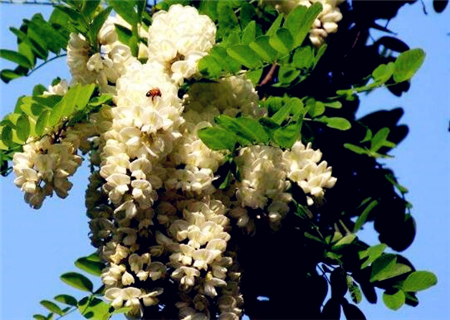
When does the black locust bloom
The black locust (Robinia pseudoacacia) takes about 3 years from planting to bloom, and enters full bloom at around 5 years. The flowering period is April to June, and the fruiting period is August to September.
Planting methods:
1. Irrigation. Do not irrigate from sowing until the seedlings emerge completely. After emergence, when soil moisture is moderate, loosen the soil and cultivate in time to raise soil temperature and favor germination. Irrigating too early, when soil moisture is too high and soil temperature is low, tends to cause seedling stagnation or yellow-leaf disease. On the basis of repeated cultivating and loosening of the soil, the first irrigation can be given in early June, and thereafter under normal conditions irrigate once every 20d. After irrigating in early July, pause for a period to promote the degree of lignification of the seedlings and enhance their winter hardiness, then give a final winter irrigation in late November.
2. Topdressing. After the black locust seedlings are thinned to a stand, carry out the first topdressing together with the first irrigation, applying urea at 45-75kg/hm^2; at the end of June, together with irrigation, apply a compound fertilizer mainly of nitrogen and phosphorus 2 times, at a rate of 75-195kg/hm^2; stop fertilizing in early August. It is best to plow in winter and harrow in early spring, applying 3000 jin to 5000 jin of rotted base fertilizer per mu. Spring land preparation should be done early, with deep plowing (25 cm or more), fine harrowing, and leveling. While preparing the land, mix 15 jin of black vitriol (ferrous sulfate) powder per mu with 1 jin of 5% phoxim, then blend in 40 times its amount of fine soil and spread it into the ground for soil disinfection.
3. Loosening soil and weeding. The seedling nursery should be cultivated promptly after irrigation or rain, always keeping it loose and free of weeds.
4. Cold protection for overwintering. One- to two-year-old black locust seedlings are prone to damage from autumn frost and dry spring winds, which causes the aboveground part of the seedlings to dry up; therefore, one-year-old seedlings should be dug out after autumn for autumn afforestation or overwintering heeling-in, and provided for afforestation in the following spring.
5. Transplanting to cultivate large seedlings. To cultivate the large seedlings needed for roads, courtyards, urban greening, and so on, Yuanzhou District generally transplants from late April to early May. Transplanting density mainly depends on the seedling cultivation specifications and years; generally, for four-year-old transplanted seedlings, a spacing of 50cm×100cm is suitable. The longer the seedling cultivation period, the greater the transplanting spacing. Black locust transplanting mostly uses hole planting; before transplanting, the aboveground part should be cut off, and split or damaged roots should be cut away. Root length should be kept at 20-30cm, the seedling roots should be dipped in mud slurry for planting, and the planting depth should bring the top of the root collar level with the ground surface. After transplanting, the seedlings should promptly receive tending work such as watering and topdressing, loosening soil and weeding, and cold protection for overwintering; especially for stumping seedlings, work such as removing tips, removing buds, and pruning should be done well, selecting and keeping strong, upright branches as the main trunk.
How the black locust differs from the Chinese scholar tree
The black locust has thorns on its branches, but the Chinese scholar tree does not.
After the leaves of the black locust wither, they turn gray, while the Chinese scholar tree does not show this phenomenon.
The raceme of the black locust is drooping, while the raceme of the Chinese scholar tree is ascending.
The flowers of the black locust are larger than those of the Chinese scholar tree.
The pod of the black locust is linear, while the pod of the Chinese scholar tree is bead-like.
The seeds of the black locust are relatively small, with black spots; the seeds of the Chinese scholar tree are about the same size as cowpea seeds, and black.
The hilum of the black locust seed has a gap in the middle, while the hilum of the Chinese scholar tree seed does not show this phenomenon.
In addition, the Chinese scholar tree is easily harmed by the Chinese scholar tree looper, while the black locust is not harmed by the Chinese scholar tree looper.
The Chinese scholar tree has pointed leaf tips, green twigs, shallow trunk cracks, terminal panicle inflorescences, and bead-like pods.
The black locust has concave leaves, non-green twigs, deep trunk cracks, axillary inflorescences, and non-bead-like pods.