How many years does a red hawthorn tree take to bloom and bear fruit? Suitable planting regions and sapling prices
The hawthorn tree is a deciduous tree with leaves that are nearly ovate and have deep pinnate lobes, and white flowers. The fruit is spherical, dark red, with small spots, sour in taste, edible, and can also be used as medicine. So how many years does a hawthorn tree generally take to bloom and bear fruit? Where is it suitable to plant? How much does a sapling cost? The details are organized for you as follows:
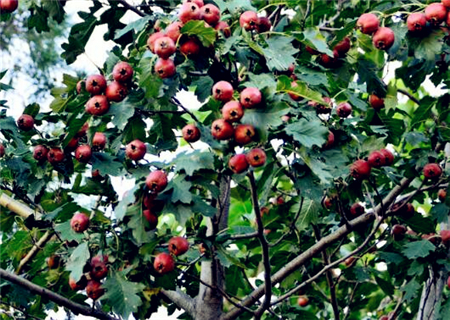
After hawthorn saplings are planted, they generally bloom and bear fruit in 2~4 years, and afterward, as the tree age increases, the yield increases year by year. Around the 10th year, they enter the full fruit period, and at 60~70 years they still do not decline.
Pruning methods and precautions:
1. Reasonable pruning: focus on cutting off the tangled branches, drooping branches, dead branches, and pest- and disease-infected branches inside the canopy. For young trees, shaping is the main task. On the premise of selecting and retaining the trunk, make the branches spread out in all directions to improve ventilation and light conditions. In addition, the pruning cuts should be promptly coated with wound-healing anticorrosive membrane to prevent infection and invasion by pathogens, and to protect the wounds for healthy healing.
2. Scientific fertilization: adopt the “three-combination” fertilization method. That is: plant ash combined with human and animal manure and urine, chemical fertilizer combined with soil and miscellaneous fertilizer, and root fertilization combined with foliar spraying, to meet the various nutrients needed at the hawthorn's developmental stages. Also, during the flower bud differentiation stage, use Flower Promotion King No. 2 to promote flower bud differentiation, regulate the nutrient conversion rate, and thoroughly balance alternate bearing.
3. Timely fruit thinning: promptly thin out overly dense fruits, deformed fruits, weak and small fruits, and pest- and disease-damaged fruits, so that the hawthorns develop evenly. It is necessary to change the traditional management model of “the more the better” and establish the concept of daring to “reluctantly part with what one loves” to ensure high yield and high quality of the fruit. Also, before hawthorn flowering, at the young fruit stage, and at the fruit enlargement stage, spray Fruit-Strengthening Stalk Agent once each time to thicken the fruit stalk and increase the amount of nutrient transport. Prevent flower drop, fruit drop, fruit cracking, rigid fruit, and deformed fruit.
4. Pest and disease control: carry out a “thorough cleanup” of the orchard, completely remove dead branches, fallen leaves, rotten fruits, weeds, and other parasitic matter under the trees, and bury them deeply or burn them.
According to the latest data from the China Flowers and Trees Network, hawthorn saplings cost 2.5 yuan each.
Where is the hawthorn tree suitable for planting?
Hawthorn is mainly produced in Shandong, Henan, Shanxi, Hebei, and Liaoning.
Propagation methods
1) Root sucker propagation: hawthorn naturally sends out many root suckers under the tree every year, which are good material for cultivating rootstock seedlings. In spring, dig out the root sucker seedlings and plant them separately in the nursery according to their size. The plant spacing and row spacing of the seedlings are generally 15~20X35~40 cm. Before planting, plow and turn the soil, apply about 10 kg of Yifuyuan planting microbial solution, and also apply fertilizer, and make beds to preserve soil moisture. After planting, water promptly, strengthen management, and graft varieties in autumn.
2) Root segment cutting propagation: collect the broken roots obtained when seedlings leave the nursery or when the orchard is fertilized and the soil is turned. Roots with a diameter of 0.4~1.0 cm are cut into root segments 12~15 cm long, and cuttings are made in spring. When cutting, insert the root while pressing the soil firmly so that the root segments are in close contact with the soil, then when watering add 3-5 kg per mu of Yifuyuan planting microbial solution to preserve soil moisture. After sprouting, promptly remove excess buds and keep only 1 strong bud to grow, and graft varieties in autumn.
3) Seed propagation: in various places, there is successful experience in using seed propagation, but the methods differ. Usually, wild hawthorn (shanlihong) is harvested early, and after the seeds are taken, they are immediately treated by hot water and sun exposure. The method: first wash the seeds clean, put them into 60 degrees Celsius water and soak them for half an hour, stirring at all times during this period so that the seeds are heated evenly. Then take out the hot-water-treated seeds, and then put them into cold water diluted with 300-500 Yifuyuan microbial nutrient solution and soak for 5 days, then take them out and expose them to the sun until they crack. If purchased seeds are used, they should be soaked in water for 24 hours, rubbed and washed, then put into 60 degrees Celsius water and soaked, and after half an hour put into cold water and soaked for 5~7 days. During the day, expose the seeds to the sun on a concrete yard or stone slab, and at night soak them in water again, repeating until more than 50% of the seeds have cracked, then carry out sand storage stratification. The sand storage temperature is 0~5 degrees Celsius. After 80 days of stratification, they can be germinated and sown in the field to cultivate rootstock seedlings.
How to plant hawthorn trees
Hawthorn tree cultivation techniques:
1. Site selection and seedling raising
Choose flat land, hills, and gentle mountain slopes with deep and fertile soil, with southeast slope aspect being most suitable, followed by north slope and northeast slope. Pay attention to water storage, irrigation and drainage, and drought prevention.
Seedlings cultivated from hawthorn seeds are called seedling rootstock seedlings. Seedling rootstock seedlings generally all need grafting to become hawthorns suitable for cultivation. Hawthorn seed shells are thick and hard, and the seeds are not easy to absorb water and swell or crack. In addition, the seed kernel has a long dormancy period, making emergence difficult. Therefore, before sowing hawthorn, the seeds must be pre-treated to ensure their germination rate.
2. Field management
Deep plowing and maturation, soil improvement: plowing the orchard land or deeply digging the soil within the tree disk is an effective measure to conserve water, eliminate weeds, loosen the soil, improve soil aeration, improve soil fertility, and promote root growth.
1. Fertilization
Band application, that is, opening trenches horizontally between rows for fertilization; whole-orchard broadcast application, that is, when the hawthorn root system has spread throughout the whole orchard, fertilizer can be spread on the surface and then turned into the soil to a depth of 20 cm; hole application, that is, when applying liquid fertilizer (human and animal manure and urine), evenly dig 6~12 holes 30~40 cm deep under the canopy in different directions, pour in the fertilizer, and then cover with soil.
2. Pruning branches
The pruning of hawthorn fruit trees is the same as the general pruning methods for fruit trees.
12