Herbaceous Banana Tree Seedlings: Price Per Plant, Propagation and Cultivation, and One-Year Fruiting Lifespan
The banana tree is a plant in the family Musaceae, native to the tropical and subtropical regions of Southeast Asia. It is not a tree but a giant herbaceous plant; its stem is soft and made up of rolled-up leaf sheaths. So how much does a seedling cost per plant? How do you propagate and plant it? How long can it live? How many times can it fruit in a year? According to the Yunnan banana planting base, banana seedlings come in two types, tissue-culture seedlings and sucker seedlings, at about 2 yuan per plant.
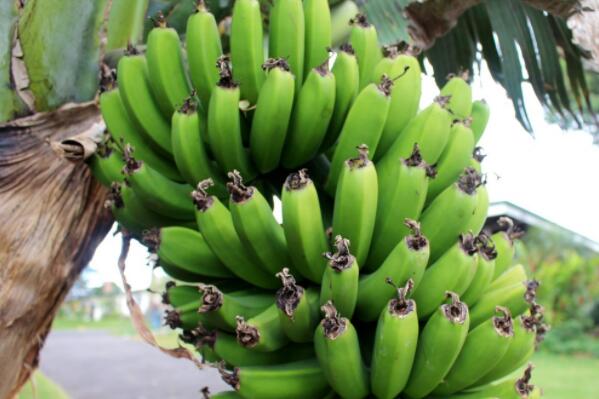
How are banana tree seedlings propagated and planted?
Propagation:
Bananas are mainly propagated using suckers or underground stems.
1. Sucker propagation
Banana suckers are divided, according to their characteristics and origin, into sword suckers (sword-leaf suckers) and large-leaf suckers (large-leaf buds). Sword suckers can be selected and kept as mother plants or used as planting material. Because sword suckers emerge at different times, they are further divided into red shoots and tattered-clothing buds, described separately below:
(1) Red shoots
Red shoots have a thick, sturdy base and a tapering, slender upper part, with small leaves; they are named for their tender red color. The whole shoot resembles a bamboo shoot (when it first emerges). They are shoots that grow above ground only after the temperature warms up after February, and can be kept as mother plants for the next generation. If they are to be transplanted as planting material, they generally need to be more than 40 cm tall. After planting, they first produce leaves and then grow roots.
(2) Tattered-clothing buds
The leaves are narrow and small, like swords. They are named because their leaves emerged in the previous year and withered over winter but still hang on the pseudostem. In the later stage of growth of tattered-clothing buds, because the temperature is relatively low, the above-ground part grows slowly and the underground part accumulates more nutrients, forming a shape that is large at the bottom and small at the top, with many roots. Guangxi is accustomed to keeping winter tattered-clothing buds as planting material for new plantations. After planting, this kind of seedling first grows roots and then produces leaves, grows quickly, and fruits early and reliably.
(3) Large-leaf buds
Large-leaf buds refer to suckers growing from buds near the ground, or buds sent out from weak mother plants, or buds sprouting from old banana corms. The bud body is relatively slender and the underground corm is also relatively small; when it first emerges it has large leaves, and the leaves are round and broad, hence the name large-leaf bud. They are not selected and kept as mother plants for continued fruiting, and are also rarely used as planting material; if used as planting material, the fruiting period is late and the fruit bunch is also small. When digging up suckers, in order to avoid damaging the underground stems of the mother plant and the sucker, experienced fruit growers first dig the soil around the outside of the sucker into a concave semicircle, then use a foot on the side near the mother plant to push forcefully toward the depression, so that the sucker can be separated from the mother plant's corm. It is even better to use a sharp knife to cut at the point where the sucker and mother plant connect. Try to damage the mother plant's underground stem as little as possible, then pull up the sucker together with its base and it can be planted.
2. Propagation by cutting underground stems into pieces
In order to cultivate a large number of sprouted seedlings in a short period, underground stems can be cut into pieces for propagation. The method is: after digging out the underground stem, cut out the central main bud, then cut it into small pieces, each piece weighing at least 120 g; a large underground stem can be cut into 8 pieces, and a small one into 2 pieces. Each piece should retain one thick bud eye, and the cut surface should be coated with plant ash as an antiseptic. According to tests by the Agricultural Science Institute of Longxi Region, Fujian Province, the underground stems of plants that have not flowered or fruited have a germination rate of only 15%, and the sprouted seedlings cultivated from them are not inferior to sword-leaf buds in either growth or yield. The best time for cutting into pieces is from November to January of the following year; most can germinate, and when the seedlings are 40-50 cm tall in May-June they can be transplanted, flowering and fruiting at the same time as those planted from suckers. When raising seedlings, the pieces can be placed evenly on the bed at a row spacing of 15 cm, with the buds facing up, then covered with soil and mulched with grass. After the buds emerge, begin applying dilute urine water, and thereafter apply fertilizer once every half month, for a total of 4-5 applications. After 6-8 months of management, when the seedlings are more than 1.2 m tall, they can be dug up and planted.
Planting:
1. Seedling selection
Choose seedlings with deep green leaves, well-developed roots, a height of 15-20 cm, 5-6 new leaves, and no pests or diseases.
2. Planting time
Spring planting, in mid-to-late February, and autumn planting, in September, are both suitable periods.
3. Planting method
Grade banana seedlings by size and plant them in separate blocks to make management easier. When planting, open a small hole in the center of the planting pit, place the seedling gently into the pit, with the depth such that the banana corm is buried about 10 cm, with the cut surface of the seedling facing to one side; after planting, press down lightly, water thoroughly with the planting water, and cover well with rice straw.
Management
1. Fertilization: the first time, in March-April, use 3-5 kg of pig manure or farmyard manure and 0.2 kg of phosphate fertilizer per plant, applied as a liquid and covered with a thin layer of soil afterward; the second time, in June-July, spread fertilizer over the banana bed, applying 50 kg of soil-miscellaneous manure, 0.2 kg of peanut bran, and 0.1 kg of compound fertilizer per plant, followed by shallow earthing up; the third time, in early-to-mid August, apply 25 kg of soil-miscellaneous manure, 5 kg of farmyard manure, and 0.2 kg of bran fertilizer per plant.
In addition, during the small-leaf stage, topdress once every 7-10 days with decomposed manure water; during the large-leaf stage, topdress once every 10 days with fermented peanut bran water, or use 1 liang of urea plus 0.5 liang of potassium fertilizer or 2 liang of compound fertilizer diluted in water and poured on.
Foliar topdressing: during the small-leaf stage, before and after shooting the bud, and during the small-fruit stage, spray with 120-fold banana quick-growth agent, Nongzhibao, Penshibao, or 0.3% potassium dihydrogen phosphate.
2. Drainage and irrigation, weeding
Banana fields should have high beds and deep furrows to facilitate drainage, lower the groundwater level, and also allow irrigation. During the period of vigorous growth, keep a shallow water layer in the furrows frequently, so that in the dry season watering can be done in the morning and evening, and cover the banana beds well. Bananas are shallow-rooted plants, so when weeding, pull the weeds by hand; do not step on the bed surface or hoe deeply enough to injure the root mass.
3. Keeping and removing suckers
Cut off the first-row suckers of the banana tree; after the second-row or third-row suckers emerge, determine and keep 1-2 suitable suckers, and remove all the rest.
4. Bunch pruning
After the banana shoots its bud, pay attention to field inspections; when the top 1-2 hands of the banana axis do not set fruit, prune the bunch on a sunny afternoon to reduce sap loss. When the sap stops flowing from the wound, brush the wound with a fungicide such as 500-fold carbendazim.
Control
1. Leaf spot disease, which harms banana leaves: starting in April each year, spray with 1500-3000-fold 25% difenoconazole emulsifiable concentrate once every two months. Or spray the leaves with 600-800-fold thiophanate-methyl or zineb.
2. Mosaic heart rot and bunchy top disease: the control methods are, first, do not introduce or buy seedlings from diseased areas; second, immediately dig out and remove diseased plants when found; third, spray 1000-1500-fold dimethoate to kill aphids and reduce transmission.
3. The control methods for pests such as banana skipper, locusts, leaf-rolling caterpillars, and weevils are: (1) peel off the rotting leaf sheaths on the outer part of the pseudostem and promptly remove the insect bags on the leaves. (2) Pour 800-fold trichlorfon or 400-fold insecticide No. 2 solution into the leaf-stalk axils. (3) Spray with 1000-fold dimethoate.
How long can a banana tree live? How many times can it fruit in a year?
A natural banana tree can live about 30 years! But banana plantation owners say that an adult banana tree has only a one-year "lifespan," and a new batch must be replaced every year. These small banana seedlings are the planting material for the second year. By the third year, all the banana trees must be completely cut down, and then small banana seedlings are introduced from the banana seedling base.