How many times a year does a mulberry tree bear fruit? Grow it this way to get more fruit
The fruit mulberry is a fairly common sapling in China. Its fruit is not only edible but can also be used in industrial production, so its price is a little on the high side. However, because the shelf life of the fruit mulberry is very short, if you want to eat mulberries, you need to understand the fruiting period of the mulberry. So how many times a year does a mulberry tree bear fruit? How should you grow it to get more fruit?
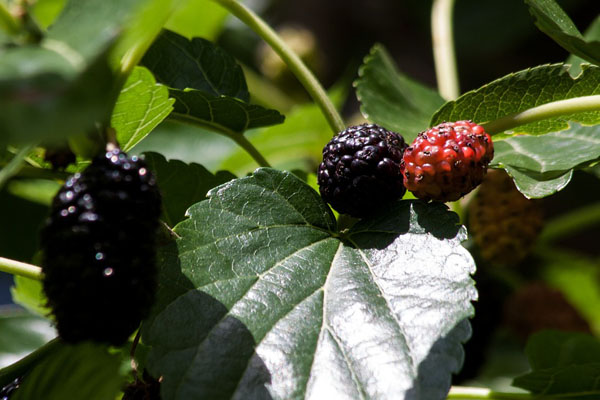
According to the growth patterns of the plant, a mulberry tree bears fruit once a year and blooms once a year. Its flowering period is in April, and the fruit ripens from May to July. Some people, in order to be able to eat mulberries, carry out a series of management measures on the mulberry tree so that it bears fruit more than once in a year, but this phenomenon rarely occurs.
Planting methods:
1. Variety selection
The fruit mulberry's full fruiting period lasts more than 30 years, so excellent varieties can be selected according to the cultivation purpose and climate conditions. In China, by combining biotechnology with traditional techniques, excellent fruit mulberry varieties with large fruit, high yield and strong adaptability have been bred. In the north, the fresh-eating and processing varieties that can be chosen include Wuhe Dashi, Hongguo No. 1, Hongguo No. 2, Hongguo No. 3, Hongguo No. 4, Baiyu Wang, etc.; the hybrid variety 8632 is only suitable for processing. In the south, fresh-eating and processing varieties such as 46CO19 and Yueshen Da 10 can be chosen. The yield of mulberry fruit is generally 1500-2000 kg per mu.
2. Site selection and orchard establishment
The fruit mulberry has strong adaptability. It is best to choose a plot of sandy loam soil with deep, fertile soil, rich organic matter, a soil pH of 6.5-7.5, gentle terrain, a high groundwater table, convenient drainage and irrigation, and far from pollution sources such as dust.
3. Land preparation and planting
1. Planting time: Mainly plant before budding in early spring; planting is also possible in early winter after leaf fall.
2. Land preparation: Before planting, the land should be leveled, fully plowed to a depth of about 25 cm, then leveled, and drainage channels dug. The planting density should be controlled within the range of 300-500 plants per mu, with a plant-to-row spacing of 1.5-2 m × 1 m. According to the terrain, generally dig planting trenches 50-60 cm deep and 60 cm wide in a north-south direction. Apply 5000 kg of decomposed organic fertilizer, 150 kg of ternary compound fertilizer, and 100 kg of cake fertilizer such as soybean meal per mu, mix evenly with the topsoil, and fill it into the trench.
3. Planting: When planting, spread the mulberry seedling's root system evenly in all directions. When backfilling half the soil, gently lift and shake the seedling so that the roots make full contact with the soil. After filling the soil level with the ground, tread it firm and build a surrounding ridge, then water thoroughly once. After planting, form ridges along the rows, with a ridge height of 15-20 cm.
4. Management of young trees
Within two years after planting, the management should focus on developing the tree shape and promoting strong fruiting branches.
1. Fertilization: Before the young trees bud and during the leaf canopy formation period, apply 100 g of urea or 5-10 kg of biogas slurry per plant respectively; in mid-May, apply 30-50 g of potassium sulfate compound fertilizer per plant; in July and afterward, spray 0.3% potassium dihydrogen phosphate solution on the leaves 2-3 times. Through multiple topdressings, comprehensively promote the accumulation of nutrients in the tree and promote the formation of fruiting branches.
2. Irrigation: Before the fruit mulberry buds in spring, water thoroughly once together with fertilization. After each topdressing and when soil moisture is poor, irrigate in good time, (www.nczfj.com). After irrigation, it is best to cover the tree disc with grass (or crop straw) to reduce water evaporation. In northern regions, irrigate with winter water before the soil freezes to ensure the young trees overwinter safely.
3. Training: The fruit mulberry is mainly trained using the medium-trunk method, and spring pruning should be used for shaping in the first two years. In the year of planting, nip the shoot at a height of 40-50 cm to cultivate the trunk. After budding, select and keep 2-3 robust new buds on the trunk with suitable directions, remove the rest, and promote 2-3 strong new branches that year. Before budding the following spring, prune in spring at 65-80 cm above the ground to cultivate the first tier of scaffold branches. After budding, keep 2-3 new shoots on each scaffold branch for growth, and cultivate 4-6 branches per plant. Shaping management should integrate techniques such as spreading branches, heading back, and thinning branches, and promptly adjust the size of the canopy to ensure ventilation and light penetration.
5. Management of fruiting trees
In the third year after planting, the trees enter the normal fruiting period. Pay attention to regulating the balance between vegetative growth and reproductive growth, overcome the alternate bearing phenomenon, and ensure high and stable yields.
1. Topdressing: In early March before budding, open a trench 20 cm from the trunk and apply 30 kg of ternary compound fertilizer per mu. Before flowering and during the young fruit stage, apply potassium sulfate compound fertilizer once each to promote pollination and young fruit expansion, generally 20-30 kg per mu. (www.nczfj.com) At the beginning of flowering and during the young fruit stage, spray 0.3% potassium dihydrogen phosphate on the leaves 2-3 times to increase the sugar content of the fruit, make the mulberries large and brightly colored, and promote stable and increased yields.
2. Drainage and irrigation: The spring budding period is the peak water demand period, so irrigate in good time according to soil moisture, and also irrigate promptly after soil topdressing. In the rainy season, keep the ditches inside and outside the orchard unobstructed, so that the field dries after rain without standing water, reduce field humidity, and reduce the spread of pathogens.
3. Bud removal: During the budding period in mid-to-late March, remove the latent buds sprouting on the trunk, the dense buds at the base of the fruiting mother branches, and the weak small buds, so as to concentrate nutrients and reduce nutrient consumption.
4. Leaf removal: During the mulberry swelling period, appropriately remove 2-3 dense mulberry leaves from the base of the fruiting mother branches and the middle and lower parts of the branches, so as to strengthen ventilation and light penetration, help accumulate nutrients, increase the sugar content of the mulberries, and improve the marketability of the fruit.
6. Mulberry harvest
1. Signs of maturity: The sign that mulberries are ripe is that the fruit stalk turns from green to yellow-white, and for purple-red varieties the fruit grains turn from red to purple.
2. Harvest time: The best time to harvest mulberries is in the early morning when the temperature is lower. After the temperature drops at night, the fruit temperature also falls. Picking at this time can extend the shelf life by 3-5 days.
3. Harvesting method: Mulberries do not ripen uniformly, and the period lasts about 1 month, so they should be picked in batches, generally once every 5 days. Mulberry flesh is soft and not resistant to storage and transport, so it is best to pick by hand. Wear sterile gloves before picking, handle them gently during picking, and do not bruise the skin. For fruit at higher positions such as treetops and branch tips, you can either spread clean plastic sheeting on the ground and harvest by shaking, or use a special fruit-picking ladder to climb up and pick.
4. Packaging and selling: Sort and grade by fruit grain size. First pack in small plastic boxes covered with cling film, 500-800 g per box, then pack them separately into special fruit boxes according to grade. When selling mulberries, establish your own brand. Print the mulberry grade, brand name, fruit photo, boxed weight, planting base name, contact address, contact phone number, etc. on the outer surface of the fruit box. After boxing, they should be transported to the fruit market for sale in good time.
7. Post-harvest management
1. Summer pruning and branch trimming: Carry out summer pruning each year after fruit picking ends in June. On the basis of the shaping pruning of young trees, cut the branches from the base so that they regrow new branches. Pruning should be done at noon on a sunny day to reduce bleeding. A large number of buds will sprout 10-15 days after pruning, so remove buds and fix shoots in good time, keeping 3-5 new shoots per branch as fruiting mother branches for the coming year; at the same time, thin out overly dense fine branches and weak branches to concentrate nutrients for growing good fruiting branches. Thereafter, carry out summer pruning at the base of the branches each year, cut the trunk at 1 m above the ground to cultivate secondary scaffold branches, keep 2-3 buds on each scaffold branch after budding, and cultivate 8-12 branches per plant, gradually forming a trunk mulberry and mulberry knuckles, and increasing the number of fruiting branches.
2. Fertilizer and water management: Fertilization should be based mainly on organic fertilizer, supplemented by compound fertilizer, applied by trench application and hole application respectively. After fruit picking, carry out topdressing in good time to strengthen the next year's fruiting branches. About 5 days after summer pruning, apply 10-15 kg of urea per mu; in early July, apply 20-30 kg of ternary compound fertilizer or urea per mu; in late August, apply base fertilizer in autumn, applying 1000-1500 kg of decomposed organic fertilizer and 20-30 kg of ternary compound fertilizer per mu to promote lignification of the branches and extend the high-yield cycle of the mulberry orchard. In summer and autumn, irrigate in good time according to soil moisture, and carry out winter irrigation before freezing.
3. Leaf harvesting: The fruit mulberry can not only produce mulberries, but its leaves can also be used to raise silkworms. After harvesting, the leaves can be picked in summer and autumn to raise silkworms. Pay attention to combining harvesting and nurturing. When picking leaves, keep the petiole and do not damage the mulberry buds, and always keep 10-15 mulberry leaves on the branch tips to nourish the tree.
4. Intertillage and weeding: Intertillage and weeding can inhibit soil water evaporation, store water and preserve moisture, and also reduce the overwintering base of pests and diseases. Ensure 1 deep plowing, and 2-3 intertillage and weeding operations in summer and autumn.
5. Winter pruning: In order to fully concentrate nutrients and improve the yield and quality of mulberries, winter pruning should be carried out. Winter pruning is carried out from late November after leaf fall to early January of the following year. Too early makes winter buds sprout in autumn, affecting the next year's yield. Focus on cutting off the 10-20 cm long tender tips at the top of the branches, as well as diseased and pest-infested branches, overly dense branches, and weak branches.
8. Pest and disease control
The main diseases of the fruit mulberry include brown spot disease, anthracnose, powdery mildew, and sclerotinia, and the main pests include mulberry tussock moth, mulberry looper, rhombic-marked leafhopper, and mulberry longhorn beetle. To ensure the food safety of the fruit, manual and biological control should be the main methods, supplemented by chemical control with high-efficiency, low-toxicity and low-residue pesticides. In winter, promptly clear away dead branches and fallen leaves in the orchard and burn them in a centralized manner; in late winter and early spring, promptly cut off diseased and weak branches to ensure ventilation and light penetration, kill pathogens, and reduce the chance of fruit infection. One week before budding, use 3-5 degrees Baume lime sulfur mixture to thoroughly disinfect the tree body and the ground. From the budding period to half a month before fruit picking, alternately spray the tree body with 600-fold 50% carbendazim wettable powder, 800-fold 75% chlorothalonil or 70% thiophanate-methyl to prevent disease occurrence, 1-2 times per month. For the mulberry longhorn beetle, during the adult occurrence period from July to August, use the adult's phototaxis to hang black light lamps to trap and kill them; for other pests, spray 4000-fold 10% imidacloprid for control.