When to sow and when does nasturtium bloom? Seed planting and yellow leaf treatment
Nasturtium is a plant of the family Tropaeolaceae and the genus Tropaeolum, also known as nasturtium, hanhe, jinlianhua, hanlianhua, jinqianlian, hanjinlian and dahongque. So when does it usually get sown and bloom? How do you plant the seeds? What should you do if the leaves turn yellow? Learned from a flower base in Suqian, Jiangsu, depending on the region and climate, nasturtium seeds can be sown in spring, autumn or winter.
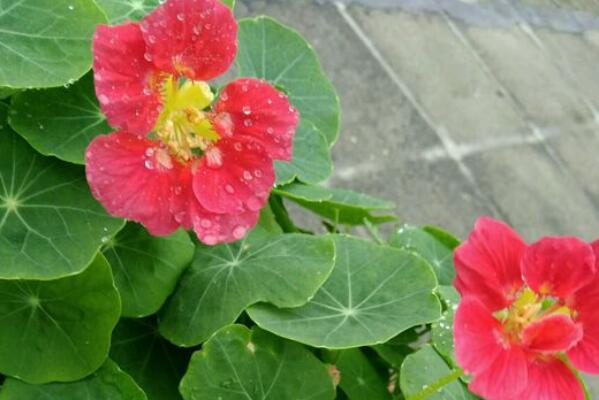
When does nasturtium usually get sown and bloom?
Sowing:
1. Spring sowing (East China): High summer temperatures are unsuitable for the growth of nasturtium, so spring sowing should be done early. From early February to early March, germination can be stimulated; after sprouting, buds appear in 30-35 days and flowers open in 40-45 days. Spring-sown nasturtium is characterized by broad leaves, slender stem nodes, fewer flowers than autumn sowing, a shorter blooming period for each flower, and fewer and smaller seeds. The spring sowing growth cycle is short, so it is more suitable for beginners.
2. Autumn sowing (East China): Autumn-sown nasturtium is carried out from late September to early October, with the peak blooming period in February to March of the following year. Autumn-sown nasturtium is characterized by thick leaves, sturdy branches, a compact plant shape, short stem nodes, abundant flowers, a long blooming period for each flower, and plump seeds. Because the autumn sowing growth cycle is long, it is more of a test of the grower's patience and planting skill.
Blooming:
The flowers are solitary or 2-3 in cymes, with five petals and 8-19 sepals, yellow, elliptical-obovate or obovate, the petals equal in length to the sepals, narrowly linear.
In the north it is often grown as an annual or biennial flower. Under suitable environmental conditions, it can bloom all year round. A single flower can last 8-9 days, and a whole plant can open dozens of flowers at the same time, with a rich fragrance and brilliant colors, which has won people's affection.
In southern China it can be grown as a perennial; in North China it is mostly autumn-sown and cultivated indoors in pots as a spring-welcoming flower, made to bloom during New Year's Day and the Spring Festival.
The leaves are plump and the flowers are beautiful, with colors including purplish red, orange-red and creamy yellow. The trailing stems of nasturtium twine around, the leaves are shaped like bowl lotus, and when the creamy yellow flowers are in full bloom they look like a swarm of butterflies dancing, making it an important ornamental flower.
How do you plant nasturtium seeds?
1. Seed treatment: Because the seed coat of nasturtium is rather thick, before sowing soak the seeds in warm water (about 40°C) or cold water for 12 hours, peel off the outer skin of the seeds, then continue soaking for 12 hours, preferably with the water not covering the seeds.
2. Seed germination: Take clean unscented paper towels, fold them into 6-8 layers, place them in a small dish, moisten with purified water (the paper towels should be soaked through), place the soaked seeds in the middle of the paper towels and press lightly, then put the small dish into a transparent food bag and tie it tightly, airing it out for 15-30 minutes each day.
3. Sprouting and sowing: Seeds germinated with paper towels generally crack open and show the sprout tip within 2-7 days. When the sprout tip is 2 mm long, it can be planted in soil for seedling raising. After planting in soil, the cotyledons will break through the soil in 2-5 days, and once the cotyledons have fully unfolded they can receive full sunlight.
12